Department of Medicine, University of Padova, Via Giustiniani 2, 35100, Padua, Italy.
Venetian Institute of Molecular Medicine, 35100, Padua, Italy.
Cardiovasc Diabetol. 2018 Jan 17;17(1):16. doi: 10.1186/s12933-018-0660-9.
The risk of diabetic complications is modified by genetic and epigenetic factors. p66Shc drives the hyperglycaemic cell damage and its deletion prevents experimental diabetic complications. We herein tested whether p66Shc expression in peripheral blood mononuclear cells (PBMCs) predicts adverse outcomes in people with diabetes.
In a cohort of 100 patients with diabetes (16 type 1 and 84 type 2), we quantified baseline p66Shc expression in PBMCs by quantitative PCR. Patients were extensively characterized for demographics, anthropometrics, biochemical data, prevalence of complications, and medications. With a pseudo-prospective design, we retrieved cardiovascular death, major adverse cardiovascular events (MACE), and new occurrence of micro- or macroangiopathy during follow-up.
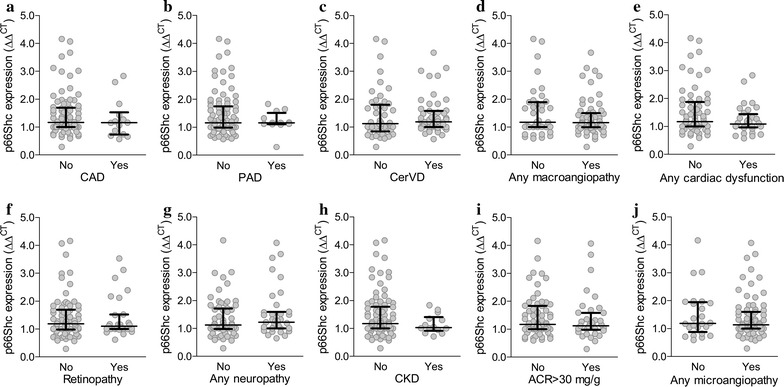
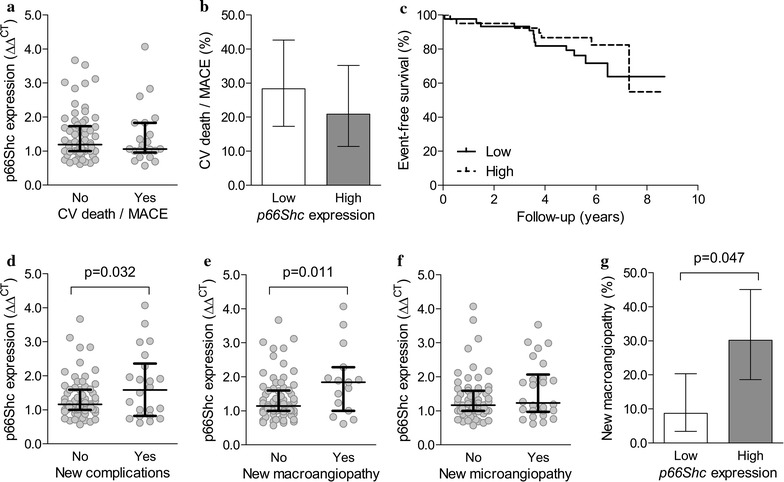
At baseline, patients were on average 60 year old, with 10-year diabetes duration, and overall poor glycaemic control (HbA1c 7.8%). Patients with high versus low p66Shc expression (based on median value) had very similar baseline characteristics. Average p66Shc expression did not differ by presence/absence of complications. During a median 5.6-year follow-up, the primary endpoint of cardiovascular death or MACE occurred in 22 patients, but no relation was detected between cardiovascular outcomes and p66Shc expression. In patients who developed new complications at follow-up, baseline p66Shc was significantly higher, especially for macroangiopathy. The incidence of new macroangiopathy was > 3-times higher in patients with high versus those with low baseline p66Shc expression.
p66Shc expression in PBMCs was not associated with prevalent diabetic complications but predicted new onset of complications, especially macroangiopathy, although no relation with hard cardiovascular endpoints was detected.
糖尿病并发症的风险受遗传和表观遗传因素的影响。p66Shc 驱动高血糖细胞损伤,其缺失可预防实验性糖尿病并发症。本文旨在检测外周血单个核细胞(PBMCs)中 p66Shc 的表达是否可预测糖尿病患者的不良结局。
在 100 例糖尿病患者(16 例 1 型和 84 例 2 型)的队列中,我们通过定量 PCR 检测 PBMCs 中 p66Shc 的基线表达。对患者进行了广泛的特征描述,包括人口统计学、人体测量学、生化数据、并发症患病率和药物治疗情况。采用准前瞻性设计,我们在随访期间检索心血管死亡、主要不良心血管事件(MACE)和微血管或大血管病变的新发病例。
基线时,患者平均年龄为 60 岁,糖尿病病程 10 年,整体血糖控制不佳(HbA1c 7.8%)。高 p66Shc 表达(基于中位数)与低 p66Shc 表达患者的基线特征非常相似。平均 p66Shc 表达与并发症的有无无关。在中位随访 5.6 年期间,心血管死亡或 MACE 的主要终点在 22 例患者中发生,但未检测到心血管结局与 p66Shc 表达之间存在相关性。在随访时发生新并发症的患者中,基线 p66Shc 明显更高,尤其是大血管病变患者。高基线 p66Shc 组发生新大血管病变的发生率是低基线 p66Shc 组的 3 倍以上。
PBMCs 中 p66Shc 的表达与已发生的糖尿病并发症无关,但可预测新并发症的发生,尤其是大血管病变,尽管未检测到与硬性心血管终点之间的关系。