Bryant Laura, Lozynska Olga, Maguire Albert M, Aleman Tomas S, Bennett Jean
Center for Advanced Retinal and Ocular Therapeutics (CAROT), FM Kirby Center for Molecular Ophthalmology, Scheie Eye Institute, Perelman School of Medicine, University of Pennsylvania, Philadelphia, PA, USA.
Department of Ophthalmology, The Children's Hospital of Philadelphia, Philadelphia, PA, USA.
Clin Ophthalmol. 2017 Dec 29;12:49-63. doi: 10.2147/OPTH.S147684. eCollection 2018.
Accurate clinical diagnosis and prognosis of retinal degeneration can be aided by the identification of the disease-causing genetic variant. It can confirm the clinical diagnosis as well as inform the clinician of the risk for potential involvement of other organs such as kidneys. It also aids in genetic counseling for affected individuals who want to have a child. Finally, knowledge of disease-causing variants informs laboratory investigators involved in translational research. With the advent of next-generation sequencing, identifying pathogenic mutations is becoming easier, especially the identification of novel pathogenic variants.
We used whole exome sequencing on a cohort of 69 patients with various forms of retinal degeneration and in whom screens for previously identified disease-causing variants had been inconclusive. All potential pathogenic variants were verified by Sanger sequencing and, when possible, segregation analysis of immediate relatives. Potential variants were identified by using a semi-masked approach in which rare variants in candidate genes were identified without knowledge of the clinical diagnosis (beyond "retinal degeneration") or inheritance pattern. After the initial list of genes was prioritized, genetic diagnosis and inheritance pattern were taken into account.
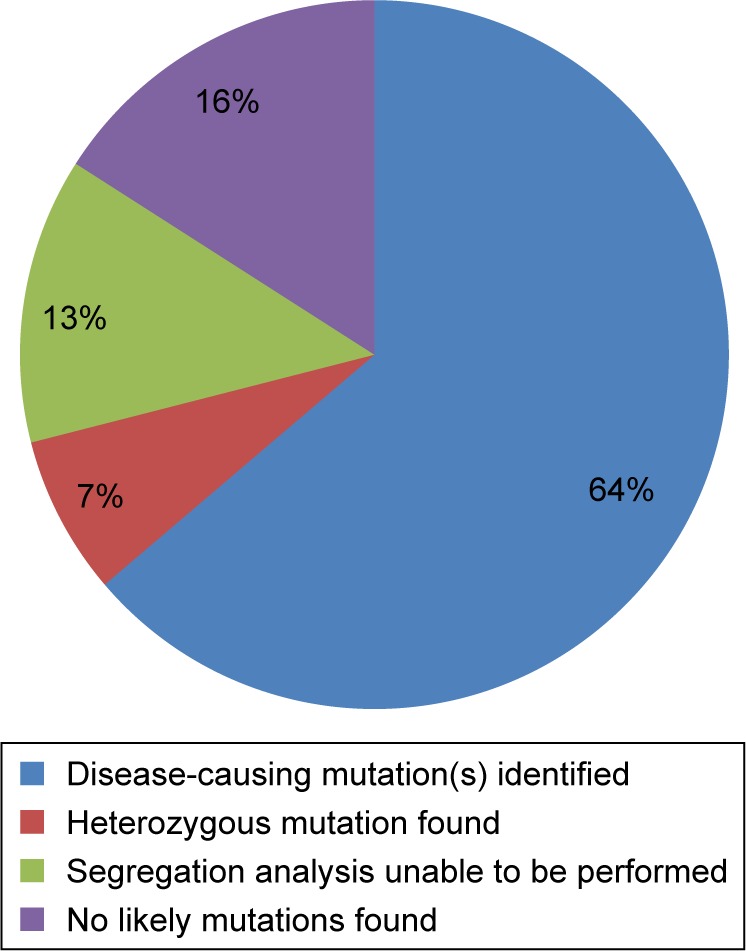
We identified the likely pathogenic variants in 64% of the subjects. Seven percent had a single heterozygous mutation identified that would cause recessive disease and 13% had no obviously pathogenic variants and no family members available to perform segregation analysis. Eleven subjects are good candidates for novel gene discovery. Two de novo mutations were identified that resulted in dominant retinal degeneration.
Whole exome sequencing allows for thorough genetic analysis of candidate genes as well as novel gene discovery. It allows for an unbiased analysis of genetic variants to reduce the chance that the pathogenic mutation will be missed due to incomplete or inaccurate family history or analysis at the early stage of a syndromic form of retinal degeneration.
确定致病基因变异有助于对视网膜变性进行准确的临床诊断和预后评估。它可以确认临床诊断,还能让临床医生了解其他器官(如肾脏)潜在受累的风险。这也有助于为想要孩子的受影响个体提供遗传咨询。最后,致病变异的相关知识对参与转化研究的实验室研究人员也有帮助。随着下一代测序技术的出现,识别致病突变变得更加容易,尤其是识别新的致病变异。
我们对69例患有各种形式视网膜变性的患者进行了全外显子组测序,这些患者之前针对已确定的致病变异进行的筛查结果不明确。所有潜在的致病变异均通过桑格测序法进行验证,并在可能的情况下对直系亲属进行分离分析。潜在变异通过半盲法进行识别,即在不知道临床诊断(除“视网膜变性”外)或遗传模式的情况下,识别候选基因中的罕见变异。在对最初的基因列表进行优先级排序后,会考虑遗传诊断和遗传模式。
我们在64%的受试者中鉴定出可能的致病变异。7%的受试者有一个单一的杂合突变,该突变会导致隐性疾病,13%的受试者没有明显的致病变异,且没有家庭成员可用于进行分离分析。11名受试者是发现新基因的良好候选对象。我们鉴定出两个导致显性视网膜变性的新发突变。
全外显子组测序能够对候选基因进行全面的遗传分析以及发现新基因。它能够对遗传变异进行无偏分析,以减少由于综合征性视网膜变性早期阶段家族史不完整或不准确而漏检致病突变的可能性。