Qian Cheng, Xia Yongsheng, Ren Yun, Yin Yan, Deng Anmei
Department of General Surgery, Huzhou Maternity and Child Care Hospital, Huzhou, Zhejiang 313000, P.R. China.
Department of Laboratory Diagnosis, Changhai Hospital, Second Military Medical University, Shanghai 200433, P.R. China.
Oncol Lett. 2017 Dec;14(6):8014-8020. doi: 10.3892/ol.2017.7211. Epub 2017 Oct 18.
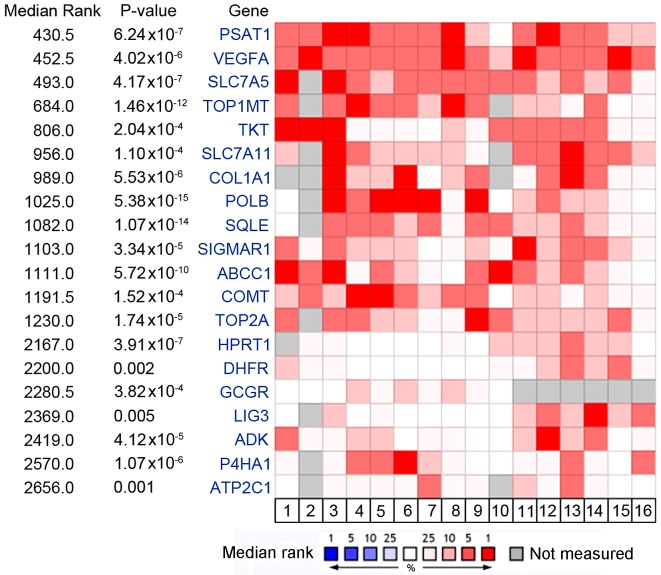
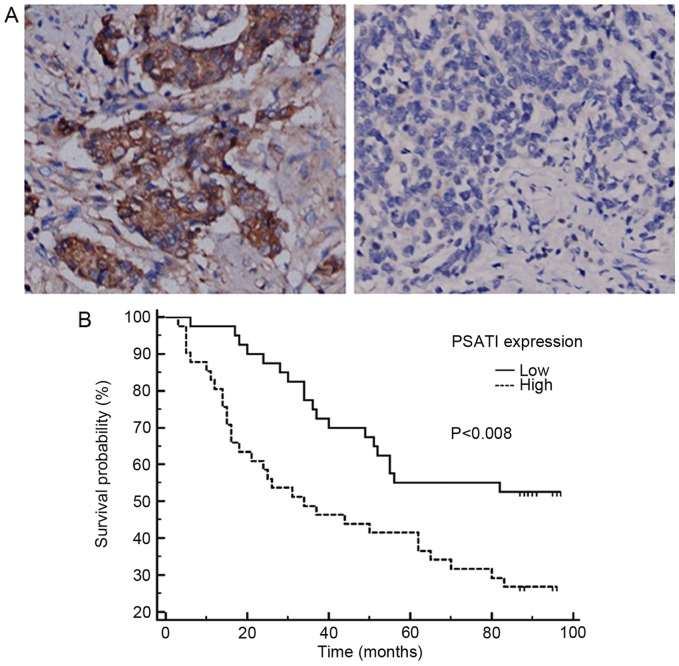
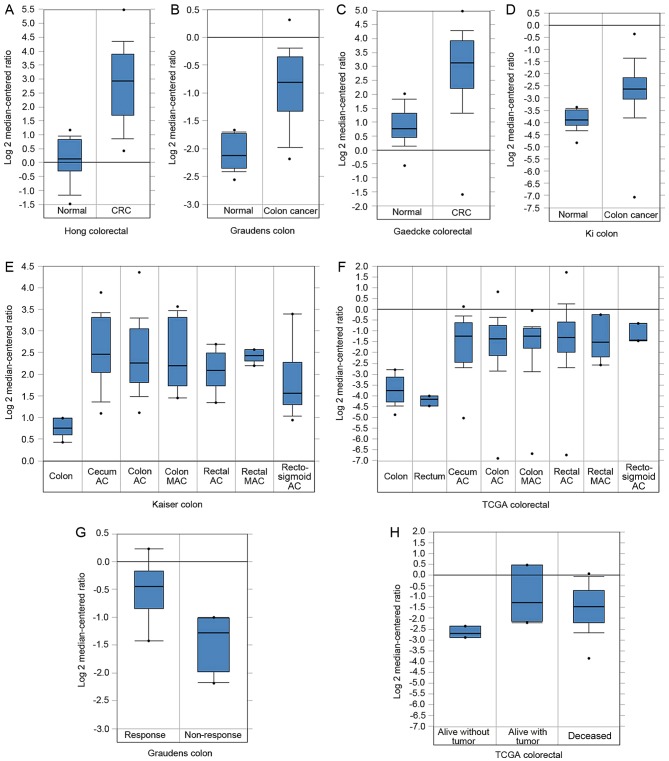
The aim of the present study was to explore the existence of known or candidate drug-target genes that are upregulated in colorectal cancer (CRC) and may serve as novel prognostic factors or therapeutic targets for this type of malignancy. An analysis was conducted using the Oncomine tool to compare the expression levels of a list of drug-target genes between cancerous and normal tissues in 6 independent CRC cohorts retrieved from the Oncomine database. Phosphoserine aminotransferase 1 (PSAT1) was identified as the top-ranked upregulated gene in CRC tumors, and was highly expressed in patients with chemoresistant disease. Subsequently, the expression of PSAT1 was further experimentally validated using immunohistochemistry in an independent cohort of CRC specimens. The immunohistochemistry results demonstrated that PSAT1 was overexpressed in the CRC tissues compared with the normal colorectal tissues, which was consistent with the previous analysis. Furthermore, PSAT1 overexpression was associated with response to irinotecan, 5-fluorouracil and leucovorin chemotherapy, and with shorter survival time, and retained significance as an independent prognostic factor for CRC when subjected to the multivariate analysis with a Cox's proportional hazards model. Therefore, the present results implicate PSAT1 as a potential prognostic biomarker and a promising therapeutic target for CRC. Targeted PSAT1 inhibition in the treatment of CRC warrants further investigation.
本研究的目的是探索已知的或候选的药物靶基因在结直肠癌(CRC)中是否上调,以及这些基因是否可作为这类恶性肿瘤新的预后因素或治疗靶点。使用Oncomine工具进行分析,以比较从Oncomine数据库检索的6个独立CRC队列中癌组织和正常组织之间一系列药物靶基因的表达水平。磷酸丝氨酸转氨酶1(PSAT1)被确定为CRC肿瘤中上调程度最高的基因,并且在化疗耐药患者中高表达。随后,在一个独立的CRC标本队列中使用免疫组织化学进一步实验验证PSAT1的表达。免疫组织化学结果表明,与正常结直肠组织相比,PSAT1在CRC组织中过表达,这与之前的分析一致。此外,PSAT1过表达与伊立替康、5-氟尿嘧啶和亚叶酸化疗的反应相关,并且与较短的生存时间相关,当使用Cox比例风险模型进行多变量分析时,PSAT1作为CRC的独立预后因素仍具有统计学意义。因此,本研究结果表明PSAT1是CRC潜在的预后生物标志物和有前景的治疗靶点。在CRC治疗中靶向抑制PSAT1值得进一步研究。