Department of Gastroenterology, Asan Medical Center, University of Ulsan College of Medicine, Seoul, Korea.
Department of Internal Medicine, Hallym University College of Medicine, Chuncheon, Korea.
Helicobacter. 2018 Apr;23(2):e12463. doi: 10.1111/hel.12463. Epub 2018 Jan 18.
The Korean College of Helicobacter and Upper Gastrointestinal Research has studied Helicobacter pylori (H. pylori) prevalence since 1998 and found a dynamic change in its prevalence in Korea. The aim of this study was to determine the recent H. pylori prevalence rate and compare it with that of previous studies according to socioeconomic variables.
We planned to enroll 4920 asymptomatic Korean adults from 21 centers according to the population distribution of seven geographic areas (Seoul, Gyeonggi, Gangwon, Chungcheong, Kyungsang, Cholla, and Jeju). We centrally collected serum and tested H. pylori serum IgG using a chemiluminescent enzyme immunoassay.
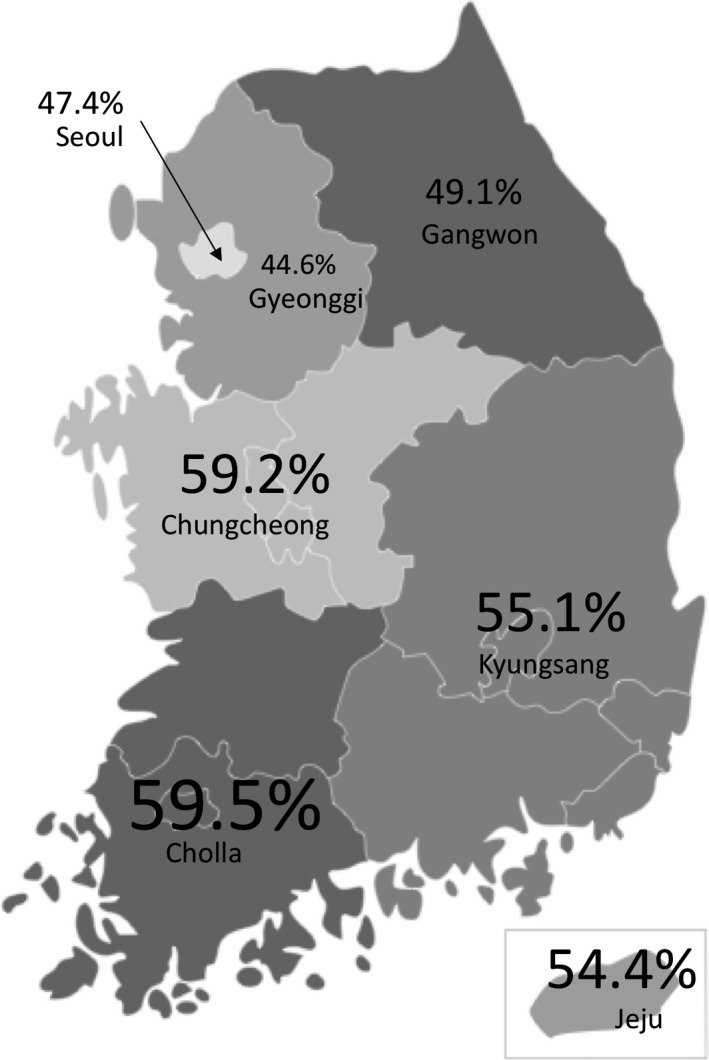
We analyzed 4917 samples (4917/4920 = 99.9%) from January 2015 to December 2016. After excluding equivocal serologic results, the H. pylori seropositivity rate was 51.0% (2414/4734). We verified a decrease in H. pylori seroprevalence compared with previous studies performed in 1998, 2005, and 2011 (P < .0001). The H. pylori seroprevalence rate differed by area: Cholla (59.5%), Chungcheong (59.2%), Kyungsang (55.1%), Jeju (54.4%), Gangwon (49.1%), Seoul (47.4%), and Gyeonggi (44.6%). The rate was higher in those older than 40 years (38.1% in those aged 30-39 years and 57.7% in those aged 40-49 years) and was lower in city residents than in noncity residents at all ages.
Helicobacter pylori seroprevalence in Korea is decreasing and may vary according to population characteristics. This trend should be considered to inform H. pylori-related policies.
自 1998 年以来,韩国幽门螺杆菌和上消化道研究学院一直在研究幽门螺杆菌(H. pylori)的流行情况,并发现其在韩国的流行情况发生了动态变化。本研究旨在确定最近的 H. pylori 流行率,并根据社会经济变量与以往研究进行比较。
我们计划根据七个地理区域(首尔、京畿道、江原道、忠清道、庆尚道、全罗道和济州道)的人口分布,从 21 个中心招募 4920 名无症状的韩国成年人。我们集中收集血清并使用化学发光酶免疫测定法检测 H. pylori 血清 IgG。
我们分析了 2015 年 1 月至 2016 年 12 月的 4917 份样本(4917/4920=99.9%)。排除不确定的血清学结果后,H. pylori 血清阳性率为 51.0%(2414/4734)。与 1998 年、2005 年和 2011 年进行的先前研究相比,我们证实 H. pylori 血清流行率有所下降(P<0.0001)。H. pylori 血清阳性率因地区而异:全罗道(59.5%)、忠清道(59.2%)、庆尚道(55.1%)、济州道(54.4%)、江原道(49.1%)、首尔(47.4%)和京畿道(44.6%)。40 岁以上人群的阳性率较高(30-39 岁人群为 38.1%,40-49 岁人群为 57.7%),各年龄段城市居民的阳性率均低于非城市居民。
韩国的 H. pylori 血清流行率正在下降,且可能因人群特征而异。这一趋势应在制定与 H. pylori 相关的政策时予以考虑。