Chang Yan-Shing, Coxon Kirstie, Portela Anayda Gerarda, Furuta Marie, Bick Debra
Florence Nightingale Faculty of Nursing, Midwifery and Palliative Care, King's College London, London, UK.
Faculty of Health, Social Care and Education, a joint Faculty at Kingston University and St George's, University of London, London, UK.
Midwifery. 2018 Apr;59:4-16. doi: 10.1016/j.midw.2017.12.014. Epub 2017 Dec 27.
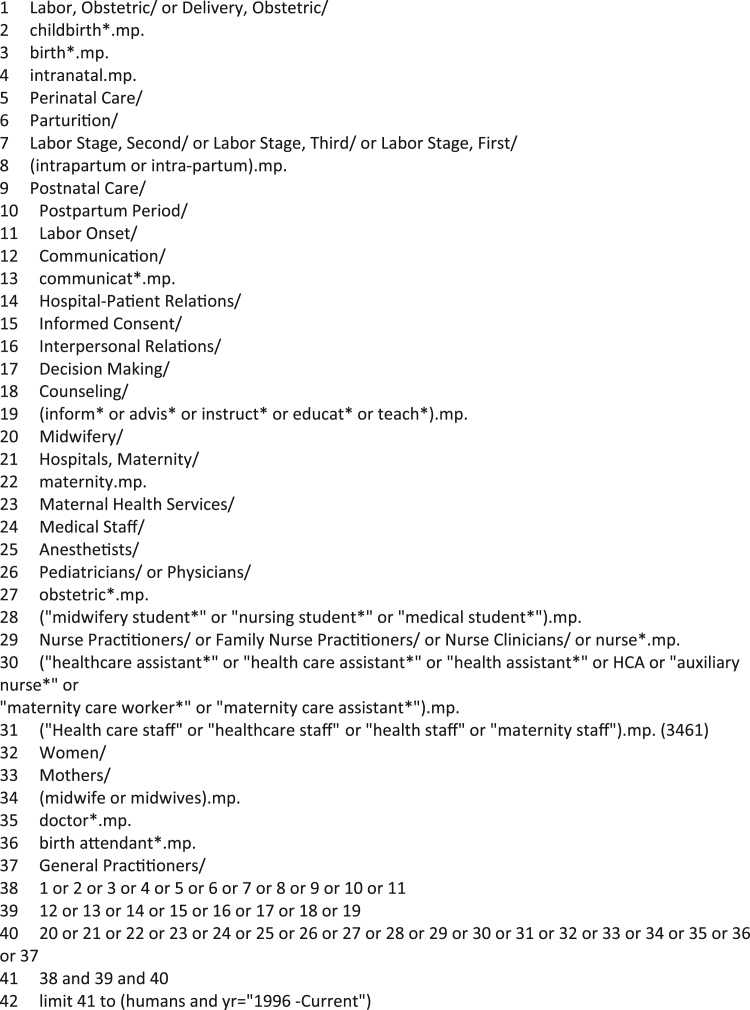
the objectives of this review were (1) to assess whether interventions to support effective communication between maternity care staff and healthy women in labour with a term pregnancy could improve birth outcomes and experiences of care; and (2) to synthesize information related to the feasibility of implementation and resources required.
a mixed-methods systematic review.
studies which reported on interventions aimed at improving communication between maternity care staff and healthy women during normal labour and birth, with no apparent medical or obstetric complications, and their family members were included. 'Maternity care staff' included medical doctors (e.g. obstetricians, anaesthetists, physicians, family doctors, paediatricians), midwives, nurses and other skilled birth attendants providing labour, birth and immediate postnatal care. Studies from all birth settings (any country, any facility including home birth, any resource level) were included.
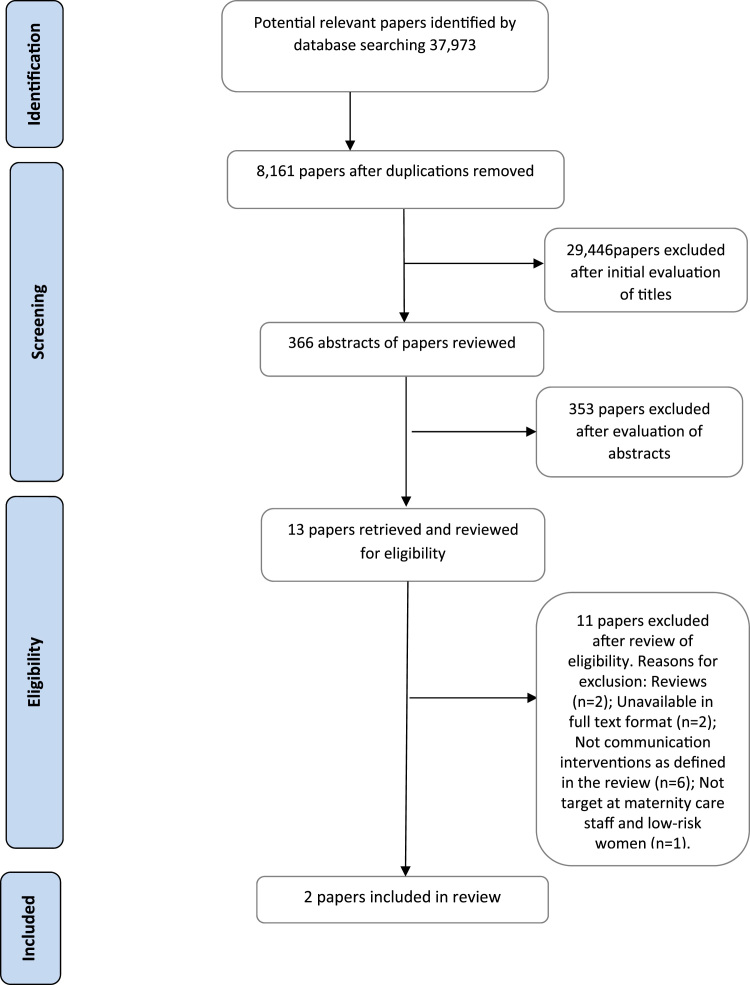
two papers met the inclusion criteria. One was a step wedge randomised controlled trial conducted in Syria, and the other a sub-analysis of a randomised controlled trial from the United Kingdom. Both studies aimed to assess effects of communication training for maternity care staff on women's experiences of labour care. The study from Syria reported that a communication skills training intervention for resident doctors was not associated with higher satisfaction reported by women. In the UK study, patient-actors' (experienced midwives) perceptions of safety and communication significantly improved for postpartum haemorrhage scenarios after training with patient-actors in local hospitals, compared with training using manikins in simulation centres, but no differences were identified for other scenarios. Both studies had methodological limitations.
the review identified a lack of evidence on impact of interventions to support effective communication between maternity care staff and healthy women during labour and birth. Very low quality evidence was found on effectiveness of communication training of maternity care staff. Robust studies which are able to identify characteristics of interventions to support effective communication in maternity care are urgently needed. Consideration also needs to be given to how organisations prepare, monitor and sustain interventions to support effective communication, which reflect outcomes of priority for women, local culture and context of labour and birth care.
本综述的目的是:(1)评估旨在支持产科护理人员与足月妊娠的健康分娩妇女进行有效沟通的干预措施是否能改善分娩结局和护理体验;(2)综合与实施可行性和所需资源相关的信息。
混合方法系统综述。
纳入报告了旨在改善正常分娩和产程中产科护理人员与健康妇女及其家庭成员之间沟通的干预措施的研究,且无明显医学或产科并发症。“产科护理人员”包括医生(如产科医生、麻醉师、内科医生、家庭医生、儿科医生)、助产士、护士和其他提供分娩、接生和产后即时护理的熟练助产人员。纳入所有分娩环境(任何国家、任何设施,包括家庭分娩、任何资源水平)的研究。
两篇论文符合纳入标准。一篇是在叙利亚进行的阶梯楔形随机对照试验,另一篇是来自英国的随机对照试验的子分析。两项研究均旨在评估产科护理人员沟通培训对妇女分娩护理体验的影响。叙利亚的研究报告称,住院医生的沟通技能培训干预与妇女报告的更高满意度无关。在英国的研究中,与在模拟中心使用人体模型进行培训相比,在当地医院与患者演员一起培训后,患者演员(经验丰富的助产士)对产后出血场景的安全性和沟通的认知有显著改善,但在其他场景中未发现差异。两项研究都有方法学上的局限性。
本综述发现缺乏关于支持产科护理人员与健康分娩妇女进行有效沟通的干预措施影响的证据。关于产科护理人员沟通培训有效性的证据质量极低。迫切需要进行有力的研究,以确定支持产科护理中有效沟通的干预措施的特征。还需要考虑组织如何准备、监测和维持支持有效沟通的干预措施,这些措施应反映妇女的优先结果、当地文化以及分娩护理的背景。