Division of Endocrinology and Diabetology, Department of Internal Medicine, Medical University of Graz, Graz, Austria.
Diabetes Research Group, School of Medicine, Swansea University, Swansea, United Kingdom.
Sci Rep. 2018 Jan 19;8(1):1262. doi: 10.1038/s41598-018-19768-2.
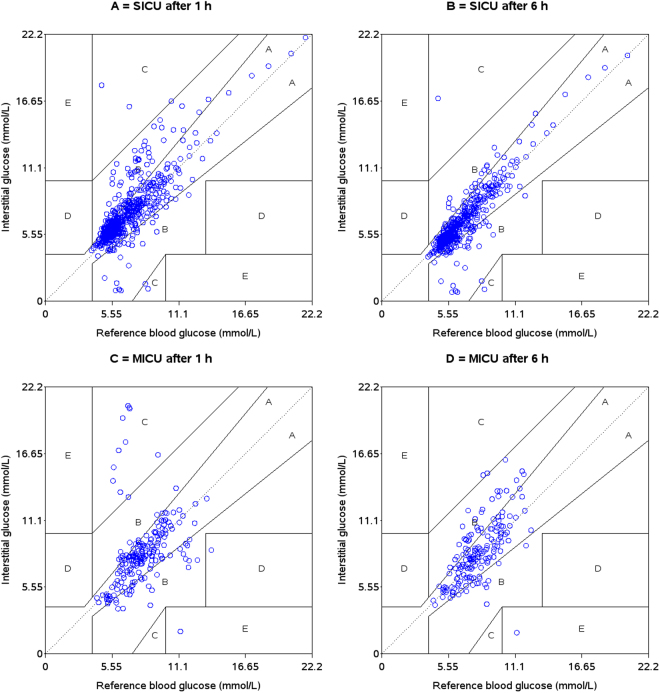
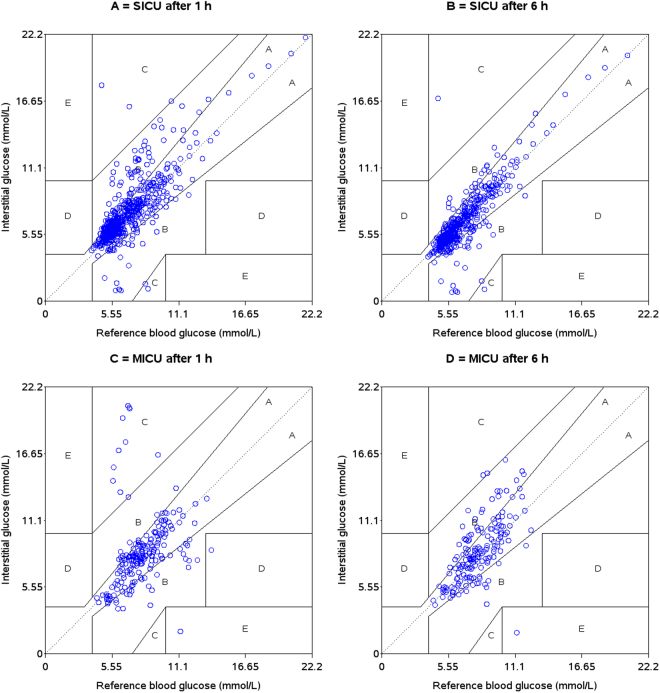
We evaluated a standard subcutaneous microdialysis technique for glucose monitoring in two critically ill patient populations and tested whether a prolonged run-in period improves the quality of the interstitial glucose signal. 20 surgical patients after major cardiac surgery (APACHE II score: 10.1 ± 3.2) and 10 medical patients with severe sepsis (APACHE II score: 31.1 ± 4.3) were included in this investigation. A microdialysis catheter was inserted in the subcutaneous adipose tissue of the abdominal region. Interstitial fluid and arterial blood were sampled in hourly intervals to analyse glucose concentrations. Subcutaneous adipose tissue glucose was prospectively calibrated to reference arterial blood either at hour 1 or at hour 6. Median absolute relative difference of glucose (MARD), calibrated at hour 6 (6.2 (2.6; 12.4) %) versus hour 1 (9.9 (4.2; 17.9) %) after catheter insertion indicated a significant improvement in signal quality in patients after major cardiac surgery (p < 0.001). Prolonged run-in period revealed no significant improvement in patients with severe sepsis, but the number of extreme deviations from the blood plasma values could be reduced. Improved concurrence of glucose readings via a 6-hour run-in period could only be achieved in patients after major cardiac surgery.
我们评估了一种标准的皮下微透析技术,用于监测两种危重症患者群体的血糖,并测试了延长预试验期是否能改善间质葡萄糖信号的质量。本研究纳入了 20 例接受心脏大手术后的外科患者(APACHE II 评分:10.1±3.2)和 10 例严重脓毒症的内科患者(APACHE II 评分:31.1±4.3)。将微透析导管插入腹部皮下脂肪组织中。每隔 1 小时采集间质液和动脉血样,以分析葡萄糖浓度。皮下脂肪组织葡萄糖被前瞻性地校准为参考动脉血,要么在第 1 小时,要么在第 6 小时。导管插入后 6 小时(6.2(2.6;12.4)%)与 1 小时(9.9(4.2;17.9)%)时葡萄糖的中位数绝对相对差异(MARD)表明,在心脏大手术后的患者中,信号质量有显著改善(p<0.001)。在严重脓毒症患者中,延长预试验期并没有显著改善信号质量,但可以减少与血浆值的极端偏差次数。只有在心脏大手术后的患者中,通过 6 小时的预试验期才能实现葡萄糖读数的一致性提高。