Hu Kai-Lun, Zhao Hongcui, Chang Hsun-Ming, Yu Yang, Qiao Jie
Beijing Key Laboratory of Reproductive Endocrinology and Assisted Reproductive Technology and Key Laboratory of Assisted Reproduction, Ministry of Education, Center for Reproductive Medicine, Department of Obstetrics and Gynecology, Peking University Third Hospital, Beijing, China.
Front Endocrinol (Lausanne). 2018 Jan 4;8:365. doi: 10.3389/fendo.2017.00365. eCollection 2017.
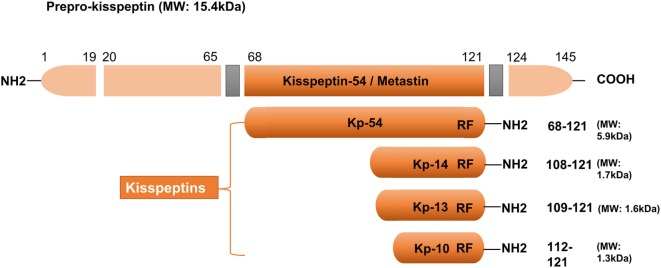
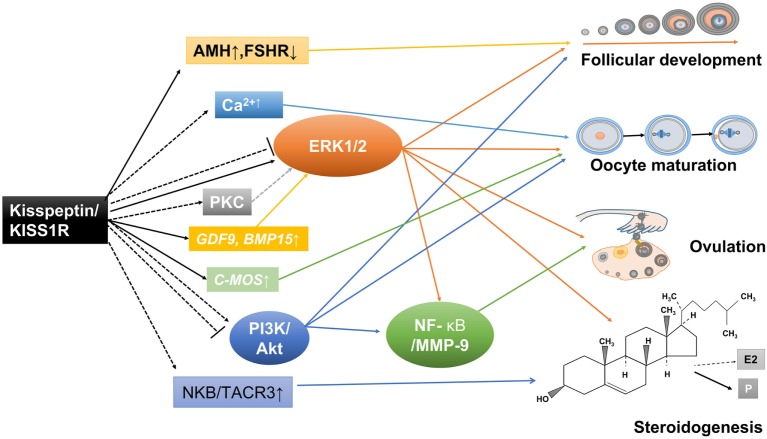
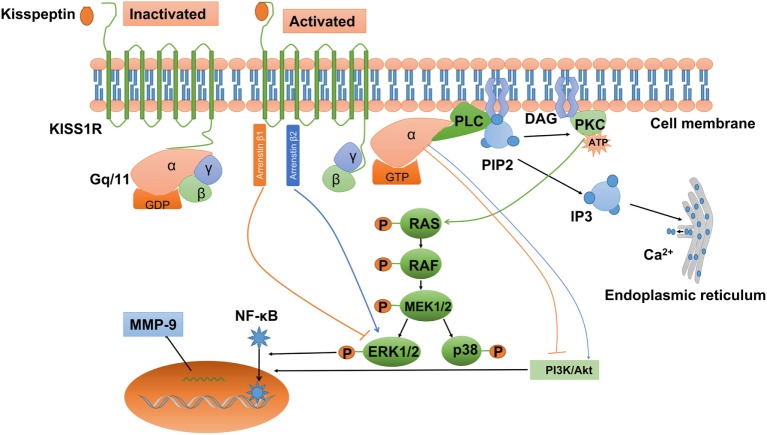
Kisspeptins are a family of neuropeptides that are critical for initiating puberty and regulating ovulation in sexually mature females the central control of the hypothalamic-pituitary-gonadal axis. Recent studies have shown that kisspeptin and its receptor kisspeptin receptor (KISS1R) are expressed in the mammalian ovary. Convincing evidence indicates that kisspeptins can activate a wide variety of signals its binding to KISS1R. Experimental data gathered recently suggest a putative role of kisspeptin signaling in the direct control of ovarian function, including follicular development, oocyte maturation, steroidogenesis, and ovulation. Dysregulation or naturally occurring mutations of the kisspeptin/KISS1R system may negatively affect the ovarian function, leading to reproductive pathology or female infertility. A comprehensive understanding of the expression, actions, and underlying molecular mechanisms of this system in the human ovary is essential for novel approaches to therapeutic and diagnostic interventions in reproductive diseases and infertility.
亲吻素是一类神经肽,对于启动青春期以及调节性成熟雌性动物的排卵(下丘脑 - 垂体 - 性腺轴的中枢控制)至关重要。最近的研究表明,亲吻素及其受体亲吻素受体(KISS1R)在哺乳动物卵巢中表达。有确凿证据表明,亲吻素与其与KISS1R结合后可激活多种信号。最近收集的实验数据表明,亲吻素信号传导在直接控制卵巢功能(包括卵泡发育、卵母细胞成熟、类固醇生成和排卵)中可能具有推定作用。亲吻素/KISS1R系统的失调或自然发生的突变可能会对卵巢功能产生负面影响,导致生殖病理或女性不孕。全面了解该系统在人类卵巢中的表达、作用及潜在分子机制,对于生殖疾病和不孕的治疗及诊断干预新方法至关重要。