Department of Surgery, Lokmanya Tilak Municipal Medical College & General Hospital, Mumbai, India.
Indian J Med Res. 2017 Sep;146(3):346-353. doi: 10.4103/ijmr.IJMR_1538_15.
BACKGROUND & OBJECTIVES: Trauma is known to lead to systemic inflammatory response syndrome (SIRS) and multiple organ dysfunction syndrome (MODS), which is often a cause of late deaths after injury. SIRS and MODS have been objectively measured using scoring systems. This prospective observational study was carried out in a tertiary care hospital in India to evaluate SIRS and MODS following trauma in terms of their incidence, the associated risk factors and the effect on the outcome.
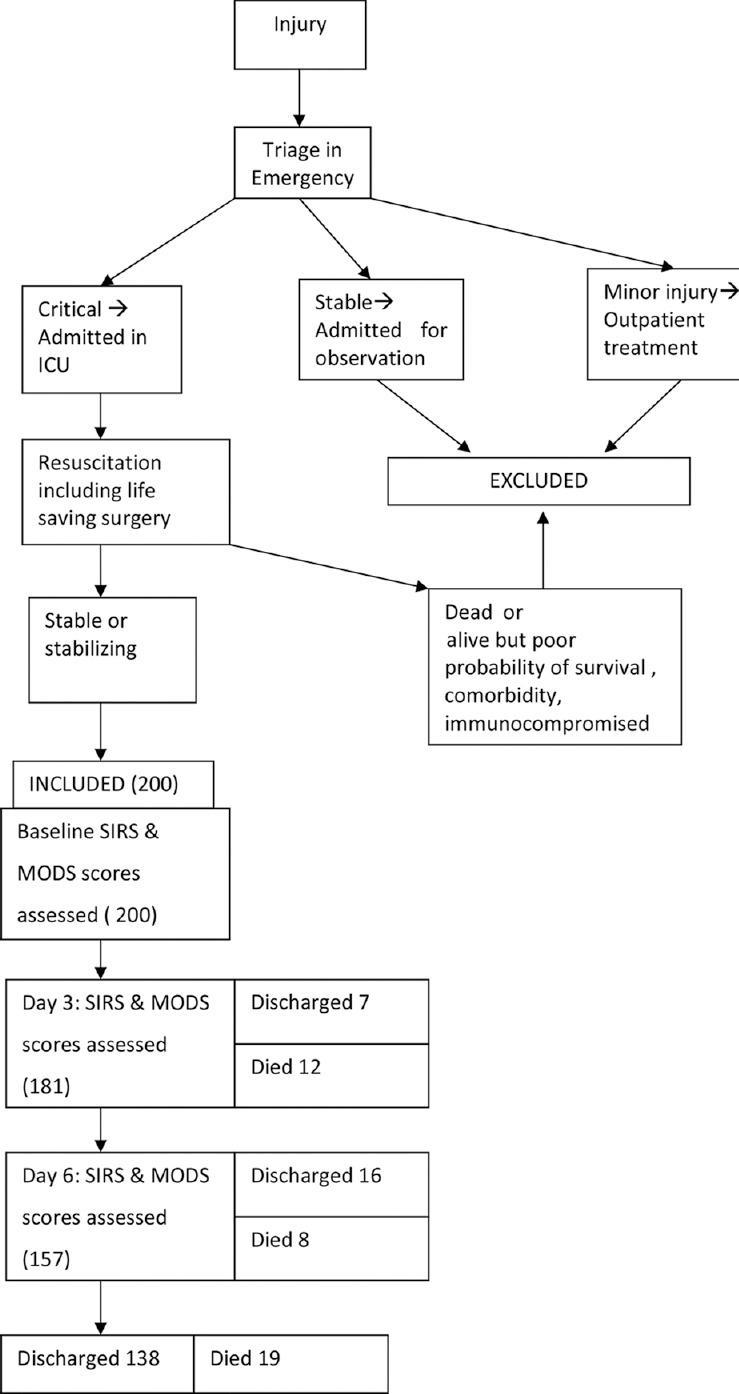
All adult patients with major life- and limb-threatening trauma were included. Patients who died within 24 h, those with severe head injury, known comorbidity, immunocompromised state, on immunosuppressants or pregnancy were excluded. SIRS and MODS scores were recorded after initial management (baseline score), on days 3 and 6 of admission. SIRS was defined as SIRS score of ≥2 and MODS was defined as MODS score of ≥1.
Two hundred patients were enrolled. SIRS was noted in 156 patients (78%). MODS was noted in 145 (72.5%) patients. Overall mortality was 39 (19.5%). Both SIRS and MODS scores were significantly associated with age >60 yr, blunt injury, (lower) revised trauma score hypotension on admission and (higher) injury severity score, but not with gender, pre-hospital time or operative treatment.
INTERPRETATION & CONCLUSIONS: Both SIRS and MODS scores were associated with longer Intensive Care Unit (ICU) stay, more ICU interventions and higher mortality. Incidence of MODS was significantly higher in patients with SIRS. Both scores showed rising trend with time in non-survivors and a decreasing trend in survivors. The serial assessment of scores can help prognosticate outcome and also allocate appropriate critical care resources to patients with rising scores.
创伤已知可导致全身炎症反应综合征(SIRS)和多器官功能障碍综合征(MODS),这通常是创伤后晚期死亡的原因。SIRS 和 MODS 已通过评分系统进行客观测量。本前瞻性观察研究在印度的一家三级护理医院进行,旨在评估创伤后 SIRS 和 MODS 的发生率、相关危险因素以及对结局的影响。
纳入所有有严重生命和肢体威胁的成年创伤患者。排除 24 小时内死亡的患者、严重头部损伤患者、已知合并症患者、免疫功能低下患者、使用免疫抑制剂或妊娠的患者。在初始治疗后(基线评分)、入院后第 3 天和第 6 天记录 SIRS 和 MODS 评分。SIRS 定义为 SIRS 评分≥2,MODS 定义为 MODS 评分≥1。
共纳入 200 例患者。156 例(78%)患者出现 SIRS,145 例(72.5%)患者出现 MODS。总死亡率为 39 例(19.5%)。SIRS 和 MODS 评分均与年龄>60 岁、钝器伤、(较低)修订创伤评分入院时低血压和(较高)损伤严重程度评分显著相关,但与性别、院前时间或手术治疗无关。
SIRS 和 MODS 评分均与 ICU 住院时间延长、ICU 干预增多和死亡率升高相关。SIRS 患者中 MODS 的发生率显著升高。在非幸存者中,评分呈上升趋势,而在幸存者中呈下降趋势。评分的连续评估有助于预测结局,并为评分升高的患者分配适当的重症监护资源。