McCleery Amanda, Wynn Jonathan K, Mathalon Daniel H, Roach Brian J, Green Michael F
University of California, Los Angeles, CA, USA.
Veterans Affairs Greater Los Angeles, Veterans Integrated Service Network 22 Mental Illness Research, Education, and Clinical Center, Los Angeles, CA, USA.
Scand J Psychol. 2018 Feb;59(1):41-48. doi: 10.1111/sjop.12413.
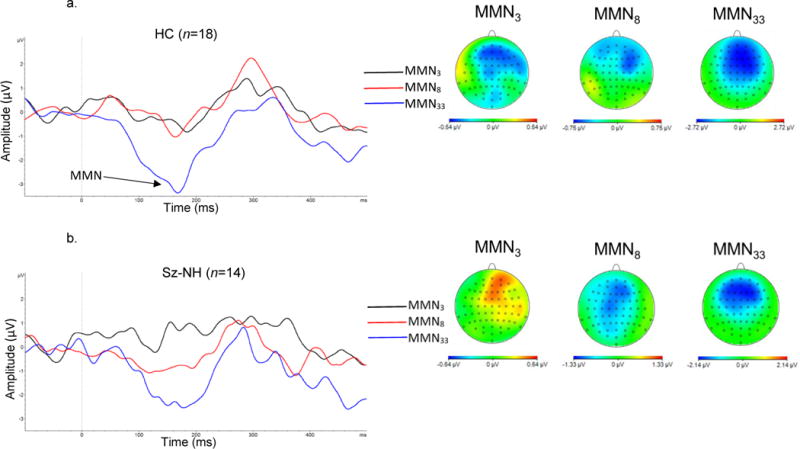
Auditory hallucinations, a hallmark symptom of psychosis, are experienced by most people with a diagnosis of schizophrenia at some point in their illness. Auditory hallucinations can be understood as a failure in predictive coding, whereby abnormalities in sensory/perceptual processing combine with biased cognitive processes to result in a dampening of normal prediction error signaling. In this paper, we used a roving mismatch negativity (MMN) paradigm to optimize evaluation of prediction error signaling and short-term neuroplasticity in 30 people with schizophrenia (n = 16 with and n = 14 without recent auditory hallucinations) and 20 healthy comparison participants. The recent hallucinations group exhibited an abnormal roving MMN profile [F(2,27) = 3.98, p = 0.03], significantly reduced prediction error signaling [t(28) = -2.25, p = 0.03], and a trend for diminished short-term neuroplasticity [t(28) = 1.80, p = 0.08]. There were no statistically significant differences between the healthy comparison group and the combined schizophrenia group on any of the roving MMN indices. These findings are consistent with a predictive coding account of hallucinations in schizophrenia, which posits reduced prediction error signaling in those who are prone to hallucinations. These results also suggest that plasticity-mediated formation and online updating of predictive coding models may also be disrupted in individuals with recent hallucinations.
幻听是精神病的一个标志性症状,大多数被诊断为精神分裂症的人在患病的某个阶段都会经历幻听。幻听可以被理解为预测编码的失败,即感觉/知觉处理中的异常与有偏差的认知过程相结合,导致正常预测误差信号减弱。在本文中,我们使用了移动失配负波(MMN)范式,以优化对30名精神分裂症患者(16名有近期幻听,14名无近期幻听)和20名健康对照参与者的预测误差信号和短期神经可塑性的评估。近期有幻听的组表现出异常的移动MMN图谱[F(2,27) = 3.98,p = 0.03],预测误差信号显著降低[t(28) = -2.25,p = 0.03],并且有短期神经可塑性减弱的趋势[t(28) = 1.80,p = 0.08]。在任何移动MMN指标上,健康对照组与合并的精神分裂症组之间均无统计学显著差异。这些发现与精神分裂症幻觉的预测编码理论一致,该理论认为易患幻觉的人预测误差信号减少。这些结果还表明,可塑性介导的预测编码模型的形成和在线更新在近期有幻听的个体中也可能受到干扰。