1 Department of Pharmacology, Hoshi University School of Pharmacy and Pharmaceutical Sciences, Shinagawa-ku, Tokyo, Japan.
2 Life Science Tokyo Advanced Research Center (L-StaR), Hoshi University School of Pharmacy and Pharmaceutical Sciences, Shinagawa-ku, Tokyo, Japan.
Mol Pain. 2018 Jan-Dec;14:1744806918756406. doi: 10.1177/1744806918756406. Epub 2018 Jan 22.
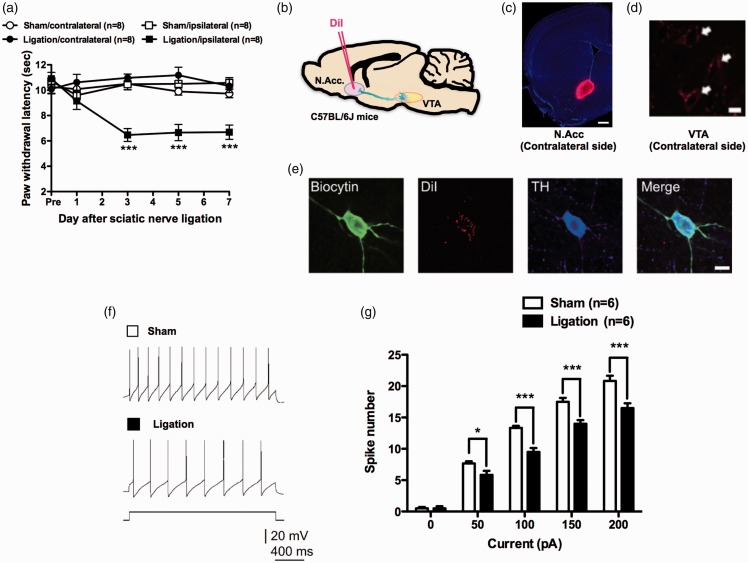
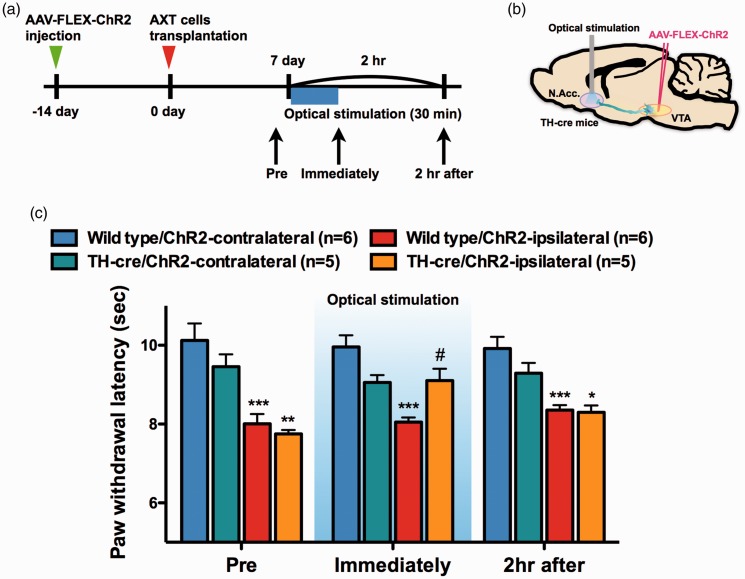
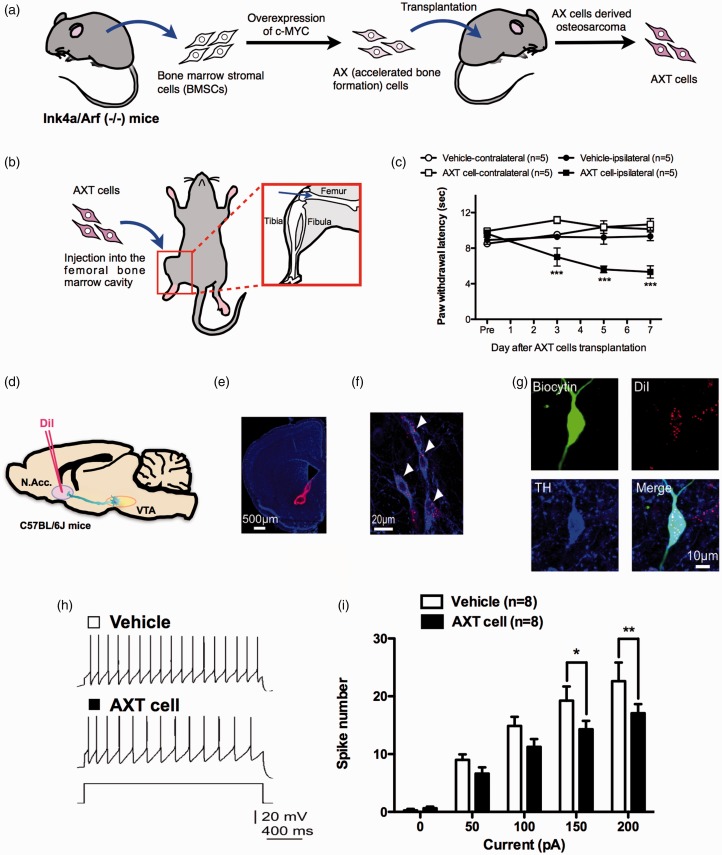
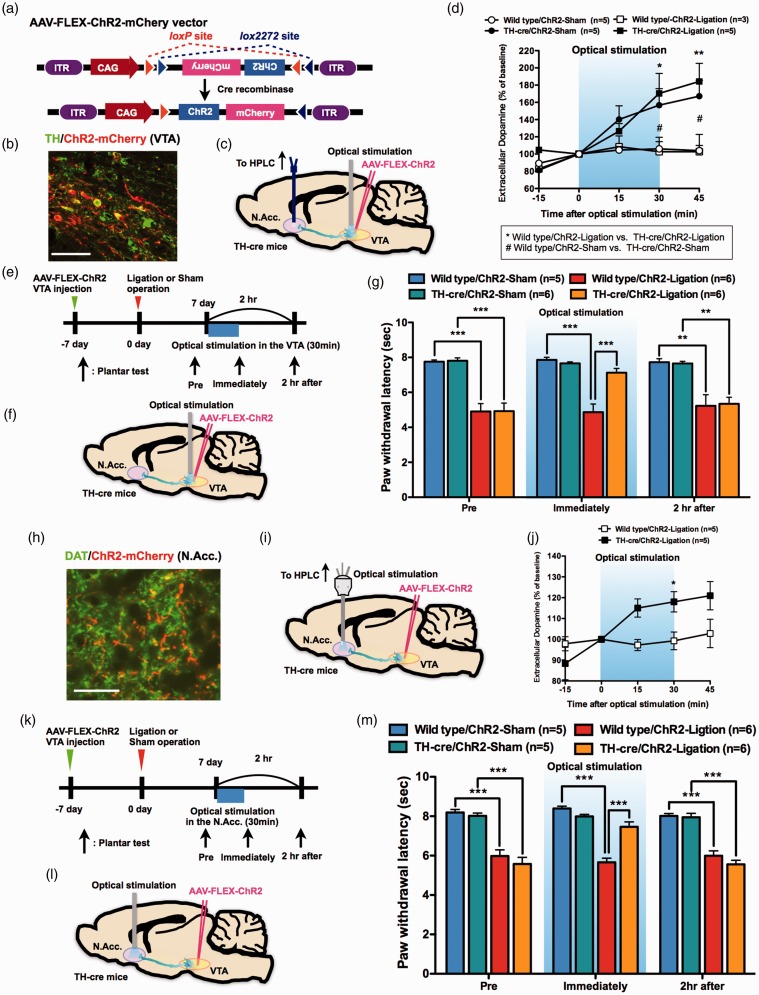
Chronic pain induced by nerve damage due to trauma or invasion of cancer to the bone elicits severe ongoing pain as well as hyperalgesia and allodynia likely reflecting adaptive changes within central circuits that amplify nociceptive signals. The present study explored the possible contribution of the mesolimbic dopaminergic circuit in promoting allodynia related to neuropathic and cancer pain. Mice with ligation of the sciatic nerve or treated with intrafemoral osteosarcoma cells showed allodynia to a thermal stimulus applied to the paw on the injured side. Patch clamp electrophysiology revealed that the intrinsic neuronal excitability of ventral tegmental area (VTA) dopamine neurons projecting to the nucleus accumbens (N.Acc.) was significantly reduced in those mice. We used tyrosine hydroxylase (TH)-cre mice that were microinjected with adeno-associated virus (AAV) to express channelrhodopsin-2 (ChR2) to allow optogenetic stimulation of VTA dopaminergic neurons in the VTA or in their N.Acc. terminals. Optogenetic activation of these cells produced a significant but transient anti-allodynic effect in nerve injured or tumor-bearing mice without increasing response thresholds to thermal stimulation in sham-operated animals. Suppressed activity of mesolimbic dopaminergic neurons is likely to contribute to decreased inhibition of N.Acc. output neurons and to neuropathic or cancer pain-induced allodynia suggesting strategies for modulation of pathological pain states.
由创伤或癌症侵犯骨骼导致的神经损伤引起的慢性疼痛会引发严重的持续性疼痛,以及痛觉过敏和感觉异常,这可能反映了中枢回路中放大伤害性信号的适应性变化。本研究探讨了中脑边缘多巴胺能回路在促进与神经病理性和癌性疼痛相关的感觉异常中的可能作用。坐骨神经结扎或股骨骨肉瘤细胞治疗的小鼠对施加于受伤侧爪子的热刺激表现出痛觉过敏。膜片钳电生理学显示,投射到伏隔核(N.Acc.)的腹侧被盖区(VTA)多巴胺神经元的内在神经元兴奋性在这些小鼠中显著降低。我们使用酪氨酸羟化酶(TH)-cre 小鼠,将腺相关病毒(AAV)微注射到表达通道视紫红质-2(ChR2)的小鼠中,以允许 VTA 多巴胺能神经元或其 N.Acc.末端的光遗传学刺激。这些细胞的光遗传学激活在神经损伤或肿瘤荷瘤小鼠中产生了显著但短暂的抗痛觉过敏作用,而对假手术动物的热刺激反应阈值没有增加。中脑边缘多巴胺能神经元的抑制活性降低可能导致 N.Acc.输出神经元的抑制减少,并导致神经病理性或癌性疼痛引起的感觉异常,这表明了调节病理性疼痛状态的策略。