• 文献检索
  • 文档翻译
  • 深度研究
  • 学术资讯
  • Suppr Zotero 插件Zotero 插件
  • 邀请有礼
  • 套餐&价格
  • 历史记录
应用&插件
Suppr Zotero 插件Zotero 插件浏览器插件Mac 客户端Windows 客户端微信小程序
定价
高级版会员购买积分包购买API积分包
服务
文献检索文档翻译深度研究API 文档MCP 服务
关于我们
关于 Suppr公司介绍联系我们用户协议隐私条款
关注我们

Suppr 超能文献

核心技术专利:CN118964589B侵权必究
粤ICP备2023148730 号-1Suppr @ 2026

文献检索

告别复杂PubMed语法,用中文像聊天一样搜索,搜遍4000万医学文献。AI智能推荐,让科研检索更轻松。

立即免费搜索

文件翻译

保留排版,准确专业,支持PDF/Word/PPT等文件格式,支持 12+语言互译。

免费翻译文档

深度研究

AI帮你快速写综述,25分钟生成高质量综述,智能提取关键信息,辅助科研写作。

立即免费体验

临终生活:反映在癌症患者推文里的临终轨迹。

#Deathbedlive: the end-of-life trajectory, reflected in a cancer patient's tweets.

机构信息

eHealth Research Group, Usher Institute of Population Health Sciences and Informatics, University of Edinburgh, Edinburgh, UK.

Ernst and Young AG, Basel, Switzerland.

出版信息

BMC Palliat Care. 2018 Jan 22;17(1):17. doi: 10.1186/s12904-018-0273-9.

DOI:10.1186/s12904-018-0273-9
PMID:29357865
原文链接:https://pmc.ncbi.nlm.nih.gov/articles/PMC5778813/
Abstract

BACKGROUND

Understanding physical and psycho-social illness trajectories towards the end of life can help in the planning of palliative and supportive care. With terminal patients increasingly seeking and sharing health information and support via social media, it is timely to examine whether these trajectories are reflected in their digital narratives. In this exploratory study, we analysed the Twitter feed of prominent cancer sufferer and physician, Kate Granger, over the final 6 months of her life.

METHODS

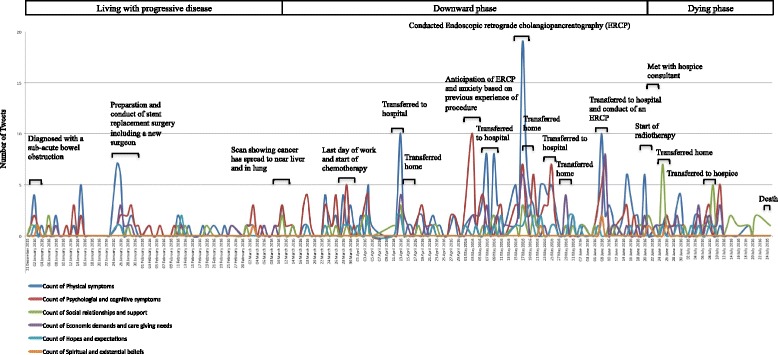
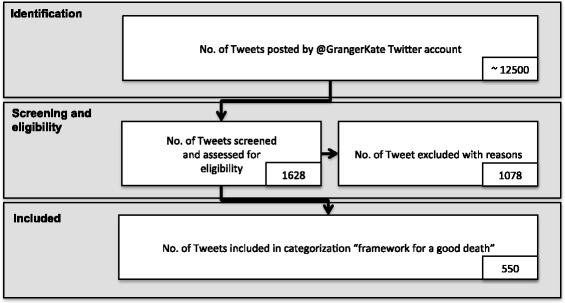
With the consent of Kate's widower, Chris Pointon, 1628 Twitter posts from @GrangerKate were manually screened. The 550 tweets judged relevant to her disease were qualitatively content analysed with reference to the six modifiable dimensions of the patient experience in Emanuel and Emanuel's 'framework for a good death'. The frequency of each tweet category was charted over time and textual content was examined and cross-referenced with key events, to obtain a deeper understanding of its nature and significance.

RESULTS

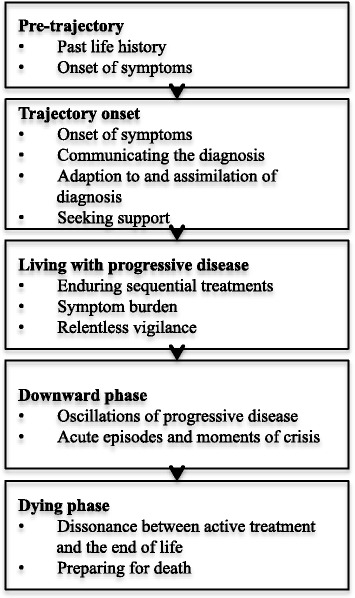
Tweets were associated with physical symptoms (N = 270), psychological and cognitive symptoms (N = 213), social relationships and support (N = 85), economic demands and care giving needs (N = 85), hopes and expectations (N = 51) and spiritual beliefs (N = 7). While medical treatments and procedures were discussed in detail, medical information-seeking was largely absent, likely reflecting Kate clinical expertise. Spirituality was expressed more as hope in treatments or "someone out there listening", than in religious terms. The high value of Kate's palliative care team was a dominant theme in the support category, alongside the support she received from her online community of fellow sufferers, friends, family and colleagues. Significant events, such as medical procedures and hospital stays generated the densest Twitter engagement. Transitions between trajectory phases were marked by changes in the relative frequency of tweet-types.

CONCLUSIONS

In Kate's words, "the power of patient narrative cannot be underestimated". While this analysis spanned only 6 months, it yielded rich insights. The results reflect theorised end-of-life dimensions and reveal the potential of social media data and digital bio-ethnography to shine a light on terminal patients' lived experiences, coping strategies and support needs, suggesting new opportunities for enhancing personalised palliative care and avenues for further research.

摘要

背景

了解生命末期的身体和心理社会疾病轨迹有助于规划姑息治疗和支持性护理。随着终末期患者越来越多地通过社交媒体寻求和分享健康信息和支持,现在及时检查这些轨迹是否反映在他们的数字叙述中是很重要的。在这项探索性研究中,我们分析了著名癌症患者和医生凯特·格兰杰(Kate Granger)在生命的最后 6 个月的推特(Twitter)feed。

方法

在凯特的遗孀克里斯·波顿(Chris Pointon)的同意下,手动筛选了来自@GrangerKate 的 1628 条推文。与她的疾病相关的 550 条推文与 Emanuel 和 Emanuel 的“美好死亡框架”中的六个可改变的患者体验维度进行了定性内容分析。每个推文类别的频率随时间绘制,并对文本内容进行检查和交叉引用关键事件,以更深入地了解其性质和意义。

结果

推文与身体症状(N=270)、心理和认知症状(N=213)、社会关系和支持(N=85)、经济需求和护理需求(N=85)、希望和期望(N=51)和精神信仰(N=7)相关。虽然详细讨论了医疗治疗和程序,但主要缺乏医疗信息搜索,这可能反映了凯特的临床专业知识。灵性更多地表达为对治疗的希望,或者“有人在听”,而不是宗教术语。凯特姑息治疗团队的高度重视是支持类别中的一个主要主题,此外还有她从在线患者社区、朋友、家人和同事那里获得的支持。重大事件,如医疗程序和住院治疗,产生了最密集的推特参与度。轨迹阶段之间的转变以推文类型的相对频率的变化为标志。

结论

用凯特的话说,“患者叙述的力量不可低估”。虽然这一分析仅跨越了 6 个月,但却产生了丰富的见解。结果反映了临终维度的理论化,并揭示了社交媒体数据和数字生物伦理学的潜力,可以揭示终末期患者的生活体验、应对策略和支持需求,为增强个性化姑息治疗提供新的机会,并为进一步研究开辟新途径。
https://cdn.ncbi.nlm.nih.gov/pmc/blobs/e5b4/5778813/e58ea8c1bd0c/12904_2018_273_Fig3_HTML.jpg
https://cdn.ncbi.nlm.nih.gov/pmc/blobs/e5b4/5778813/865b99b23187/12904_2018_273_Fig1_HTML.jpg
https://cdn.ncbi.nlm.nih.gov/pmc/blobs/e5b4/5778813/409131b65ba3/12904_2018_273_Fig2_HTML.jpg
https://cdn.ncbi.nlm.nih.gov/pmc/blobs/e5b4/5778813/e58ea8c1bd0c/12904_2018_273_Fig3_HTML.jpg
https://cdn.ncbi.nlm.nih.gov/pmc/blobs/e5b4/5778813/865b99b23187/12904_2018_273_Fig1_HTML.jpg
https://cdn.ncbi.nlm.nih.gov/pmc/blobs/e5b4/5778813/409131b65ba3/12904_2018_273_Fig2_HTML.jpg
https://cdn.ncbi.nlm.nih.gov/pmc/blobs/e5b4/5778813/e58ea8c1bd0c/12904_2018_273_Fig3_HTML.jpg

相似文献

1
#Deathbedlive: the end-of-life trajectory, reflected in a cancer patient's tweets.临终生活:反映在癌症患者推文里的临终轨迹。
BMC Palliat Care. 2018 Jan 22;17(1):17. doi: 10.1186/s12904-018-0273-9.
2
Palliative care experiences of adult cancer patients from ethnocultural groups: a qualitative systematic review protocol.不同种族文化群体成年癌症患者的姑息治疗体验:一项定性系统评价方案
JBI Database System Rev Implement Rep. 2015 Jan;13(1):99-111. doi: 10.11124/jbisrir-2015-1809.
3
Thinking ahead about medical treatments in advanced illness: a qualitative study of barriers and enablers in end-of-life care planning with patients and families from ethnically diverse backgrounds.预先思考晚期疾病的医疗治疗:对不同种族背景的终末期患者和家庭进行临终关怀规划的障碍和促进因素的定性研究。
Health Soc Care Deliv Res. 2023 Jun;11(7):1-135. doi: 10.3310/JVFW4781.
4
Trajectories of the multidimensional dying experience for terminally ill cancer patients.晚期癌症患者多维死亡体验的轨迹
J Pain Symptom Manage. 2014 Nov;48(5):863-74. doi: 10.1016/j.jpainsymman.2014.01.011. Epub 2014 Apr 15.
5
Social media and palliative medicine: a retrospective 2-year analysis of global Twitter data to evaluate the use of technology to communicate about issues at the end of life.社交媒体与姑息医学:对全球推特数据进行的为期两年的回顾性分析,以评估利用技术就临终问题进行交流的情况。
BMJ Support Palliat Care. 2015 Jun;5(2):207-12. doi: 10.1136/bmjspcare-2014-000701. Epub 2014 Sep 2.
6
Provision of spiritual support to patients with advanced cancer by religious communities and associations with medical care at the end of life.为晚期癌症患者提供精神支持:宗教团体与临终关怀医疗服务的关联。
JAMA Intern Med. 2013 Jun 24;173(12):1109-17. doi: 10.1001/jamainternmed.2013.903.
7
Understanding the meaning of social well-being at the end of life.理解生命末期社会福祉的意义。
Oncol Nurs Forum. 2008 May;35(3):365-71. doi: 10.1188/08.ONF.365-371.
8
Spiritual Care Needs of Terminal Ill Cancer Patients.晚期癌症患者的精神关怀需求。
Asian Pac J Cancer Prev. 2021 Dec 1;22(12):3773-3779. doi: 10.31557/APJCP.2021.22.12.3773.
9
An exploratory study of spiritual care at the end of life.一项关于临终精神关怀的探索性研究。
Ann Fam Med. 2008 Sep-Oct;6(5):406-11. doi: 10.1370/afm.883.
10
Prescription of Controlled Substances: Benefits and Risks管制药品的处方:益处与风险

引用本文的文献

1
Promoting Public Engagement in Palliative and End-of-Life Care Discussions on Chinese Social Media: Model Development and Analysis.促进中国社交媒体上公众参与姑息治疗和临终关怀讨论:模式开发与分析
J Med Internet Res. 2025 Mar 18;27:e59944. doi: 10.2196/59944.
2
End-of-Life Preparedness and Quality of Advance Care Planning Discussions in Patients With Advanced Metastatic Cancer.晚期转移性癌症患者的临终准备及预立医疗照护计划讨论的质量
Oncol Nurs Forum. 2024 Dec 12;52(1):70-80. doi: 10.1188/25.ONF.70-80.
3
Capturing patient experiences of care with digital technology to improve service delivery and quality of care: A scoping review.

本文引用的文献

1
Improving palliative care with deep learning.利用深度学习改善姑息治疗。
BMC Med Inform Decis Mak. 2018 Dec 12;18(Suppl 4):122. doi: 10.1186/s12911-018-0677-8.
2
Defining a Good Death (Successful Dying): Literature Review and a Call for Research and Public Dialogue.界定善终(成功离世):文献综述及对研究与公众对话的呼吁
Am J Geriatr Psychiatry. 2016 Apr;24(4):261-71. doi: 10.1016/j.jagp.2016.01.135. Epub 2016 Jan 22.
3
Using Facebook for Health-related Research Study Recruitment and Program Delivery.利用脸书进行与健康相关的研究招募和项目实施。
利用数字技术获取患者的就医体验以改善服务提供和医疗质量:一项范围综述。
Digit Health. 2024 Oct 22;10:20552076241282900. doi: 10.1177/20552076241282900. eCollection 2024 Jan-Dec.
4
Navigating who I was and who I am online: How people with dementia use social media platforms to support identity.在网络世界中认清过去的自己与现在的自己:痴呆症患者如何利用社交媒体平台来维持自我认同。
Dementia (London). 2025 May;24(4):647-665. doi: 10.1177/14713012241292659. Epub 2024 Oct 11.
5
Social media for palliative and end-of-life care research: a systematic review.社交媒体在姑息治疗和临终关怀研究中的应用:系统评价。
BMJ Support Palliat Care. 2024 May 17;14(2):149-162. doi: 10.1136/spcare-2023-004579.
6
Physicians' Conceptions of the Dying Patient: Scoping Review and Qualitative Content Analysis of the United Kingdom Medical Literature.医生对临终患者的观念:英国医学文献的范围综述和定性内容分析。
Qual Health Res. 2022 Oct;32(12):1881-1896. doi: 10.1177/10497323221119939. Epub 2022 Aug 18.
7
Sentiment and emotion trends in nurses' tweets about the COVID-19 pandemic.护士在推特上发布的关于 COVID-19 大流行的情绪和情感趋势。
J Nurs Scholarsh. 2022 Sep;54(5):613-622. doi: 10.1111/jnu.12775. Epub 2022 Mar 27.
8
Innovation in Orthopedics: Part 1-Design Thinking.骨科创新:第1部分——设计思维。
Curr Rev Musculoskelet Med. 2022 Apr;15(2):143-149. doi: 10.1007/s12178-022-09748-5. Epub 2022 Mar 14.
9
Using Twitter Comments to Understand People's Experiences of UK Health Care During the COVID-19 Pandemic: Thematic and Sentiment Analysis.利用推特评论了解新冠疫情期间英国人对英国医疗保健的体验:主题和情感分析。
J Med Internet Res. 2021 Oct 25;23(10):e31101. doi: 10.2196/31101.
10
Advancing the Science of Recruitment for Family Caregivers: Focus Group and Delphi Methods.推进家庭照顾者招募科学:焦点小组和德尔菲法
JMIR Nurs. 2019 Jul 22;2(1):e13862. doi: 10.2196/13862. eCollection 2019 Jan-Dec.
Curr Opin Psychol. 2016 May;9:38-43. doi: 10.1016/j.copsyc.2015.09.011.
4
Using Social Media for Actionable Disease Surveillance and Outbreak Management: A Systematic Literature Review.利用社交媒体进行可操作的疾病监测与疫情管理:一项系统文献综述
PLoS One. 2015 Oct 5;10(10):e0139701. doi: 10.1371/journal.pone.0139701. eCollection 2015.
5
A Review of Facebook Research in the Social Sciences.《社交媒体科学领域的 Facebook 研究综述》。
Perspect Psychol Sci. 2012 May;7(3):203-20. doi: 10.1177/1745691612442904.
6
Identifying the prevalence, trajectory, and determinants of psychological distress in extremity sarcoma.确定肢体肉瘤患者心理困扰的患病率、发展轨迹及影响因素。
Sarcoma. 2015;2015:745163. doi: 10.1155/2015/745163. Epub 2015 Feb 12.
7
Living in uncertain times: trajectories to death in residential care homes.生活在不确定的时代:养老院中的死亡轨迹。
Br J Gen Pract. 2014 Sep;64(626):e576-83. doi: 10.3399/bjgp14X681397.
8
Do cancer patients tweet? Examining the twitter use of cancer patients in Japan.癌症患者会发推文吗?调查日本癌症患者对推特的使用情况。
J Med Internet Res. 2014 May 27;16(5):e137. doi: 10.2196/jmir.3298.
9
Palliative social media.姑息性社交媒体
BMJ Support Palliat Care. 2014 Mar;4(1):13-8. doi: 10.1136/bmjspcare-2013-000584.
10
Defining the illness trajectory of metastatic breast cancer.定义转移性乳腺癌的疾病轨迹。
BMJ Support Palliat Care. 2015 Dec;5(4):358-65. doi: 10.1136/bmjspcare-2012-000415. Epub 2013 Jul 23.