Solomon-Moore Emma, Toumpakari Zoi, Sebire Simon J, Thompson Janice L, Lawlor Deborah A, Jago Russell
Centre for Exercise, Nutrition and Health Sciences, School for Policy Studies, University of Bristol, Bristol, UK.
School of Sport, Exercise and Rehabilitation Sciences, University of Birmingham, Birmingham, UK.
BMJ Open. 2018 Jan 21;8(1):e019732. doi: 10.1136/bmjopen-2017-019732.
Examine the extent that parent gender is associated with supporting children's physical activity.
Cross-sectional mixed-methods study.
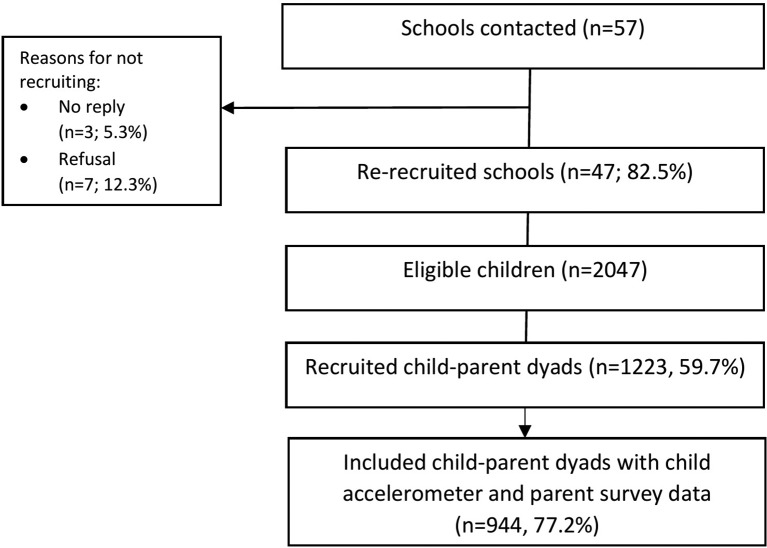
47 primary schools located in Bristol (UK).
944 children aged 8-9 years and one of their parents provided quantitative data; 51 parents (20 fathers) were interviewed.
Children wore an accelerometer, and mean minutes of moderate-to-vigorous physical activity (MVPA) per day, counts per minute (CPM) and achievement of national MVPA guidelines were derived. Parents reported who leads in supporting child activity during the week and weekend. Linear and logistic regression examined the association between gender of parent who supports child activity and child physical activity. For the semistructured telephone interviews, inductive and deductive content analyses were used to explore the role of gender in how parents support child activity.
Parents appeared to have a stronger role in supporting boys to be more active, than girls, and the strongest associations were when they reported that both parents had equal roles in supporting their child. For example, compared with the reference of female/mother support, equal contribution from both parents during the week was associated with boys doing 5.9 (95% CI 1.2 to 10.6) more minutes of MVPA per day and more CPM when both parents support on weekday and weekends (55.1 (14.3 to 95.9) and 52.8 (1.8 to 103.7), respectively). Associations in girls were weaker and sometimes in the opposite direction, but there was no strong statistical evidence for gender interactions. Themes emerged from the qualitative data, specifically; parents proactively supporting physical activity equally, mothers supporting during the week, families getting together at weekends, families doing activities separately due to preferences and parents using activities to bond one-to-one with children.
Mothers primarily support child activity during the week. Children, possibly more so boys, are more active if both parents share the supporting role.
研究父母性别与支持孩子体育活动之间的关联程度。
横断面混合方法研究。
位于英国布里斯托尔的47所小学。
944名8至9岁的儿童及其父母之一提供了定量数据;51名父母(20名父亲)接受了访谈。
孩子们佩戴加速度计,得出每天中度至剧烈体育活动(MVPA)的平均分钟数、每分钟计数(CPM)以及达到国家MVPA指南的情况。父母报告在工作日和周末谁在支持孩子活动方面起主导作用。线性和逻辑回归分析了支持孩子活动的父母性别与孩子体育活动之间的关联。对于半结构化电话访谈,采用归纳和演绎内容分析法来探讨性别在父母支持孩子活动方式中的作用。
父母在支持男孩更积极参与体育活动方面似乎比支持女孩发挥着更强的作用,最强的关联是当他们报告父母双方在支持孩子方面具有平等作用时。例如,与女性/母亲支持的参照相比,工作日父母双方平等贡献与男孩每天多进行5.9(95%可信区间1.2至10.6)分钟的MVPA以及在工作日和周末父母双方都提供支持时更多的CPM相关(分别为55.1(14.3至95.9)和52.8(1.8至103.7))。女孩的关联较弱,有时方向相反,但没有强有力的统计证据表明存在性别交互作用。定性数据中出现了一些主题,具体如下:父母积极平等地支持体育活动、母亲在工作日提供支持、家庭在周末团聚、家庭因偏好而分别进行活动以及父母利用活动与孩子进行一对一的情感联结。
母亲主要在工作日支持孩子活动。如果父母双方共同承担支持角色,孩子,尤其是男孩,会更积极活跃。