Jago Russell, Solomon-Moore Emma, Macdonald-Wallis Corrie, Sebire Simon J, Thompson Janice L, Lawlor Deborah A
Centre for Exercise, Nutrition & Health Sciences, School for Policy Studies, University of Bristol, 8 Priory Road, Bristol, BS8 1TZ, UK.
School of Sport, Exercise and Rehabilitation Sciences, University of Birmingham, Birmingham, B15 2TT, UK.
Int J Behav Nutr Phys Act. 2017 Apr 28;14(1):33. doi: 10.1186/s12966-017-0492-0.
The aim of this study was to examine how children's and parents' physical activity changes from Year 1 (5-6) to Year 4 (8-9 years of age).
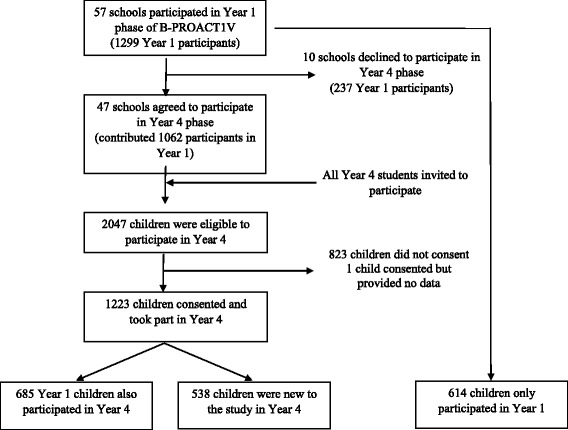
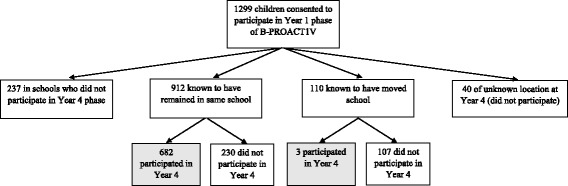
Data are from the Bristol (UK) B-PROACT1V cohort. Fifty-seven primary schools were recruited when the children were in Year 1, with 1299 children and their parents providing data. Forty-seven schools were re-recruited in Year 4, with 1223 children and parents providing data (685 of whom participated in Year 1). Children and at least one parent wore an accelerometer for 5 days including a weekend and mean minutes of sedentary time, moderate-to-vigorous intensity physical activity (MVPA) and accelerometer counts per minute (CPM) were derived. Multiple imputation was used to impute missing data for all 1837 families who took part, including those who participated at just one time. Paired t-tests examined if there was statistical evidence of change in accelerometer measures.
Multiple imputation and observed data were comparable and results using complete observed data were mostly the same as those using imputed data. Imputed data showed that mean boys' CPM decreased from 747 to 673 (difference in mean 74 [95% CI 45 to 103]) and girls' from 686 to 587 (99 [79 to 119]). Boys' time spent in MVPA reduced from 72 to 69 (3 [0 to 6]) and girls' from 62 to 56 (7 [4 to 9]) minutes per day. There were increases in sedentary time for both boys (354 to 428 min, 74 [61 to 88]) and girls (365 to 448, 83 [71 to 96]). There was no evidence of change in parent CPM or MVPA. Mothers' sedentary time increased by 26 min per day [16 to 35].
There were similar increases in sedentary time in girls and boys between age 5-6 and 8-9, and decreases in MVPA that were more marked in girls. The similarity of multiple-imputed and complete observed data suggest that these findings may not be markedly affected by selection bias. Result support early interventions to prevent the age-related decline in children's physical activity.
本研究旨在探讨儿童及其父母的身体活动从一年级(5 - 6岁)到四年级(8 - 9岁)如何变化。
数据来自英国布里斯托尔的B - PROACT1V队列研究。当孩子们在一年级时,招募了57所小学,1299名儿童及其父母提供了数据。四年级时重新招募了47所学校,1223名儿童及其父母提供了数据(其中685人在一年级时参与过)。儿童和至少一位家长佩戴加速度计5天,包括一个周末,并得出久坐时间、中度至剧烈强度身体活动(MVPA)的平均分钟数以及每分钟加速度计计数(CPM)。对参与的所有1837个家庭(包括仅参与一次的家庭)使用多重填补法来填补缺失数据。配对t检验用于检验加速度计测量值是否有变化的统计证据。
多重填补数据与观察数据具有可比性,使用完整观察数据的结果与使用填补数据的结果基本相同。填补数据显示,男孩的平均CPM从747降至673(平均差异为74 [95% CI 45至103]),女孩从686降至587(99 [79至119])。男孩每天花在MVPA上的时间从72分钟减少到69分钟(3 [0至6]),女孩从62分钟减少到56分钟(7 [4至9])。男孩(354至428分钟,74 [61至88])和女孩(365至448分钟,83 [71至96])的久坐时间均增加。没有证据表明家长的CPM或MVPA有变化。母亲的久坐时间每天增加了26分钟[16至35]。
5 - 6岁至8 - 9岁之间,男孩和女孩的久坐时间有相似的增加,MVPA减少,且女孩更为明显。多重填补数据和完整观察数据的相似性表明,这些发现可能不会受到选择偏倚的显著影响。结果支持早期干预以预防儿童身体活动与年龄相关的下降。