Department of Pediatrics, University of Colorado School of Medicine, Aurora, CO 80045, USA.
The Adult and Child Consortium for Health Outcomes Research and Delivery Science, University of Colorado School of Medicine and Children's Hospital Colorado, Aurora, CO 80045, USA.
Int J Environ Res Public Health. 2018 Jan 23;15(2):185. doi: 10.3390/ijerph15020185.
To assess, among parents of predominantly minority, low-income adolescent girls who had either not initiated (NI) or not completed (NC) the HPV vaccine series, attitudes and other factors important in promoting the series, and whether attitudes differed by language preference. From August 2013-October 2013, we conducted a mail survey among parents of girls aged 12-15 years randomly selected from administrative data in a Denver safety net system; 400 parents from each group (NI and NC) were targeted. Surveys were in English or Spanish.
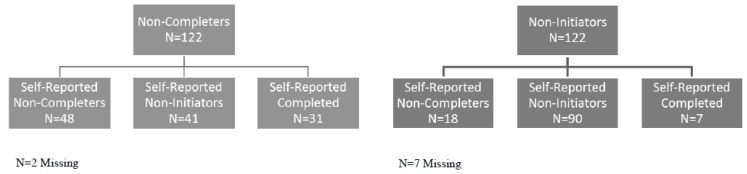
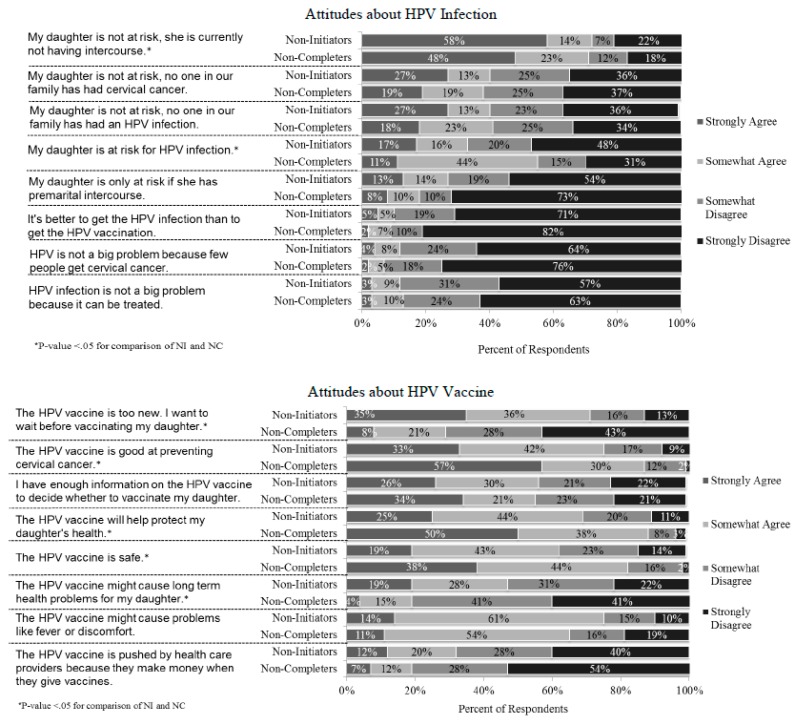
The response rate was 37% (244/660; 140 moved or gone elsewhere; 66% English-speaking, 34% Spanish-speaking). Safety attitudes of NIs and NCs differed, with 40% NIs vs. 14% NC's reporting they thought HPV vaccine was unsafe ( < 0.0001) and 43% NIs vs. 21% NCs that it may cause long-term health problems ( < 0.001). Among NCs, 42% reported they did not know their daughter needed more shots (English-speaking, 20%, Spanish-speaking 52%) and 39% reported that "I wasn't worried about the safety of the HPV vaccine before, but now I am" (English-speaking, 23%, Spanish-speaking, 50%). Items rated as very important among NIs in the decision regarding vaccination included: more information about safety (74%), more information saying it prevents cancer (70%), and if they knew HPV was spread mainly by sexual contact (61%). : Safety concerns, being unaware of the need for multiple doses, and low perceived risk of infection remain significant barriers to HPV vaccination for at-risk adolescents. Some parents' safety concerns do not appear until initial vaccination.
未启动(NI)或未完成(NC) HPV 疫苗系列接种的以少数族裔为主、低收入的青少年女孩的父母,评估他们对促进该系列接种的态度和其他重要因素,以及这些态度是否因语言偏好而有所不同。2013 年 8 月至 10 月,我们从丹佛安全网系统的行政数据中随机选择了 12-15 岁女孩的父母进行了邮件调查;每组(NI 和 NC)目标 400 名父母。调查使用英语或西班牙语进行。
回应率为 37%(244/660;140 人已搬离或失联;66%为英语使用者,34%为西班牙语使用者)。NI 和 NC 的安全态度存在差异,40%的 NI 认为 HPV 疫苗不安全,而 14%的 NC 认为 HPV 疫苗不安全(<0.0001);43%的 NI 认为 HPV 疫苗可能导致长期健康问题,而 21%的 NC 认为 HPV 疫苗可能导致长期健康问题(<0.001)。在 NC 中,42%的人报告说他们不知道女儿需要更多的疫苗接种(英语使用者 20%,西班牙语使用者 52%),39%的人报告说“我以前不担心 HPV 疫苗的安全性,但现在我担心了”(英语使用者 23%,西班牙语使用者 50%)。在决定接种疫苗时,NI 认为非常重要的项目包括:更多关于安全性的信息(74%)、更多关于预防癌症的信息(70%),以及如果他们知道 HPV 主要通过性接触传播(61%)。
对于高危青少年而言,安全问题、不知道需要多剂疫苗接种以及对感染风险的低认知仍然是 HPV 疫苗接种的重大障碍。一些家长的安全担忧在初次接种疫苗时才会出现。