Santos Hudson P, Kossakowski Jolanda J, Schwartz Todd A, Beeber Linda, Fried Eiko I
School of Nursing, University of North Carolina, Chapel Hill, North Carolina, United States of America.
Department of Psychological Methods, University of Amsterdam, Amsterdam, The Netherlands.
PLoS One. 2018 Jan 23;13(1):e0191675. doi: 10.1371/journal.pone.0191675. eCollection 2018.
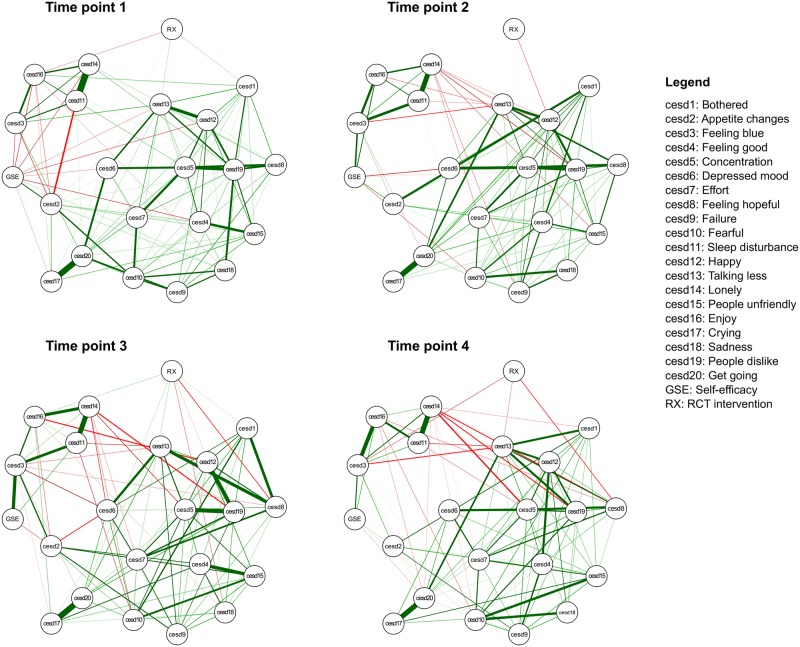
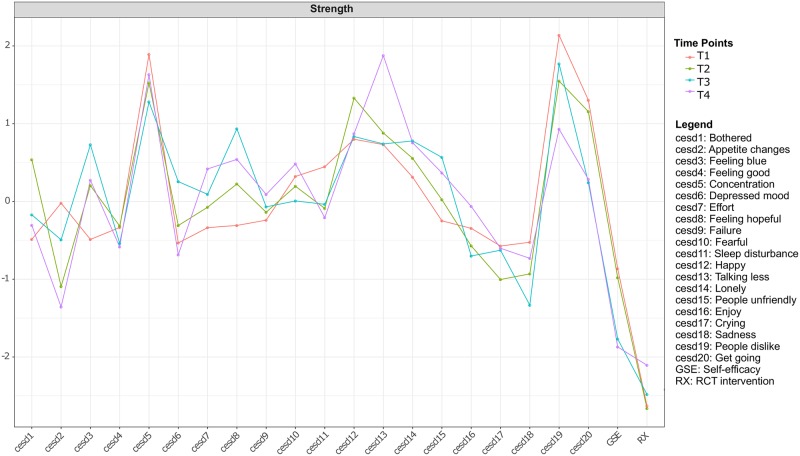
Maternal depression was recently conceptualized as a network of interacting symptoms. Prior studies have shown that low self-efficacy, as an index of maternal functioning, is one important source of stress that worsens depression. We have limited information, however, on the specific relationships between depression symptoms and self-efficacy. In this study, we used regularized partial correlation networks to explore the multivariate relationships between maternal depression symptoms and self-efficacy over time. Depressed mothers (n = 306) completed the Center for Epidemiological Studies Depression (CES-D) scale at four time points, between four and eight weeks apart. We estimated (a) the network structure of the 20 CES-D depression symptoms and self-efficacy for each time point, (b) determined the centrality or structural importance of all variables, and (c) tested whether the network structure changed over time. In the resulting networks, self-efficacy was mostly negatively connected with depression symptoms. The strongest relationships among depression symptoms were 'lonely-sleep difficulties' and 'inability to get going-crying'. 'Feeling disliked' and 'concentration difficulty' were the two most central symptoms. In comparing the network structures, we found that the network structures were moderately stable over time. This is the first study to investigate the network structure and their temporal stability of maternal depression symptoms and self-efficacy in low-income depressed mothers. We discuss how these findings might help future research to identify clinically relevant symptom-to-symptom relationships that could drive maternal depression processes, and potentially inform tailored interventions. We share data and analytical code, making our results fully reproducible.
产后抑郁最近被概念化为一个相互作用症状的网络。先前的研究表明,低自我效能感作为母亲功能的一个指标,是加重抑郁的一个重要压力源。然而,我们对于抑郁症状和自我效能感之间的具体关系了解有限。在本研究中,我们使用正则化偏相关网络来探究产后抑郁症状与自我效能感随时间的多变量关系。患有抑郁症的母亲(n = 306)在四个时间点完成了流行病学研究中心抑郁量表(CES-D),时间间隔为四到八周。我们估计了(a)每个时间点20个CES-D抑郁症状和自我效能感的网络结构,(b)确定了所有变量的中心性或结构重要性,以及(c)测试了网络结构是否随时间变化。在所得的网络中,自我效能感大多与抑郁症状呈负相关。抑郁症状之间最强的关系是“孤独-睡眠困难”和“无法开始-哭泣”。“感觉被讨厌”和“注意力难以集中”是两个最核心的症状。在比较网络结构时,我们发现网络结构随时间有一定程度的稳定性。这是第一项研究低收入抑郁症母亲产后抑郁症状和自我效能感的网络结构及其时间稳定性的研究。我们讨论了这些发现如何可能有助于未来的研究识别可能推动产后抑郁过程的临床相关症状间关系,并有可能为针对性干预提供信息。我们共享数据和分析代码,使我们的结果完全可重复。