Aikawa H, Suzuki K
Am J Pathol. 1986 Feb;122(2):335-42.
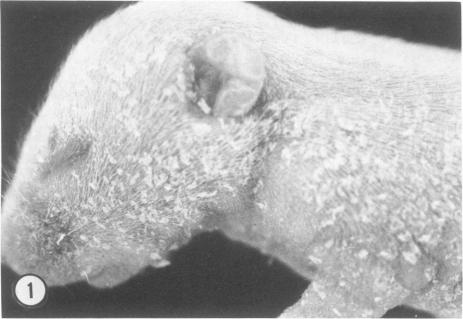
Pellagra in the human is characterized by the clinical "three D's," namely, dermatitis, diarrhea, and dementia. Newborn mice that received a single intraperitoneal injection of 6-aminonicotinamide (6-AN) (50 mg/kg body weight), an antagonist of niacin, consistently developed lesions in the skin, intestinal tract, and central nervous system. Anterior horn cells in the spinal cord as well as motor neurons in the brain showed the ultrastructural features of neuronal chromatolysis, while glial and ependymal cells showed postinjection (PI) edematous changes on Day 5. In the skin, correlating with clinical delay of hair growth, the first discernible microscopic abnormality was vacuolar change in the hair follicles on PI Day 3. By PI Day 5, hyperkeratosis and irregular acanthosis were noted. Edematous swelling of the enteric glial cells was observed in the myenteric plexus of the descending colon on PI Day 5. Although the pathologic features of these 6-AN-treated mice may not be exactly identical to those of human pellagra, possible contributory mechanisms in the development of pellagra lesions may be elucidated by this experimental model.
人类糙皮病的特征为临床“三 D 症状”,即皮炎、腹泻和痴呆。新生小鼠单次腹腔注射烟酰胺拮抗剂 6 - 氨基烟酰胺(6 - AN)(50 毫克/千克体重)后,皮肤、肠道和中枢神经系统持续出现病变。脊髓前角细胞以及大脑中的运动神经元呈现出神经元染色质溶解的超微结构特征,而神经胶质细胞和室管膜细胞在注射后第 5 天出现水肿变化。在皮肤方面,与临床毛发增长延迟相关,注射后第 3 天毛囊中最早可辨别的微观异常是空泡变化。到注射后第 5 天,出现角化过度和不规则棘皮症。在注射后第 5 天,降结肠肌间神经丛中观察到肠神经胶质细胞的水肿肿胀。尽管这些经 6 - AN 处理的小鼠的病理特征可能与人类糙皮病并不完全相同,但该实验模型可能阐明糙皮病病变发展中的潜在促成机制。