Department of Otolaryngology-Head and Neck Surgery, Institute of Otolaryngology, Chinese People's Liberation Army General Hospital, Beijing 100853, China.
Chin Med J (Engl). 2018 Feb 5;131(3):307-315. doi: 10.4103/0366-6999.223843.
Bilateral sudden sensorineural hearing loss (BSSHL) is rare and assumed to be a different clinical entity compared to unilateral SSHL (USSHL). This study examined the differences between the idiopathic BSSHL and USSHL.
Forty-six sequential BSSHL patients (Se-BSSHL) and 68 simultaneous BSSHL (Si-BSSHL) were consecutively admitted between June 2008 and December 2015. Two sets of patients served as control groups: (1) USSHL patients with healthy contralateral ear and (2) USSHL patients with contralateral preexisting hearing loss (USSHLwCHL). We retrospectively analyzed differences among four cohorts using analysis of variance, Kruskal-Wallis test, Welch's t-test, and Chi-square test as appropriate before and after propensity score matching (PSM) based on age, gender, and body mass index (BMI).
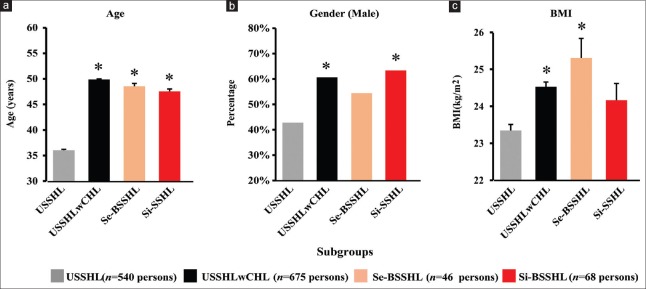
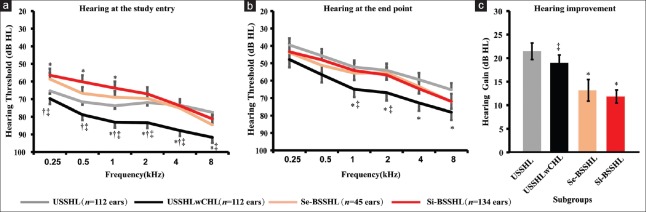
The prevalence of idiopathic BSSHL was 8.6% (114/1329) among the total SSHL patients. In the total cohort, USSHL patients tended to be younger, female, and tended to have lower BMI, renal parameters, and total cholesterol in addition to higher high-density lipoprotein compared to the other three groups. Most routine blood indicators, some coagulation markers, and immunoglobulin M (H = 13.4, P = 0.004) were significantly different among the study groups. After PSM, the major significant differences were found in audiometric characteristics. Si-BSSHL and Se-BSSHL patients demonstrated similar hearing thresholds as USSHL but were significantly better than the USSHLwCHL patients across most frequencies before and after treatment (H = 30.0, P < 0.001 for initial hearing and H = 12.0, P = 0.007 for final hearing). Moreover, the BSSHL patients showed different hearing loss distribution patterns (more descending type, χ2 = 33.8, P = 0.001) with less hearing gain (H = 17.5, P < 0.001) compared to the USSHL patients.
Idiopathic BSSHL is a relatively rare subtype of SSHL with a higher rate of descending audiogram type and inferior hearing outcome rather than being classified as a completely different disease entity compared to USSHL.
双侧突发性聋(Bilateral sudden sensorineural hearing loss,BSSHL)较为罕见,与单侧突发性聋(Unilateral sudden sensorineural hearing loss,USSHL)相比,被认为是一种不同的临床实体。本研究旨在探讨特发性 BSSHL 与 USSHL 之间的差异。
2008 年 6 月至 2015 年 12 月,连续收治了 46 例特发性 BSSHL 患者(单侧发病的 BSSHL,Se-BSSHL)和 68 例同时性 BSSHL 患者(双侧发病的 BSSHL,Si-BSSHL)。这两组患者分别作为对照组:(1)USSHL 患者,对侧耳听力正常;(2)USSHL 患者,对侧耳存在先前听力损失(USSHLwCHL)。在进行倾向评分匹配(propensity score matching,PSM)之前,我们使用方差分析、Kruskal-Wallis 检验、Welch's t 检验和卡方检验等方法,对四组患者的年龄、性别和体重指数(body mass index,BMI)进行了回顾性分析。PSM 后,对各亚组间的差异进行了分析。
在全部突发性聋患者中,特发性 BSSHL 的患病率为 8.6%(114/1329)。在总队列中,USSHL 患者较年轻、女性居多,且 BMI、肾参数和总胆固醇较低,高密度脂蛋白较高。研究组间的大多数常规血液指标、部分凝血标志物和免疫球蛋白 M(H = 13.4,P = 0.004)存在显著差异。PSM 后,在听力特征方面存在主要差异。与 USSHLwCHL 患者相比,Si-BSSHL 和 Se-BSSHL 患者的听力阈值相似,但治疗前后多数频率的听力改善更明显(初始听力:H = 30.0,P < 0.001;最终听力:H = 12.0,P = 0.007)。此外,与 USSHL 患者相比,BSSHL 患者的听力损失分布模式不同(下降型更多,χ2 = 33.8,P = 0.001),听力改善程度较低(H = 17.5,P < 0.001)。
特发性 BSSHL 是一种较为罕见的突发性聋亚型,其听力图类型多呈下降型,听力预后较差,与 USSHL 并非完全不同的疾病实体。