State Key Laboratory of Functional Material for Informatics, Shanghai Institute of Microsystem and Information Technology, Chinese Academy of Sciences, Shanghai, 200050, China.
University of Chinese Academy of Sciences, Beijing, 100049, China.
Sci Rep. 2018 Jan 24;8(1):1486. doi: 10.1038/s41598-018-20035-7.
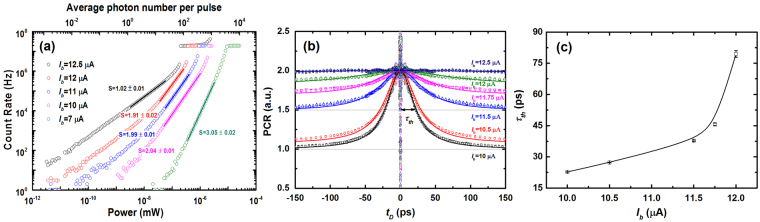
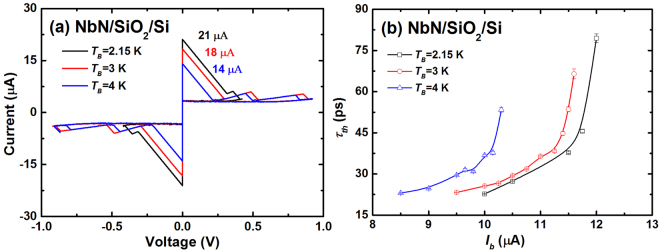
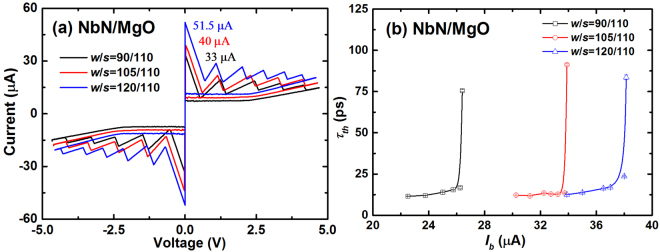
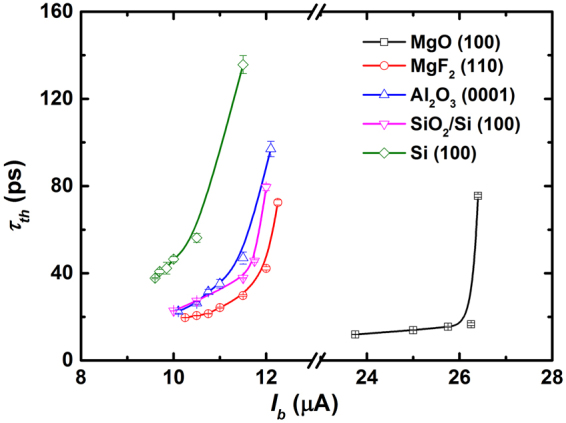
Hotspot relaxation time (τ ) is one of the essential parameter which defines the maximum count rate of superconducting nanowire single-photon detectors (SNSPDs). We studied the τ for NbN-based SNSPDs on various substrates using the two-photon detection method based on the pump-probe spectroscopy technique. We observed that τ strongly increased with increasing bias current in the two-photon detection regime. In addition, the minimum hotspot relaxation time (τ ) was not significantly affected by the bath temperature; this is different from the previous observations reported for WSi SNSPDs. In addition, a strong dependency of (τ ) on the substrate was found. The minimum (τ ) was 11.6 ps for SNSPDs made of 5.5-nm-thick NbN on MgO (100), whereas the maximum (τ ) was 34.5 ps for SNSPDs made of 7.5-nm-thick NbN on Si (100). We presented a direct correlation between the values of τ and degrees of disorder of NbN films grown on different substrates.
热点弛豫时间(τ)是定义超导纳米线单光子探测器(SNSPD)最大计数率的基本参数之一。我们使用基于泵浦-探测光谱技术的双光子探测方法研究了不同衬底上基于 NbN 的 SNSPD 的 τ。我们观察到,在双光子探测区域中,τ随着偏置电流的增加而强烈增加。此外,与之前报道的 WSi SNSPD 相比,热点弛豫时间(τ)的最小值不受浴温的显著影响。此外,还发现(τ)对衬底有很强的依赖性。由 5.5nm 厚的 NbN 在 MgO(100)上制成的 SNSPD 的最小(τ)为 11.6 ps,而由 7.5nm 厚的 NbN 在 Si(100)上制成的 SNSPD 的最大(τ)为 34.5 ps。我们提出了 τ 值与在不同衬底上生长的 NbN 薄膜的无序程度之间的直接相关性。