INSERM, U1099, F-35000, Rennes, France.
Université de Rennes 1, LTSI, F-35000, Rennes, France.
BMC Med Inform Decis Mak. 2018 Jan 24;18(1):9. doi: 10.1186/s12911-018-0586-x.
Medical coding is used for a variety of activities, from observational studies to hospital billing. However, comorbidities tend to be under-reported by medical coders. The aim of this study was to develop an algorithm to detect comorbidities in electronic health records (EHR) by using a clinical data warehouse (CDW) and a knowledge database.
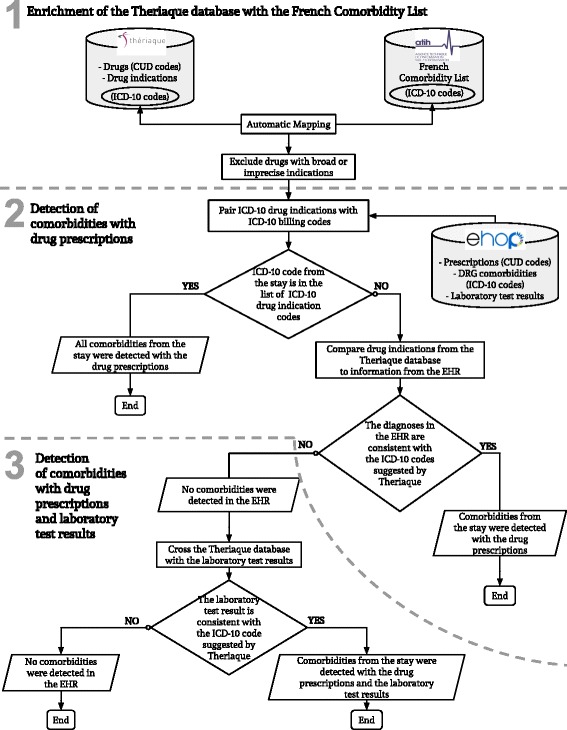
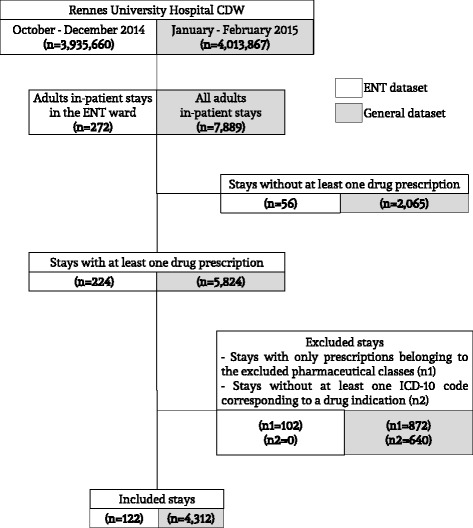
We enriched the Theriaque pharmaceutical database with the French national Comorbidities List to identify drugs associated with at least one major comorbid condition and diagnoses associated with a drug indication. Then, we compared the drug indications in the Theriaque database with the ICD-10 billing codes in EHR to detect potentially missing comorbidities based on drug prescriptions. Finally, we improved comorbidity detection by matching drug prescriptions and laboratory test results. We tested the obtained algorithm by using two retrospective datasets extracted from the Rennes University Hospital (RUH) CDW. The first dataset included all adult patients hospitalized in the ear, nose, throat (ENT) surgical ward between October and December 2014 (ENT dataset). The second included all adult patients hospitalized at RUH between January and February 2015 (general dataset). We reviewed medical records to find written evidence of the suggested comorbidities in current or past stays.
Among the 22,132 Common Units of Dispensation (CUD) codes present in the Theriaque database, 19,970 drugs (90.2%) were associated with one or several ICD-10 diagnoses, based on their indication, and 11,162 (50.4%) with at least one of the 4878 comorbidities from the comorbidity list. Among the 122 patients of the ENT dataset, 75.4% had at least one drug prescription without corresponding ICD-10 code. The comorbidity diagnoses suggested by the algorithm were confirmed in 44.6% of the cases. Among the 4312 patients of the general dataset, 68.4% had at least one drug prescription without corresponding ICD-10 code. The comorbidity diagnoses suggested by the algorithm were confirmed in 20.3% of reviewed cases.
This simple algorithm based on combining accessible and immediately reusable data from knowledge databases, drug prescriptions and laboratory test results can detect comorbidities.
医疗编码用于各种活动,从观察性研究到医院计费。然而,合并症往往被医疗编码员报告不足。本研究的目的是开发一种算法,通过使用临床数据仓库 (CDW) 和知识库来检测电子健康记录 (EHR) 中的合并症。
我们使用法国国家合并症清单丰富了 Theriaque 制药数据库,以识别与至少一种主要合并症相关的药物以及与药物适应证相关的诊断。然后,我们将 Theriaque 数据库中的药物适应证与 EHR 中的 ICD-10 计费代码进行比较,根据药物处方检测潜在的遗漏合并症。最后,我们通过匹配药物处方和实验室检查结果来改进合并症检测。我们使用从雷恩大学医院 (RUH) CDW 提取的两个回顾性数据集来测试获得的算法。第一个数据集包括 2014 年 10 月至 12 月期间住院在耳鼻喉 (ENT) 外科病房的所有成年患者(ENT 数据集)。第二个数据集包括 2015 年 1 月至 2 月期间住院在 RUH 的所有成年患者(一般数据集)。我们审查了病历,以寻找当前或过去住院期间建议合并症的书面证据。
在 Theriaque 数据库中存在的 22,132 个常见配药单位 (CUD) 代码中,根据其适应证,19,970 种药物(90.2%)与一个或多个 ICD-10 诊断相关,11,162 种(50.4%)与 4878 种合并症清单中的至少一种相关。在 ENT 数据集的 122 名患者中,75.4%的患者至少有一种没有相应 ICD-10 代码的药物处方。该算法建议的合并症诊断在 44.6%的病例中得到证实。在一般数据集的 4312 名患者中,68.4%的患者至少有一种没有相应 ICD-10 代码的药物处方。该算法建议的合并症诊断在 20.3%的审查病例中得到证实。
该算法基于结合来自知识库、药物处方和实验室检查结果的可访问且可立即重复使用的数据,简单易用,可以检测合并症。