Department of Molecular and Integrative Physiology, University of Michigan, Ann Arbor, Michigan 48109-2200, USA.
Institute of Gerontology, University of Michigan, Ann Arbor, Michigan 48109-2200, USA.
Mol Cells. 2018 Jan 31;41(1):3-10. doi: 10.14348/molcells.2018.2213. Epub 2018 Jan 23.
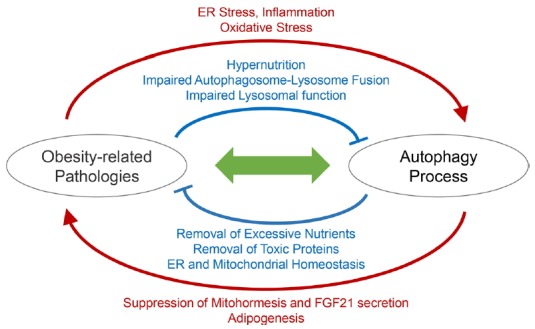
Autophagy is one of the major degradative mechanisms that can eliminate excessive nutrients, toxic protein aggregates, damaged organelles and invading microorganisms. In response to obesity and obesity-associated lipotoxic, proteotoxic and oxidative stresses, autophagy plays an essential role in maintaining physiological homeostasis. However, obesity and its associated stress insults can often interfere with the autophagic process through various mechanisms, which result in further aggravation of obesity-related metabolic pathologies in multiple metabolic organs. Paradoxically, inhibition of autophagy, within specific contexts, indirectly produces beneficial effects that can alleviate several detrimental consequences of obesity. In this minireview, we will provide a brief discussion about our current understanding of the impact of obesity on autophagy and the role of autophagy dysregulation in modulating obesity-associated pathological outcomes.
自噬是一种主要的降解机制,可以清除过多的营养物质、有毒的蛋白质聚集体、受损的细胞器和入侵的微生物。在应对肥胖和肥胖相关的脂毒性、毒性蛋白和氧化应激时,自噬在维持生理内稳态方面起着至关重要的作用。然而,肥胖及其相关的应激损伤通常可以通过多种机制干扰自噬过程,从而导致多种代谢器官中与肥胖相关的代谢病理进一步恶化。矛盾的是,在特定情况下抑制自噬会间接产生有益的效果,可以减轻肥胖的一些不利后果。在这篇小综述中,我们将简要讨论肥胖对自噬的影响,以及自噬失调在调节肥胖相关病理结果中的作用。