Makerere University College of Health Sciences (MakCHS), Kampala, Uganda.
Radiology Department of Mulago Hospital, Lecturer at MakCHS, Kampala, Uganda.
AIDS Res Ther. 2018 Jan 25;15(1):3. doi: 10.1186/s12981-018-0191-1.
Deep venous thrombosis (DVT) and its major complication pulmonary embolism (PE) are collectively known as venous thromboembolism. In Uganda, the prevalence of DVT among HIV patients has not been previously published. The aim of the study was to determine the prevalence and sonographic features of lower limb deep venous thrombosis among HIV positive patients on anti-retroviral treatment (ART).
This was a cross sectional study in which HIV positive patients on ART were recruited from an out-patient HIV clinic at Mulago National Referral Hospital. Patients were randomly selected and enrolled until a sample size of 384 was reached. Study participants underwent compression and Doppler ultrasound studies of both lower limb deep veins using Medison Sonoacer7 ultrasound machine.
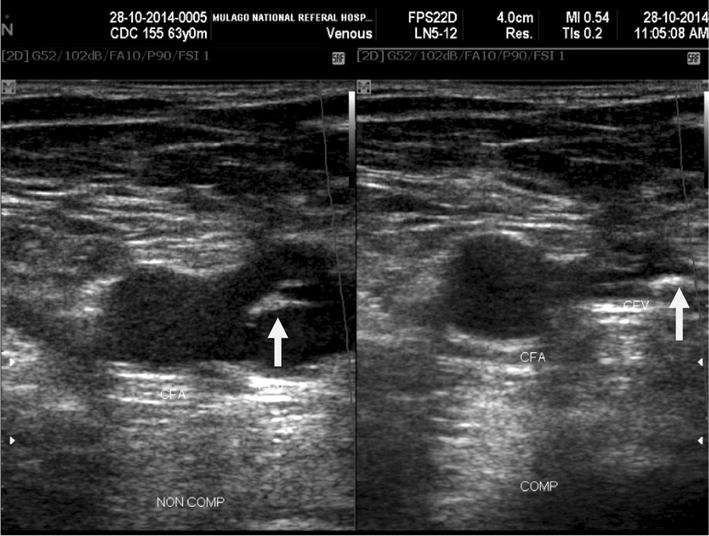
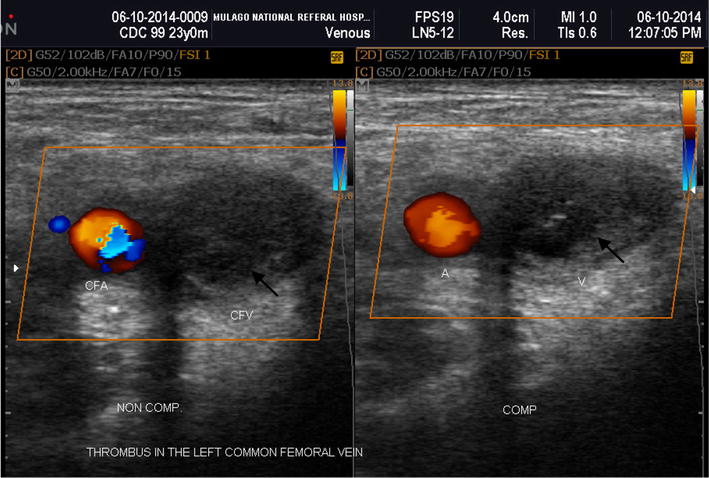
We found a prevalence of DVT of 9.1% (35 of 384 participants) among HIV patients on ART. The prevalence of latent (asymptomatic) DVT was 2.3%. Among 35 patients with DVT, 42.8% had chronic DVT; 31.1% had acute DVT and the rest had latent DVT. Among the risk factors, the odds of occurrence of DVT among patients with prolonged immobility were 4.81 times as high as in those with no prolonged immobility (p = 0.023; OR = 4.81; 95% CI 1.25-18.62). Treatment with second line anti-retroviral therapy (ART) including protease inhibitors (PIs) was associated with higher odds of DVT occurrence compared with first line ART (p = 0.020; OR = 2.38; 95% CI 1.14-4.97). The odds of DVT occurrence in patients with a lower CD4 count (< 200 cells/µl) were 5.36 times as high as in patients with CD4 counts above 500 cells/µl (p = 0.008). About 48.6% patients with DVT had a low risk according to Well's score.
DVT was shown in nearly 10% of HIV patients attending an out-patient clinic in an urban setting in Uganda. Risk factors included protease inhibitors in their ART regimen, prolonged immobility, and low CD4 count (< 200 cells/µl). Clinicians should have a low threshold for performing lower limb Doppler ultrasound scan examination on infected HIV patients on ART who are symptomatic for DVT. Therefore, clinicians should consider anti-coagulant prophylaxis and lower deep venous ultrasound screening of patients who are on second line ART regimen with low CD4 cell counts and/or with prolonged immobility or hormonal contraception.
深静脉血栓(DVT)及其主要并发症肺栓塞(PE)统称为静脉血栓栓塞症。在乌干达,HIV 患者的 DVT 患病率尚未公布。本研究的目的是确定接受抗逆转录病毒治疗(ART)的 HIV 阳性患者下肢深静脉血栓形成的患病率和超声特征。
这是一项横断面研究,在乌干达首都坎帕拉的穆拉戈国家转诊医院的门诊 HIV 诊所招募接受 ART 的 HIV 阳性患者。随机选择患者并招募,直到达到 384 名参与者的样本量。研究参与者使用 Medison Sonoacer7 超声机对双侧下肢深静脉进行压缩和多普勒超声检查。
我们发现,接受 ART 的 HIV 患者中 DVT 的患病率为 9.1%(35/384 名参与者)。潜伏(无症状)DVT 的患病率为 2.3%。在 35 名 DVT 患者中,42.8%为慢性 DVT;31.1%为急性 DVT,其余为潜伏 DVT。在危险因素中,与无长时间不动相比,长时间不动患者发生 DVT 的几率高 4.81 倍(p=0.023;OR=4.81;95%CI 1.25-18.62)。与一线 ART 相比,使用二线抗逆转录病毒治疗(ART)包括蛋白酶抑制剂(PI)治疗与更高的 DVT 发生几率相关(p=0.020;OR=2.38;95%CI 1.14-4.97)。CD4 计数<200 个/µl 的患者发生 DVT 的几率是 CD4 计数>500 个/µl 的患者的 5.36 倍(p=0.008)。根据 Wells 评分,约 48.6%的 DVT 患者为低危。
在乌干达城市地区的门诊诊所中,近 10%的 HIV 患者患有 DVT。危险因素包括 ART 方案中使用蛋白酶抑制剂、长时间不动和低 CD4 计数(<200 个/µl)。对于有症状的 DVT 感染 HIV 的 ART 患者,临床医生应降低进行下肢多普勒超声检查的门槛。因此,对于接受二线 ART 方案治疗、CD4 细胞计数低和/或长时间不动或激素避孕的患者,应考虑抗凝预防和下肢深静脉超声筛查。