Huang Chi-Ping, Chen Chi-Cheng, Shyr Chih-Rong
1Department of Urology, Graduate Institute of Clinical Medical Science, China Medical University and Hospital, 40454, Taichung, Taiwan.
2Department of Urology, Taichung Tzu Chi Hospital, Buddhist Tzu Chi Medical Foundation, Taichung 404, Taiwan.
Cancer Cell Int. 2018 Jan 16;18:9. doi: 10.1186/s12935-018-0501-7. eCollection 2018.
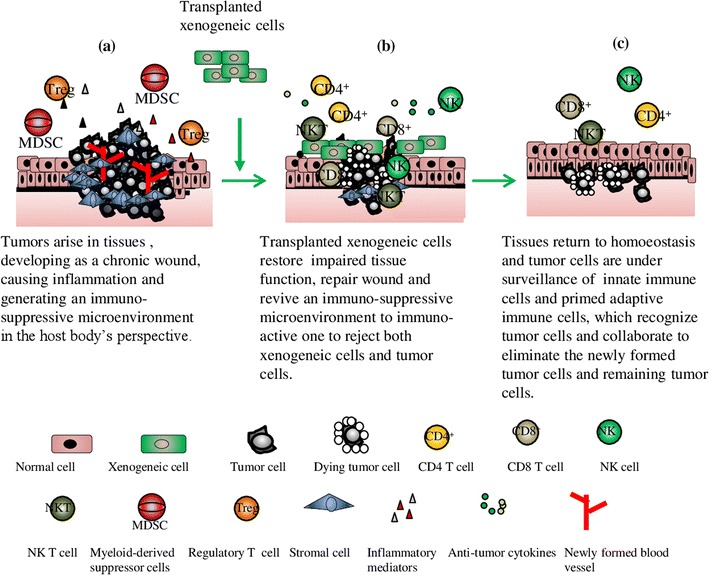
Conventional cancer treatments such as surgery, radiotherapy, chemotherapy and targeted therapy, not only destruct tumors, but also injure the normal tissues, resulting in limited efficacy. Recent advances in cancer therapy have aimed at changing the host milieu of cancer against its development and progression by targeting tumor microenvironment and host immune system to eradicate tumors. To the host body, tumors arise in tissues. They impair the normal healthy tissue physiological function, become chronically inflamed and develop non-healing or overhealing wounds as well as drive immuno-suppressive activity to escape immunity attack. Therefore, the rational therapeutic strategies for cancers should treat both the tumors and the host body for the best efficacy to turn the deadly malignant disease to a manageable one. Xenogeneic cell therapy (i.e. cellular xenotransplantation) using cells from non-human source animals such as pigs has shown promising results in animal studies and clinical xenotransplantation in restoring lost tissue physiological function and repairing the wound. However, the major hurdle of xenogeneic cell therapy is the host immunological barriers that are induced by transplanted xenogeneic cells to reject xenografts. Possibly, the immunological barriers of xenogeneic cells could be used as immunological boosters to activate the host immune system. Here, we hypothesized that because of the biological properties of xenogeneic cells to the recipient humans, the transplantation of xenogeneic cells (i.e. cellular xenotransplantation) into cancer patients' organs of the same origin with developed tumors may restore the impaired function of organs, repair the wound, reduce chronic inflammation and revive the anti-tumor immunity to achieve beneficial outcome for patients.
传统的癌症治疗方法,如手术、放疗、化疗和靶向治疗,不仅会破坏肿瘤,还会损伤正常组织,导致疗效有限。癌症治疗的最新进展旨在通过靶向肿瘤微环境和宿主免疫系统来改变癌症的宿主环境,以对抗其发展和进展,从而根除肿瘤。对宿主身体而言,肿瘤发生在组织中。它们损害正常健康组织的生理功能,引发慢性炎症,形成不愈合或过度愈合的伤口,并驱动免疫抑制活动以逃避免疫攻击。因此,合理的癌症治疗策略应同时治疗肿瘤和宿主身体,以获得最佳疗效,将致命的恶性疾病转变为可控制的疾病。使用来自非人类源动物(如猪)的细胞进行的异种细胞治疗(即细胞异种移植)在动物研究和临床异种移植中已显示出在恢复受损组织生理功能和修复伤口方面取得了有前景的结果。然而,异种细胞治疗的主要障碍是移植的异种细胞诱导宿主产生免疫屏障以排斥异种移植物。异种细胞的免疫屏障可能可以用作免疫增强剂来激活宿主免疫系统。在此,我们假设,由于异种细胞对受体人类的生物学特性,将异种细胞(即细胞异种移植)移植到患有肿瘤的癌症患者的同源器官中,可能会恢复器官受损的功能,修复伤口,减轻慢性炎症并恢复抗肿瘤免疫力,从而为患者带来有益的结果。