Frenzel Elrike, Legebeke Jelmer, van Stralen Atze, van Kranenburg Richard, Kuipers Oscar P
1Department of Molecular Genetics, Groningen Biomolecular Sciences and Biotechnology Institute, Centre for Synthetic Biology, University of Groningen, Nijenborgh 7, 9747 AG Groningen, The Netherlands.
2Laboratory of Microbiology, Wageningen University, Stippeneng 4, 6708 WE Wageningen, The Netherlands.
Biotechnol Biofuels. 2018 Jan 17;11:8. doi: 10.1186/s13068-017-1008-5. eCollection 2018.
Fluorescent reporter proteins (FP) have become an indispensable tool for the optimization of microbial cell factories and in synthetic biology per se. The applicability of the currently available FPs is, however, constrained by species-dependent performance and misfolding at elevated temperatures. To obtain functional reporters for thermophilic, biotechnologically important bacteria such as , an in vivo screening approach based on a mutational library of superfolder GFP was applied.
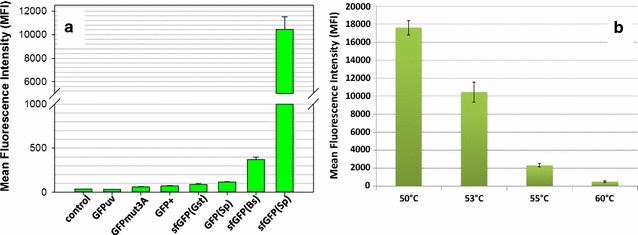
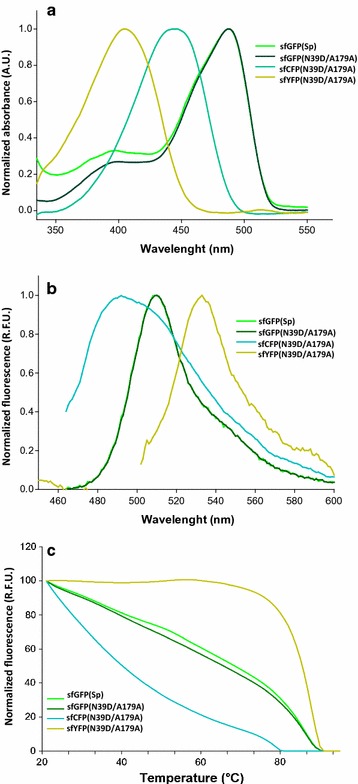
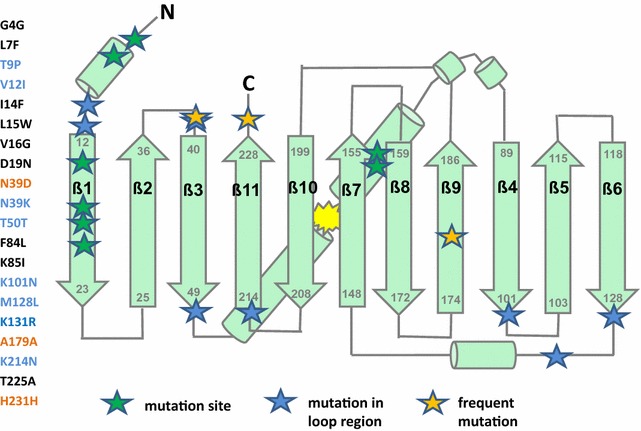
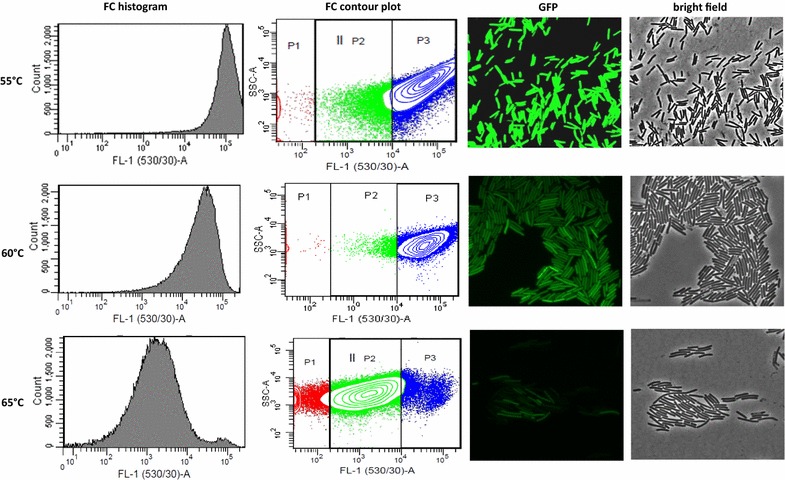
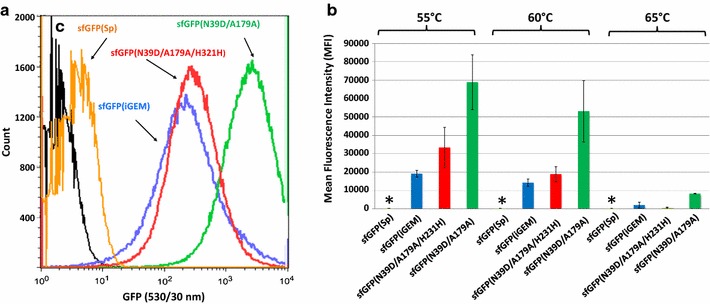
Flow cytometry-based benchmarking of a set of GFPs, sfGFPs and species-specific codon-optimized variants revealed that none of the proteins was satisfyingly detectable in at its optimal growth temperature of 60 °C. An undirected mutagenesis approach coupled to fluorescence-activated cell sorting allowed the isolation of sfGFP variants that were extremely well expressed in the chassis background at 60 °C. Notably, a few nucleotide substitutions, including silent mutations, significantly improved the functionality and brightness. The best mutant sfGFP(N39D/A179A) showed an 885-fold enhanced mean fluorescence intensity (MFI) at 60 °C and is the most reliable reporter protein with respect to cell-to-cell variation and signal intensity reported so far. The in vitro spectral and thermostability properties were unaltered as compared to the parental sfGFP protein, strongly indicating that the combination of the amino acid exchange and an altered translation or folding speed, or protection from degradation, contribute to the strongly improved in vivo performance. Furthermore, sfGFP(N39D/A179A) and the newly developed cyan and yellow derivatives were successfully used for labeling several industrially relevant thermophilic bacilli, thus proving their broad applicability.
This study illustrates the power of in vivo isolation of thermostable proteins to obtain reporters for highly efficient fluorescence labeling. Successful expression in a variety of thermophilic bacteria proved that the novel FPs are highly suitable for imaging and flow cytometry-based studies. This enables a reliable cell tracking and single-cell-based real-time monitoring of biological processes that are of industrial and biotechnological interest.
荧光报告蛋白(FP)已成为优化微生物细胞工厂及合成生物学本身不可或缺的工具。然而,目前可用的荧光报告蛋白的适用性受到物种依赖性性能以及高温下错误折叠的限制。为了获得适用于嗜热的、具有重要生物技术意义的细菌(如 )的功能性报告蛋白,采用了基于超级折叠绿色荧光蛋白(superfolder GFP)突变文库的体内筛选方法。
基于流式细胞术对一组绿色荧光蛋白(GFP)、超级折叠绿色荧光蛋白(sfGFP)和物种特异性密码子优化变体进行的基准测试表明,在其60°C的最佳生长温度下,没有一种蛋白在 中能被令人满意地检测到。一种与荧光激活细胞分选相结合的无向诱变方法使得能够分离出在60°C底盘背景中表达极其良好的sfGFP变体。值得注意的是,一些核苷酸替换,包括沉默突变,显著改善了功能性和亮度。最佳突变体sfGFP(N39D/A179A)在60°C时平均荧光强度(MFI)增强了885倍,是迄今为止报道的关于细胞间变异和信号强度方面最可靠的报告蛋白。与亲本sfGFP蛋白相比,其体外光谱和热稳定性特性未改变,这有力地表明氨基酸交换与翻译或折叠速度改变,或防止降解相结合,有助于体内性能的大幅改善。此外,sfGFP(N39D/A179A)以及新开发的青色和黄色衍生物成功用于标记几种与工业相关的嗜热芽孢杆菌,从而证明了它们的广泛适用性。
本研究说明了体内分离耐热蛋白以获得用于高效荧光标记的报告蛋白的能力。在多种嗜热细菌中的成功表达证明了新型荧光报告蛋白非常适合基于成像和流式细胞术的研究。这使得能够对具有工业和生物技术意义的生物过程进行可靠的细胞追踪和基于单细胞的实时监测。