Cárdenas César A, González-Aravena Marcelo, Santibañez Pamela A
Departamento Científico, Instituto Antártico Chileno, Punta Arenas, Chile.
PeerJ. 2018 Jan 18;6:e4289. doi: 10.7717/peerj.4289. eCollection 2018.
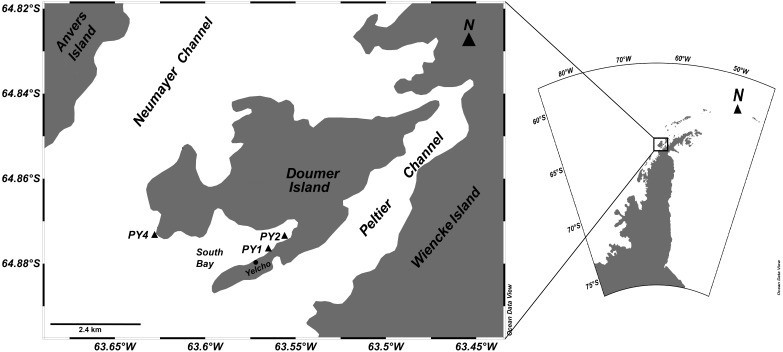
The Western Antarctic Peninsula (WAP) has undergone significant changes in air and seawater temperatures during the last 50 years. Although highly stenotherm Antarctic organisms are expected to be severely affected by the increase of seawater temperature, high-resolution datasets of seawater temperature within coastal areas of the WAP (where diverse marine communities have been reported) are not commonly available. Here we report on within-year (2016-2017) variation in seawater temperature at three sites on Doumer Island, Palmer Archipelago, WAP. Within a year, Antarctic organisms in South Bay were exposed to water temperatures in excess of 2 °C for more than 25 days and 2.5 °C for more than 10 days. We recorded a temperature range between -1.7° to 3.0 °C. Warming of seawater temperature was 3.75 times faster after October 2016 than it was before October. Results from this study indicate that organisms at South Bay are already exposed to temperatures that are being used in experimental studies to evaluate physiological responses to thermal stress in WAP organisms. Continuous measurements of short to long-term variability in seawater temperature provides important information for parametrizing meaningful experimental treatments that aim to assess the local effects of environmental variation on Antarctic organisms under future climate scenarios.
在过去50年里,南极半岛西部(WAP)的空气和海水温度发生了显著变化。尽管预计对温度变化高度敏感的南极生物会受到海水温度上升的严重影响,但WAP沿海地区(据报道有多样化的海洋群落)的高分辨率海水温度数据集并不常见。在此,我们报告了2016 - 2017年期间WAP帕尔默群岛杜默尔岛三个地点的海水温度年内变化情况。在一年时间里,南湾的南极生物暴露于超过2°C的水温中达25天以上,暴露于超过2.5°C的水温中达10天以上。我们记录到的温度范围在 - 1.7°至3.0°C之间。2016年10月之后海水温度的变暖速度比10月之前快3.75倍。这项研究的结果表明,南湾的生物已经暴露在实验研究中用于评估WAP生物对热应激生理反应的温度之下。对海水温度短期到长期变化的持续测量为设定有意义的实验处理参数提供了重要信息,这些实验旨在评估未来气候情景下环境变化对南极生物的局部影响。