Khan Waqar, Khan Fasihullah, Ajmal Hafiz Muhammad Salman, Huda Noor Ul, Kim Ji Hyun, Kim Sam-Dong
Division of Electronics and Electrical Engineering, Dongguk University, Seoul 100-715, Korea.
School of Advanced Materials Science and Engineering, Sungkyunkwan University, Suwon-Si, Gyeonggi-Do 16419, Korea.
Nanomaterials (Basel). 2018 Jan 26;8(2):68. doi: 10.3390/nano8020068.
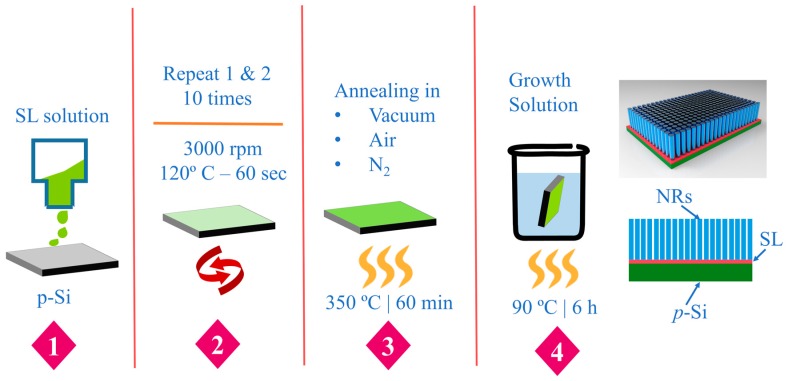
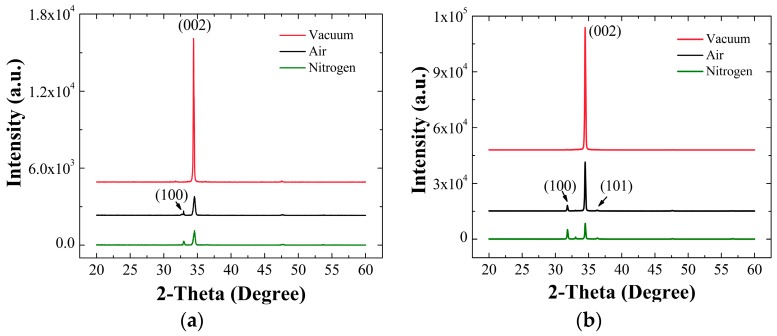
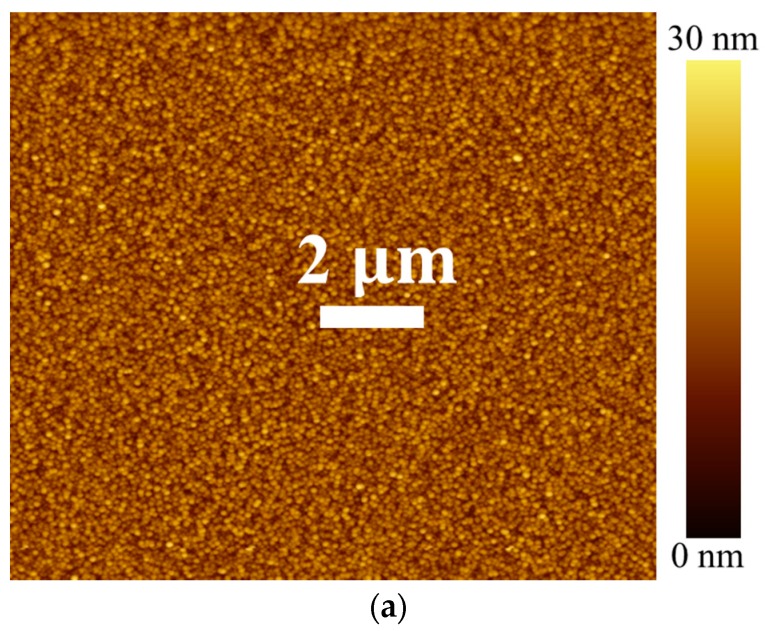
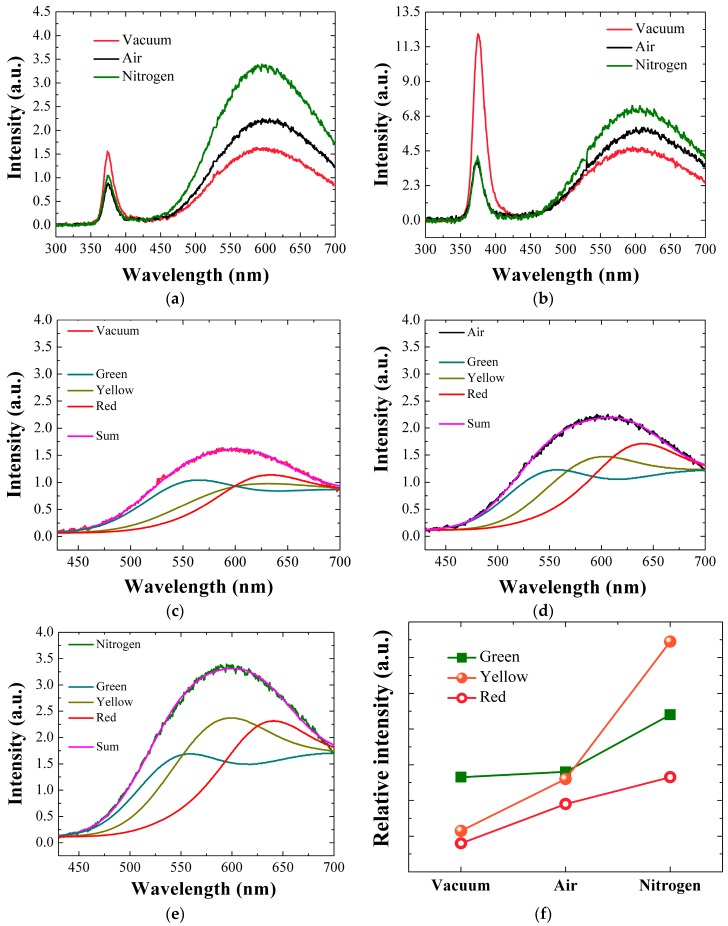
In this study, the ambient condition for the as-coated seed layer (SL) annealing at 350 °C is varied from air or nitrogen to vacuum to examine the evolution of structural and optical properties of ZnO nanorods (NRs). The NR crystals of high surface density (240 rods/μm²) and aspect ratio (20.3) show greatly enhanced (002) degree of orientation and crystalline quality, when grown on the SLs annealed in vacuum, compared to those annealed in air or nitrogen ambient. This is due to the vacuum-annealed SL crystals of a highly preferred orientation toward (002) and large grain sizes. X-ray photoelectron spectroscopy also reveals that the highest O/Zn atomic ratio of 0.89 is obtained in the case of vacuum-annealed SL crystals, which is due to the effective desorption of hydroxyl groups and other contaminants adsorbed on the surface formed during aqueous solution-based growth process. Near band edge emission (ultra violet range of 360-400 nm) of the vacuum-annealed SLs is also enhanced by 44% and 33% as compared to those annealed in air and nitrogen ambient, respectively, in photoluminescence with significant suppression of visible light emission associated with deep level transition. Due to this improvement of SL optical crystalline quality, the NR crystals grown on the vacuum-annealed SLs produce ~3 times higher ultra violet emission intensity than the other samples. In summary, it is shown that the ZnO NRs preferentially grow along the wurtzite c-axis direction, thereby producing the high crystalline quality of nanostructures when they grow on the vacuum-annealed SLs of high crystalline quality with minimized impurities and excellent preferred orientation. The ZnO nanostructures of high crystalline quality achieved in this study can be utilized for a wide range of potential device applications such as laser diodes, light-emitting diodes, piezoelectric transducers and generators, gas sensors, and ultraviolet detectors.
在本研究中,将涂覆后的籽晶层(SL)在350℃退火时的环境条件从空气或氮气改为真空,以研究ZnO纳米棒(NRs)的结构和光学性质的演变。与在空气或氮气环境中退火的籽晶层上生长的纳米棒相比,在真空中退火的籽晶层上生长的具有高表面密度(约240根/μm²)和纵横比(约20.3)的纳米棒晶体显示出(002)取向度和晶体质量大大提高。这是由于真空退火的籽晶层晶体具有高度优先的(002)取向和大晶粒尺寸。X射线光电子能谱还表明,在真空退火的籽晶层晶体中获得了最高的O/Zn原子比0.89,这是由于在基于水溶液的生长过程中吸附在表面的羟基和其他污染物的有效解吸。与在空气和氮气环境中退火的籽晶层相比,真空退火的籽晶层的近带边发射(360 - 400 nm的紫外范围)在光致发光中也分别增强了44%和33%,同时显著抑制了与深能级跃迁相关的可见光发射。由于籽晶层光学晶体质量的这种改善,在真空退火的籽晶层上生长的纳米棒晶体产生的紫外发射强度比其他样品高约3倍。总之,结果表明,ZnO纳米棒优先沿纤锌矿c轴方向生长,因此当它们在具有最小杂质和优异择优取向的高晶体质量的真空退火籽晶层上生长时,会产生高晶体质量的纳米结构。本研究中获得的高晶体质量的ZnO纳米结构可用于广泛的潜在器件应用,如激光二极管、发光二极管、压电换能器和发电机、气体传感器以及紫外探测器。