Lashmanova Ekaterina, Zemskaya Nadezhda, Proshkina Ekaterina, Kudryavtseva Anna, Volosnikova Marina, Marusich Elena, Leonov Sergey, Zhavoronkov Alex, Moskalev Alexey
Department of Biological and Medical Physics, Moscow Institute of Physics and Technology, Dolgoprudny, Russia.
Institute of Biology, Komi Scientific Center of Ural Branch of RAS, Syktyvkar, Russia.
Front Pharmacol. 2017 Dec 7;8:884. doi: 10.3389/fphar.2017.00884. eCollection 2017.
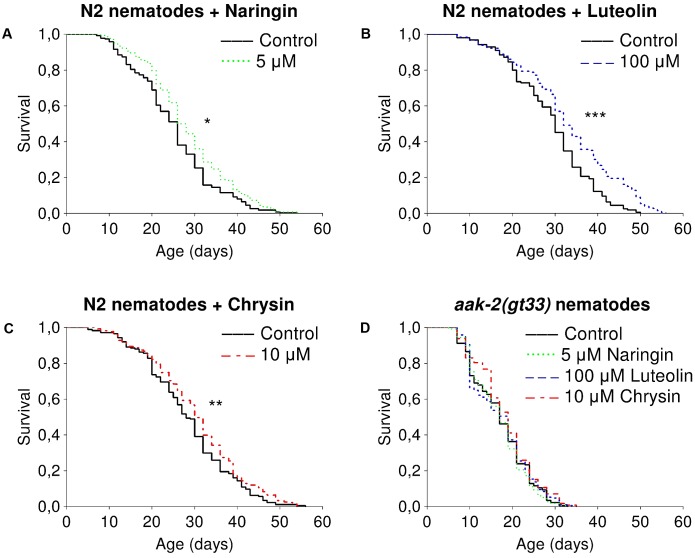
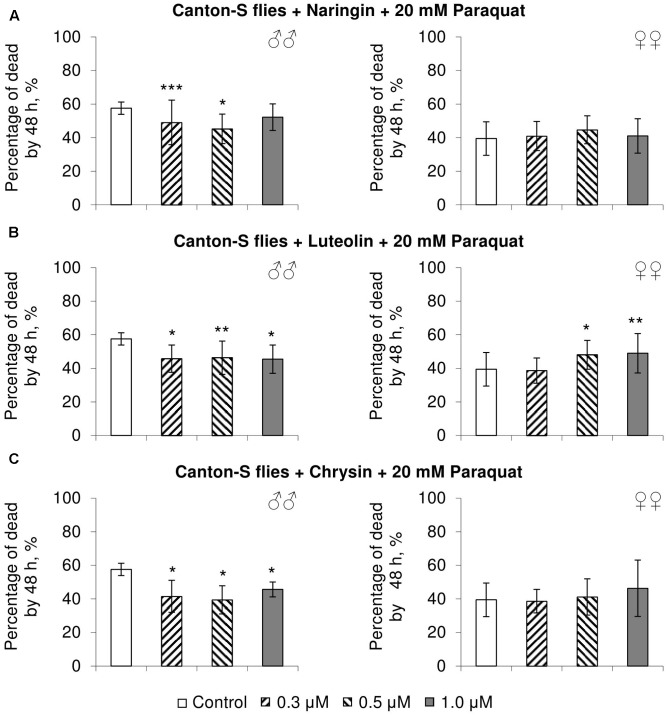
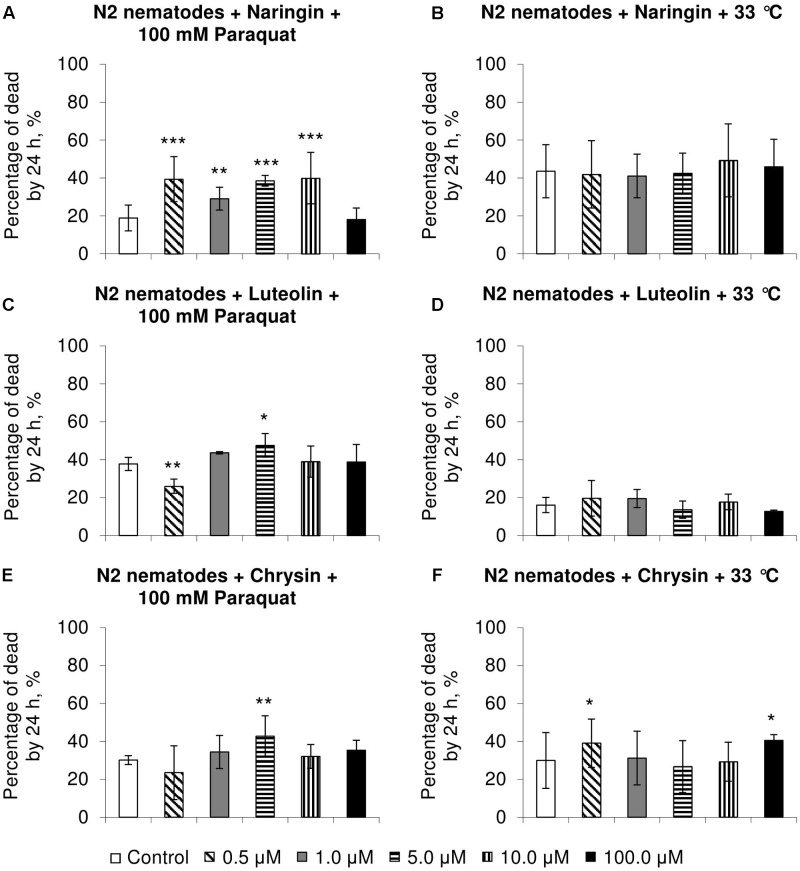
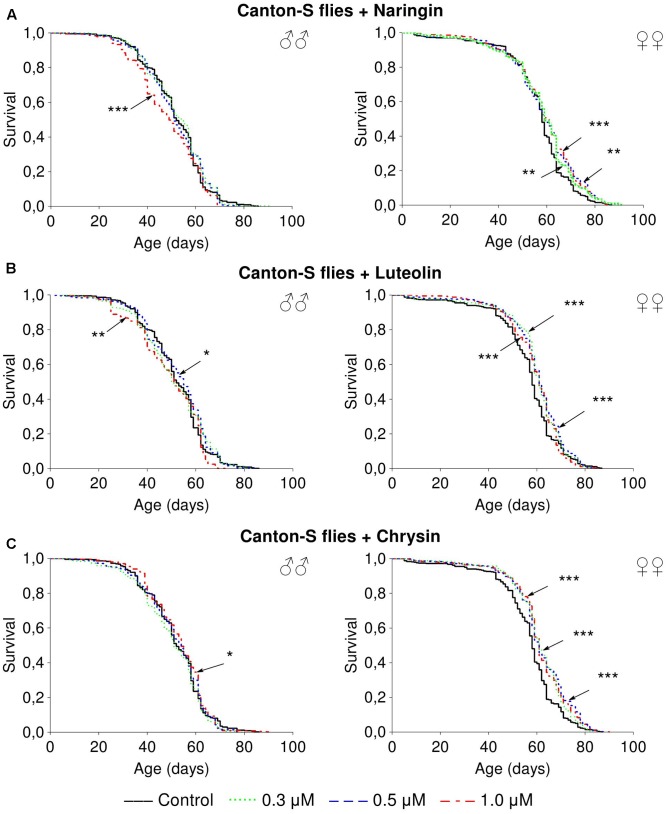
Flavonoids is an intensively studied group of natural compounds with antioxidant, antineoplastic, antihyperglycemic, cardioprotective, and neuroprotective properties. The present study intends to investigate the geroprotective action of three selected flavonoids (naringin, luteolin, chrysin) in two model organisms, and . Luteolin and chrysin were shown to improve lifespan parameters when administered to both model organisms. The observed positive effects of these flavonoids in were limited to females and were not associated with reduced fecundity or locomotor impairment. The life-extending effects of flavonoids were observed in N2 wild-type worms but absent in mutants implying that these effects can be associated with AMP-activated protein kinase activity. Naringin improved lifespan parameters of , but had no effect on females; in some cases, naringin was found to decrease the lifespan of males. Compared to chrysin and luteolin, however, naringin more effectively activates Nrf2 target genes (particularly, ) under oxidative stress. Then we compared molecular mechanisms of studied compounds and a well-known geroprotector rapamycin, using software tool GeroScope. There are no transcriptomic data on luteolin or chrysin provided by LINCS Project database. The bioinformatics comparison of transcriptomics data for A549 and MCF7 human cell lines treated with rapamycin or naringin revealed that these compounds share just a few common signaling pathways and quite distinct in their geroprotective action. Thus, based on effects of naringin, luteolin, chrysin on lifespan we have revealed new potential geroprotectors.
黄酮类化合物是一类经过深入研究的天然化合物,具有抗氧化、抗肿瘤、抗高血糖、心脏保护和神经保护特性。本研究旨在研究三种选定的黄酮类化合物(柚皮苷、木犀草素、白杨素)在两种模式生物中的老年保护作用。木犀草素和白杨素在给予两种模式生物时均显示出可改善寿命参数。这些黄酮类化合物在[具体生物1]中观察到的积极作用仅限于雌性,且与繁殖力降低或运动功能障碍无关。在N2野生型蠕虫中观察到黄酮类化合物的寿命延长作用,但在[具体生物2]突变体中未观察到,这意味着这些作用可能与AMP激活的蛋白激酶活性有关。柚皮苷改善了[具体生物1]的寿命参数,但对[具体生物2]雌性没有影响;在某些情况下,发现柚皮苷会缩短雄性的寿命。然而,与白杨素和木犀草素相比,柚皮苷在氧化应激下更有效地激活Nrf2靶基因(特别是[具体基因])。然后,我们使用软件工具GeroScope比较了所研究化合物与著名的老年保护剂雷帕霉素的分子机制。LINCS项目数据库未提供关于木犀草素或白杨素的转录组数据。对用雷帕霉素或柚皮苷处理的A549和MCF7人细胞系的转录组数据进行生物信息学比较发现,这些化合物仅共享少数共同的信号通路,并且在其老年保护作用方面有很大不同。因此,基于柚皮苷、木犀草素、白杨素对寿命的影响,我们发现了新的潜在老年保护剂。