Jocken Johan W E, González Hernández Manuel A, Hoebers Nicole T H, van der Beek Christina M, Essers Yvonne P G, Blaak Ellen E, Canfora Emanuel E
Department of Human Biology, NUTRIM School of Nutrition and Translational Research in Metabolism, Maastricht University Medical Centre+, Maastricht, Netherlands.
Top Institute Food and Nutrition, Wageningen, Netherlands.
Front Endocrinol (Lausanne). 2018 Jan 11;8:372. doi: 10.3389/fendo.2017.00372. eCollection 2017.
Gut-derived short-chain fatty acids (SCFA), formed by microbial fermentation of dietary fibers, are believed to be involved in the etiology of obesity and diabetes. Previous data from our group showed that colonic infusions of physiologically relevant SCFA mixtures attenuated whole-body lipolysis in overweight men. To further study potential mechanisms involved in the antilipolytic properties of SCFA, we aimed to investigate the effects of SCFA incubations on intracellular lipolysis and signaling using a human white adipocyte model, the human multipotent adipose tissue-derived stem (hMADS) cells.
hMADS adipocytes were incubated with mixtures of acetate, propionate, and butyrate or single SCFA (acetate, propionate and butyrate) in concentrations ranging between 1 µmol/L and 1 mmol/L. Glycerol release and lipase activation was investigated during basal conditions and following β-adrenergic stimulation.
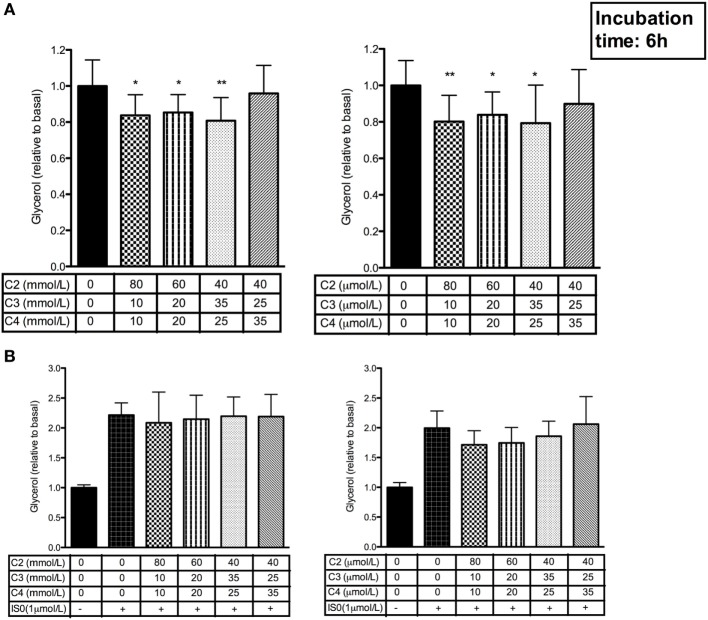
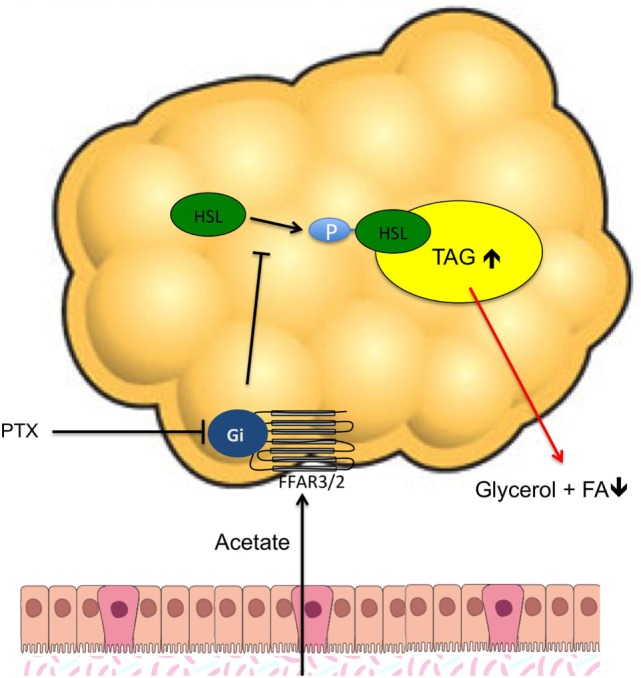
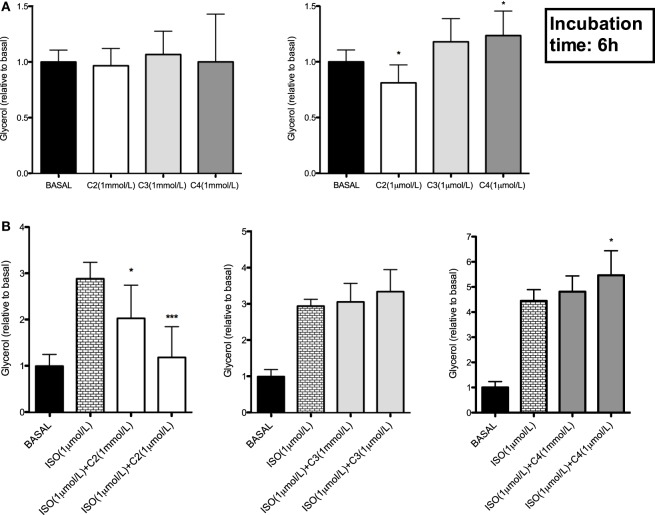
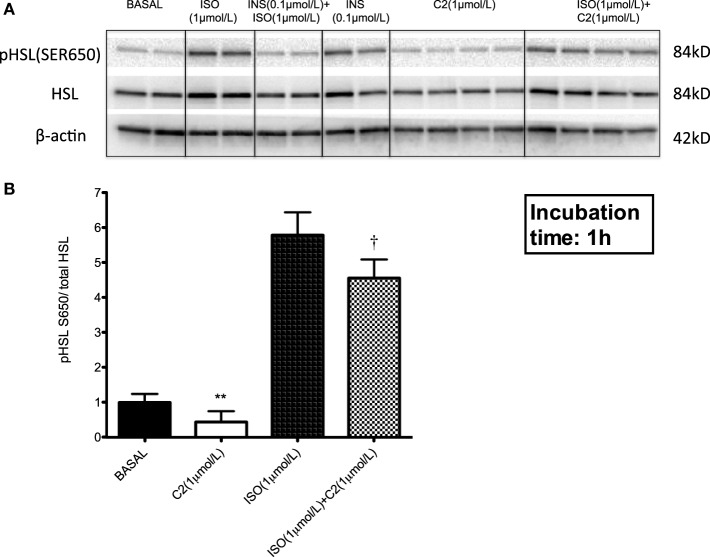
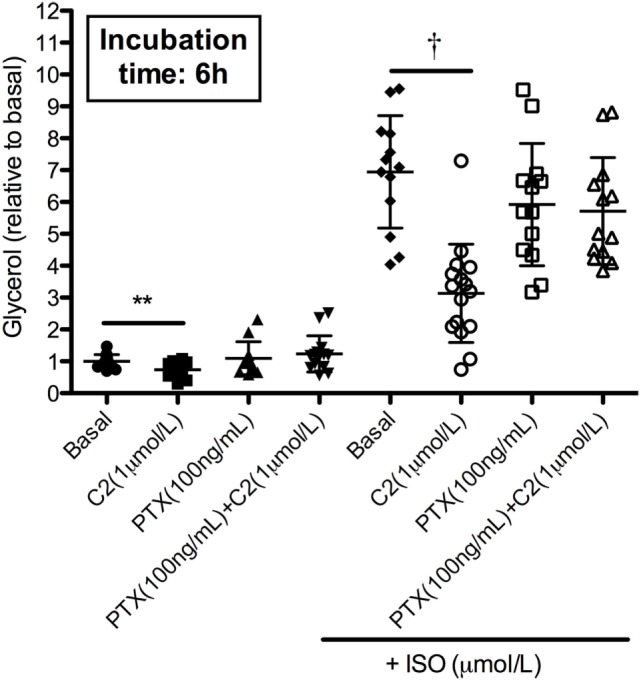
SCFA mixtures high in acetate and propionate decreased basal glycerol release, when compared to control ( < 0.05), while mixtures high in butyrate had no effect. Also, β-adrenergic receptor mediated glycerol release was not significantly altered following incubation with SCFA mixtures. Incubation with only acetate decreased basal (1 µmol/L) and β-adrenergically (1 µmol/L and 1 mmol/L) mediated glycerol release when compared with control ( < 0.05). In contrast, butyrate (1 µmol/L) slightly increased basal and β-adrenergically mediated glycerol release compared with control ( < 0.05), while propionate had no effect on lipolysis. The antilipolytic effect of acetate was accompanied by a reduced phosphorylation of hormone-sensitive lipase (HSL) at serine residue 650. In addition, inhibition of Gi G proteins following pertussis toxin treatment prevented the antilipolytic effect of acetate.
The present data demonstrated that acetate was mainly responsible for the antilipolytic effects of SCFA and acts attenuation of HSL phosphorylation in a Gi-coupled manner in hMADS adipocytes. Therefore, the modulation of colonic and circulating acetate may be an important target to modulate human adipose tissue lipid metabolism.
肠道来源的短链脂肪酸(SCFA)由膳食纤维经微生物发酵形成,被认为与肥胖和糖尿病的病因有关。我们团队之前的数据显示,向超重男性结肠输注生理相关的SCFA混合物可减弱全身脂肪分解。为进一步研究SCFA抗脂肪分解特性的潜在机制,我们旨在使用人白色脂肪细胞模型——人多能脂肪组织来源干细胞(hMADS细胞),研究SCFA孵育对细胞内脂肪分解和信号传导的影响。
将hMADS脂肪细胞与乙酸盐、丙酸盐和丁酸盐的混合物或浓度在1 μmol/L至1 mmol/L之间的单一SCFA(乙酸盐、丙酸盐和丁酸盐)孵育。在基础条件下以及β-肾上腺素能刺激后,研究甘油释放和脂肪酶激活情况。
与对照组相比,富含乙酸盐和丙酸盐的SCFA混合物降低了基础甘油释放(P<0.05),而富含丁酸盐的混合物则无此作用。此外,与SCFA混合物孵育后,β-肾上腺素能受体介导的甘油释放没有显著改变。与对照组相比,仅用乙酸盐孵育可降低基础(1 μmol/L)和β-肾上腺素能(1 μmol/L和1 mmol/L)介导的甘油释放(P<0.05)。相反,与对照组相比,丁酸盐(1 μmol/L)略微增加了基础和β-肾上腺素能介导的甘油释放(P<0.05),而丙酸盐对脂肪分解没有影响。乙酸盐的抗脂肪分解作用伴随着激素敏感性脂肪酶(HSL)丝氨酸残基650处磷酸化的减少。此外,百日咳毒素处理后抑制Gi G蛋白可阻止乙酸盐的抗脂肪分解作用。
目前的数据表明,乙酸盐是SCFA抗脂肪分解作用的主要原因,并以Gi偶联的方式在hMADS脂肪细胞中减弱HSL磷酸化。因此,调节结肠和循环中的乙酸盐可能是调节人体脂肪组织脂质代谢的重要靶点。