Singh Lalit P, Devi Takhellambam S, Yumnamcha Thangal
Department of Anatomy and Cell Biology, Wayne State University School of Medicine, USA.
Department of Ophthalmology, Wayne State University School of Medicine, USA.
JOJ Ophthalmol. 2017;4(4). doi: 10.19080/jojo.2017.04.555643. Epub 2017 Sep 15.
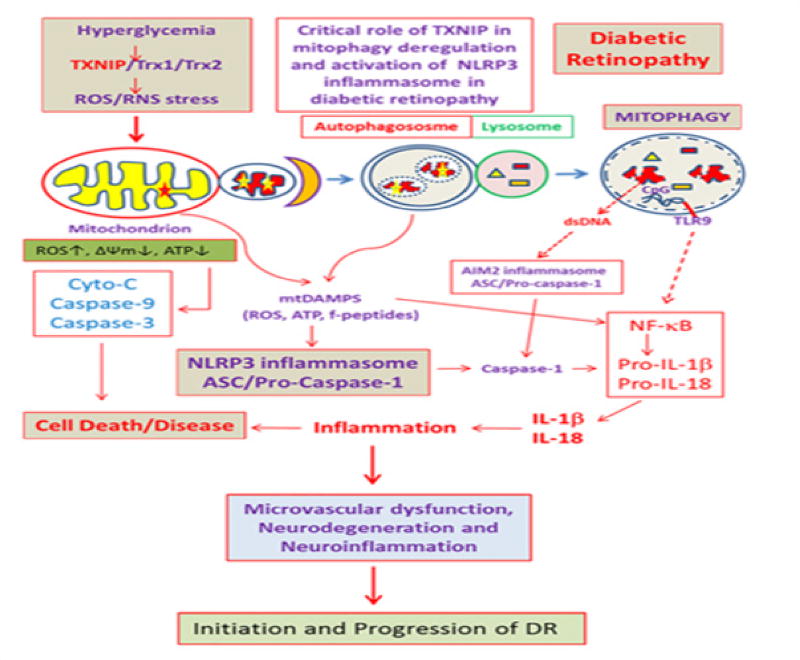
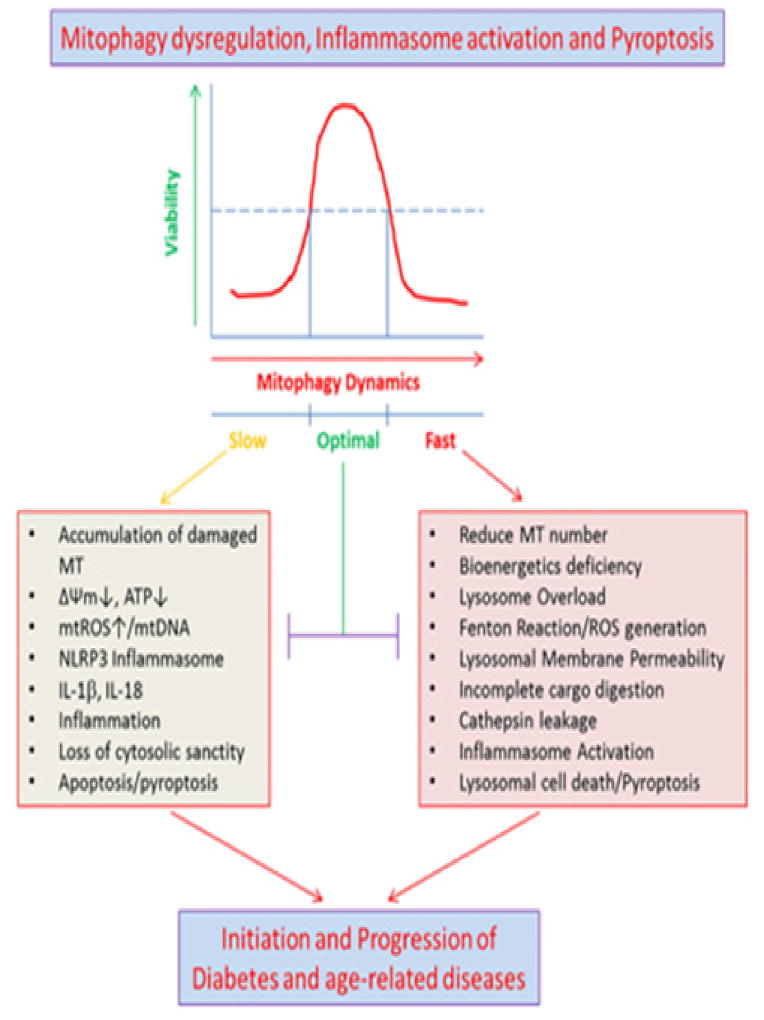
Mitochondria are responsible for bioenergetics, metabolism and apoptosis signals in health and disease. The retina being a part of the central nervous system consumes large amounts of glucose and oxygen to generate ATP via the mitochondrial oxidative phosphorylation for its phototransduction and visual function. During ATP generation, electrons leak from the mitochondrial electron transport chain, which is captured by molecular oxygen to produce reactive oxygen species (ROS). These mtROS damage mitochondrial proteins, mtDNA, and membrane lipids and release them in the cytosol. Mitochondrial components are recognized as danger-associated molecular patterns (DAMPS) by cytosolic pattern recognition receptors such as NOD-like receptors, NLRP3 inflammasomes. They process pro-caspase-1 to active caspase-1, which cleaves pro-inflammatory IL-1β o mature IL-1β causing inflammation and cell death by pyroptosis. To counter the damaging action of mtROS and inflammasomes in fully differentiated cells in the retina, the removal of the damaged and dysfunctional mitochondria by a double-membrane autophagic process via lysosomal degradation called mitophagy is critical for mitochondrial homeostasis and cell survival. Nonetheless, under chronic diseases including diabetic retinopathy (DR), mitophagy dysregulation and NLRP3 inflammasome activation exist, which cause premature cell death and disease progression. Recently, the thioredoxin-interacting protein TXNIP, which is strongly induced by diabetes and inhibits anti-oxidant function of thioredoxin, has been implicated in mitochondrial dysfunction, mitophagic dysregulation and NLRP3 inflammasome activation in DR. Therefore, TXNIP silencing or pharmacological inhibition may normalize mitophagic flux and NLRP3 inflammasome activation, which will prevent or slow down the progression of DR.
线粒体负责生物能量学、新陈代谢以及健康和疾病状态下的凋亡信号。视网膜作为中枢神经系统的一部分,消耗大量葡萄糖和氧气,通过线粒体氧化磷酸化产生三磷酸腺苷(ATP),以维持其光转导和视觉功能。在ATP生成过程中,电子从线粒体电子传递链泄漏,被分子氧捕获生成活性氧(ROS)。这些线粒体ROS(mtROS)会损伤线粒体蛋白、线粒体DNA和膜脂,并将它们释放到细胞质中。线粒体成分被胞质模式识别受体(如NOD样受体、NLRP3炎性小体)识别为危险相关分子模式(DAMPS)。它们将前半胱天冬酶-1加工成活性半胱天冬酶-1,后者将促炎白细胞介素-1β切割成成熟的白细胞介素-1β,导致炎症和细胞焦亡死亡。为了对抗视网膜中完全分化细胞内mtROS和炎性小体的破坏作用,通过溶酶体降解的双膜自噬过程(即线粒体自噬)清除受损和功能失调的线粒体,对于线粒体稳态和细胞存活至关重要。尽管如此,在包括糖尿病视网膜病变(DR)在内的慢性疾病中,存在线粒体自噬失调和NLRP3炎性小体激活的情况,这会导致细胞过早死亡和疾病进展。最近,硫氧还蛋白相互作用蛋白TXNIP在糖尿病中被强烈诱导并抑制硫氧还蛋白的抗氧化功能,它与DR中的线粒体功能障碍、线粒体自噬失调和NLRP3炎性小体激活有关。因此,TXNIP沉默或药物抑制可能会使线粒体自噬通量和NLRP3炎性小体激活恢复正常,从而预防或减缓DR的进展。