Quanjel Tessa C C, Winkens Anne, Spreeuwenberg Marieke D, Struijs Jeroen N, Winkens Ron A G, Baan Caroline A, Ruwaard Dirk
a Department of Health Services Research, Care and Public Health Research Institute (CAPHRI), Faculty of Health, Medicine and Life Sciences , Maastricht University , Maastricht , The Netherlands.
b Faculty of Health, Medicine and Life Sciences , Maastricht University , Maastricht , The Netherlands.
Scand J Prim Health Care. 2018 Mar;36(1):99-106. doi: 10.1080/02813432.2018.1426147. Epub 2018 Jan 28.
Consistent evidence on the effects of specialist services in the primary care setting is lacking. Therefore, this study evaluated the effects of an in-house internist at a GP practice on the number of referrals to specialist care in the hospital setting. Additionally, the involved GPs and internist were asked to share their experiences with the intervention.
A retrospective interrupted times series study.
Two multidisciplinary general practitioner (GP) practices.
An internist provided in-house patient consultations in two GP practices and participated in the multidisciplinary meetings.
The referral data extracted from the electronic medical record system of the GP practices, including all referral letters from the GPs to specialist care in the hospital setting.
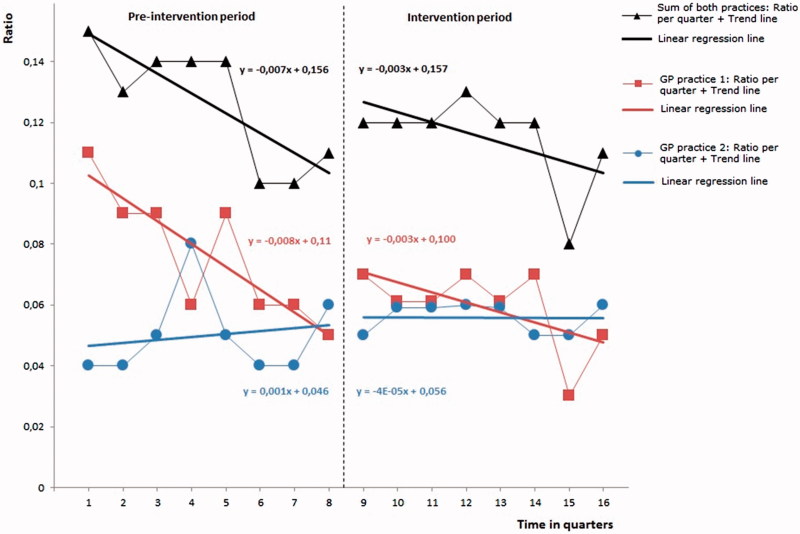
The number of referrals to internal medicine in the hospital setting. This study used an autoregressive integrated moving average model to estimate the effect of the intervention taking account of a time trend and autocorrelation among the observations, comparing the pre-intervention period with the intervention period.
It was found that the referrals to internal medicine did not statistically significant decrease during the intervention period.
This small explorative study did not find any clues to support that an in-house internist at a primary care setting results in a decrease of referrals to internal medicine in the hospital setting. Key Points An in-house internist at a primary care setting did not result in a significant decrease of referrals to specialist care in the hospital setting. The GPs and internist experience a learning-effect, i.e. an increase of knowledge about internal medicine issues.
缺乏关于基层医疗环境中专科服务效果的一致证据。因此,本研究评估了全科医生诊所的驻院内科医生对医院专科护理转诊数量的影响。此外,还要求参与的全科医生和内科医生分享他们对该干预措施的经验。
一项回顾性中断时间序列研究。
两家多学科全科医生(GP)诊所。
一名内科医生在两家全科医生诊所提供内部患者咨询,并参加多学科会议。
从全科医生诊所的电子病历系统中提取的转诊数据,包括全科医生向医院专科护理发出的所有转诊信。
医院内科的转诊数量。本研究使用自回归积分滑动平均模型,在考虑时间趋势和观察值之间的自相关性的情况下,估计干预措施的效果,将干预前期与干预期进行比较。
发现在干预期内,内科转诊数量没有统计学上的显著下降。
这项小型探索性研究没有找到任何线索来支持基层医疗环境中的驻院内科医生会导致医院内科转诊数量减少。要点基层医疗环境中的驻院内科医生并没有导致医院专科护理转诊数量的显著下降。全科医生和内科医生经历了一种学习效应,即关于内科问题的知识有所增加。