School of Psychology, Victoria University of Wellington, Wellington, New Zealand.
Department of Molecular Biology and Genetics - DANDRITE, Aarhus University, Aarhus, Denmark.
Sci Rep. 2018 Jan 29;8(1):1733. doi: 10.1038/s41598-017-18784-y.
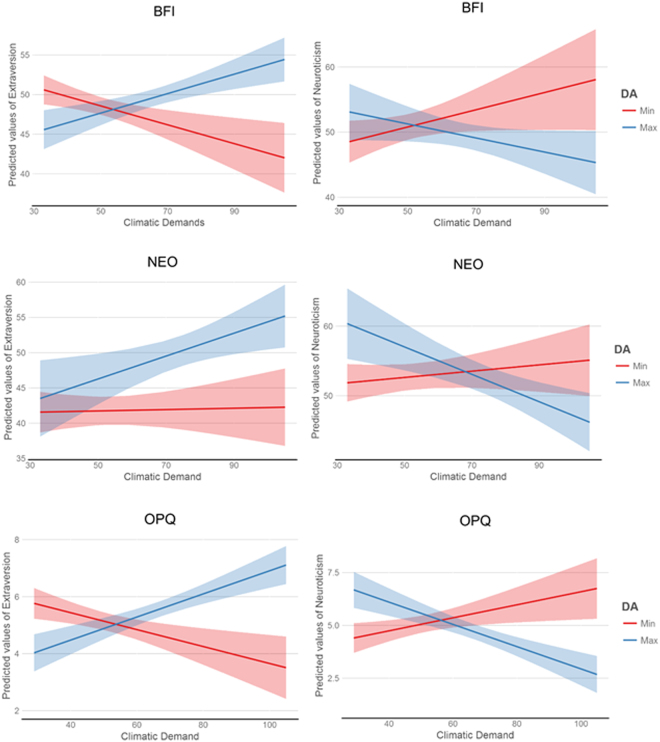
Cross-national differences in personality have long been recognized in the behavioural sciences. However, the origins of such differences are debated. Building on reinforcement sensitivity theories and gene-by-environment interactions, we predict that personality trait phenotypes linked to dopaminergic brain functions (centrally involved in reward processing) diverge most strongly in climatically stressful environments, due to shifts in perceived rewards vs risks. Individuals from populations with a highly efficient dopamine system are biased towards behavioural approach traits (Extraversion and Emotional Stability) due to higher perceived reward values, whereas individuals from populations with a less efficient dopaminergic system are biased towards risk avoidance. In temperate climates, we predict smaller phenotypic differences due to overall weakened reward and risk ratios. We calculated a population-level index of dopamine functioning using 9 commonly investigated genetic polymorphisms encoding dopamine transporters and receptors, derived from a meta-analysis with data from 805 independent samples involving 127,685 participants across 73 societies or territories. We found strong support for the dopamine gene by climatic stress interaction: Population genetic differences in dopamine predicted personality traits at the population level in demanding climates, but not in temperate, less demanding climates, even when controlling for known correlates of personality including wealth and parasite stress.
跨文化人格差异在行为科学中早已得到认可。然而,这种差异的起源仍存在争议。基于强化敏感性理论和基因-环境相互作用,我们预测与多巴胺能大脑功能(在奖励处理中起核心作用)相关的人格特质表型在气候压力大的环境中差异最大,因为感知到的奖励与风险发生了转变。具有高效多巴胺系统的人群中的个体由于更高的感知奖励价值而偏向于行为接近特质(外向性和情绪稳定性),而多巴胺系统效率较低的人群中的个体则偏向于风险回避。在温带气候中,我们预测由于整体奖励和风险比率的减弱,表型差异会更小。我们使用来自 805 个独立样本的荟萃分析中 9 种常见的编码多巴胺转运体和受体的遗传多态性,计算了一个基于人口的多巴胺功能指数,涉及 73 个社会或地区的 127685 名参与者。我们发现多巴胺基因与气候压力相互作用得到了强有力的支持:在要求苛刻的气候中,人口遗传差异可以预测人口水平上的人格特质,但在温带、要求较低的气候中则不能,即使在控制了包括财富和寄生虫压力在内的已知人格相关因素之后也是如此。