Amel Zabihi Narges, Mahmoudabady Maryam, Soukhtanloo Mohammad, Hayatdavoudi Parichehr, Beheshti Farimah, Niazmand Saeed
Department of Physiology, Faculty of Medicine, Mashhad University of Medical Sciences, Mashhad, Iran.
Neurogenic Inflammation Research Center, Mashhad University of Medical Sciences, Mashhad, Iran.
Avicenna J Phytomed. 2018 Jan-Feb;8(1):63-72.
Oxidative stress plays a critical role in the development of hypercholesterolemia-induced complications. This study evaluated the effects of aspirin and hydroethanolic extract on oxidative stress in the heart and kidney of hypercholesterolemic rabbits.
The antioxidant activity, as well as total phenolic and salicin content of (Sa) extract were assessed by DPPH radical scavenging activity, Folin-Ciocalteu and HPLC methods, respectively. Animals were divided into two groups of control (fed with normal chow), and HD (fed with high cholesterol diet for 6 weeks). Then, hypercholesterolemic animals allocated to the following treatment groups: CHO (received HD), Sa extract (HD plus extract 60 and 120 mg/kg), and aspirin (HD plus aspirin 120 mg/kg) and received the treatments on a daily basis for 6 weeks. MDA, GSH, and nitrite concentrations as well as the activities of SOD and CAT were evaluated in cardiac and kidney tissues.
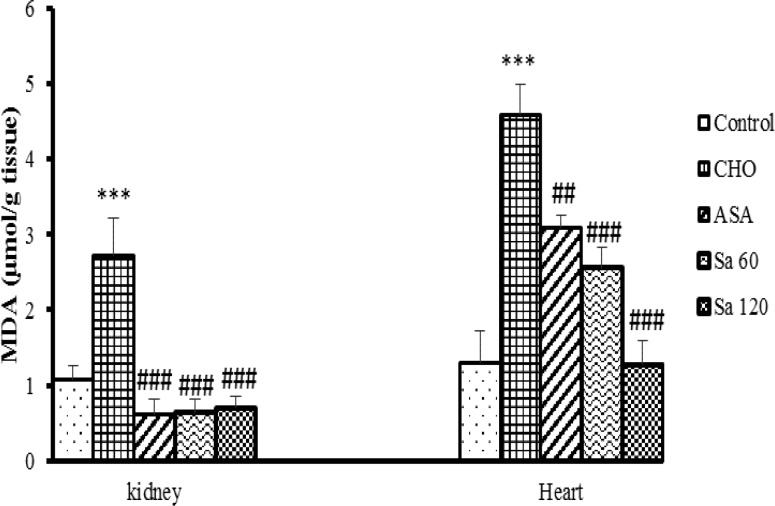
The scavenging activity, total phenolic content and salicin were 19.1 µg/ml (IC50), 153.75 ± 3.6 mg of gallic acid/g, and 18.03 µg/mg, respectively. In comparison to CHO group, MDA levels were diminished in Sa and ASA groups but GSH levels were improved. NO metabolites increased in the heart of Sa 120 mg/kg group and in the kidney of all Sa and ASA treated groups. SOD activity increased only in the heart of Sa groups and in the kidney of Sa and ASA groups. CAT activity increased in the heart and kidney tissues of all Sa and ASA treated groups.
The results showed extract improved redox homeostasis in heart and kidney tissues of hypercholesterolemic rabbits. The extract antioxidant property may be related to its phenolic content.
氧化应激在高胆固醇血症所致并发症的发生发展中起关键作用。本研究评估了阿司匹林和水乙醇提取物对高胆固醇血症家兔心脏和肾脏氧化应激的影响。
分别采用DPPH自由基清除活性、福林-酚法和高效液相色谱法评估(Sa)提取物的抗氧化活性以及总酚和水杨苷含量。将动物分为两组,对照组(喂食普通饲料)和HD组(喂食高胆固醇饲料6周)。然后,将高胆固醇血症动物分配到以下治疗组:CHO组(接受高胆固醇饲料)、Sa提取物组(高胆固醇饲料加提取物60和120mg/kg)、阿司匹林组(高胆固醇饲料加阿司匹林120mg/kg),并每天接受治疗,持续6周。评估心脏和肾脏组织中的丙二醛(MDA)、谷胱甘肽(GSH)和亚硝酸盐浓度以及超氧化物歧化酶(SOD)和过氧化氢酶(CAT)的活性。
清除活性、总酚含量和水杨苷分别为19.1μg/ml(半数抑制浓度)、153.75±3.6mg没食子酸/g和18.03μg/mg。与CHO组相比,Sa组和ASA组的MDA水平降低,但GSH水平升高。在Sa 120mg/kg组的心脏以及所有Sa和ASA治疗组的肾脏中,一氧化氮代谢产物增加。仅在Sa组的心脏以及Sa和ASA组的肾脏中,SOD活性增加。在所有Sa和ASA治疗组的心脏和肾脏组织中,CAT活性增加。
结果表明提取物改善了高胆固醇血症家兔心脏和肾脏组织中的氧化还原稳态。提取物的抗氧化特性可能与其酚类含量有关。