Cash-Gibson Lucinda, Rojas-Gualdrón Diego F, Pericàs Juan M, Benach Joan
Health Inequalities Research Group, Employment Conditions Knowledge Network (GREDS-EMCONET), Department of Political and Social Sciences, Universitat Pompeu Fabra, Barcelona (Catalonia, Spain).
Johns Hopkins University-Pompeu Fabra University Public Policy Center, Barcelona (Catalonia, Spain).
PLoS One. 2018 Jan 31;13(1):e0191901. doi: 10.1371/journal.pone.0191901. eCollection 2018.
Increasing evidence shows that health inequalities exist between and within countries, and emphasis has been placed on strengthening the production and use of the global health inequalities research, so as to improve capacities to act. Yet, a comprehensive overview of this evidence base is still needed, to determine what is known about the global and historical scientific production on health inequalities to date, how is it distributed in terms of country income groups and world regions, how has it changed over time, and what international collaboration dynamics exist.
A comprehensive bibliometric analysis of the global scientific production on health inequalities, from 1966 to 2015, was conducted using Scopus database. The historical and global evolution of the study of health inequalities was considered, and through joinpoint regression analysis and visualisation network maps, the preceding questions were examined.
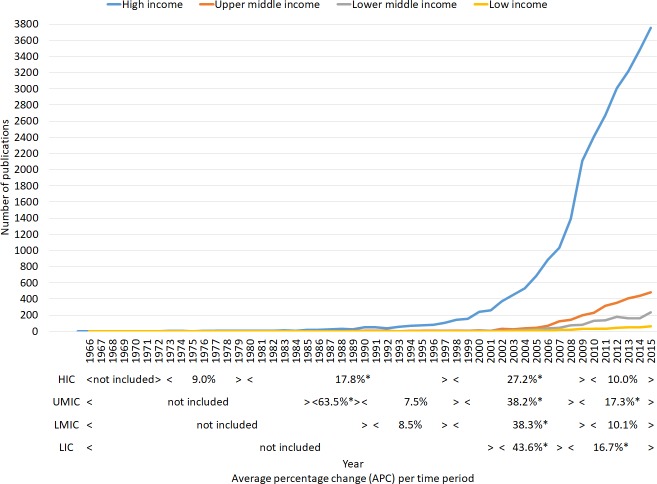
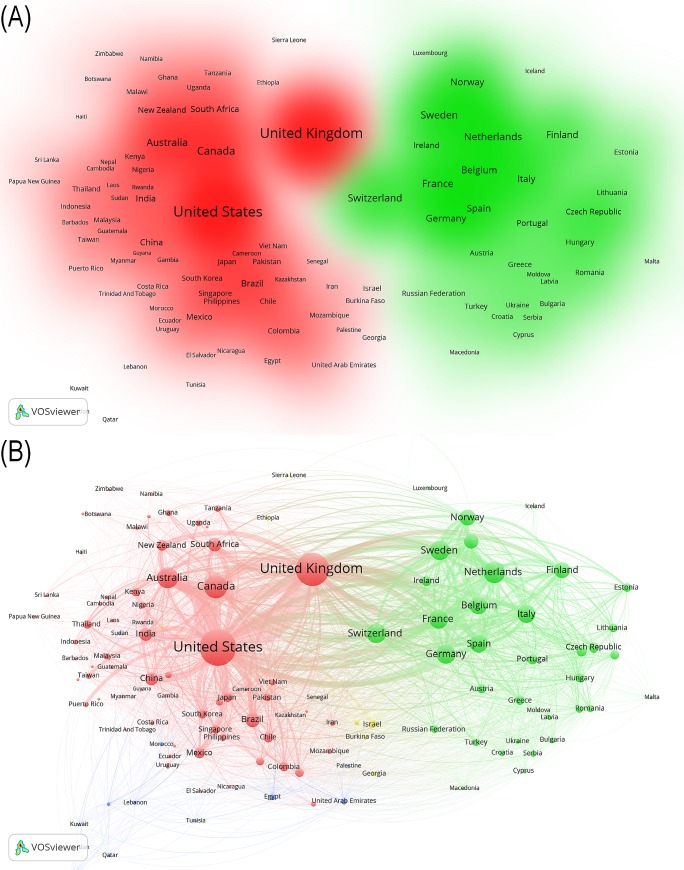
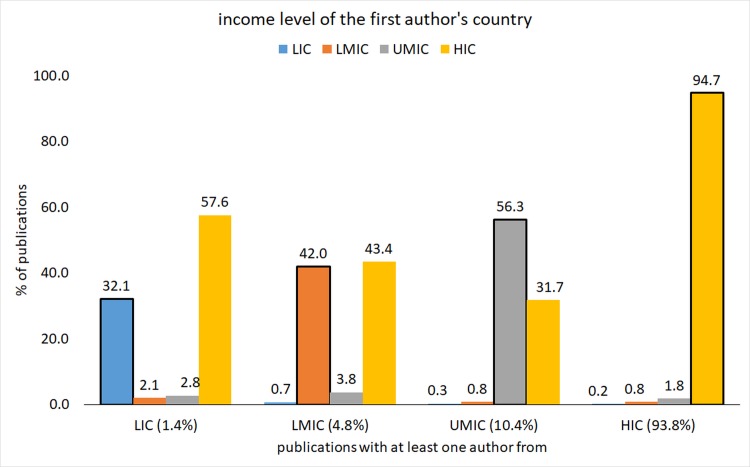
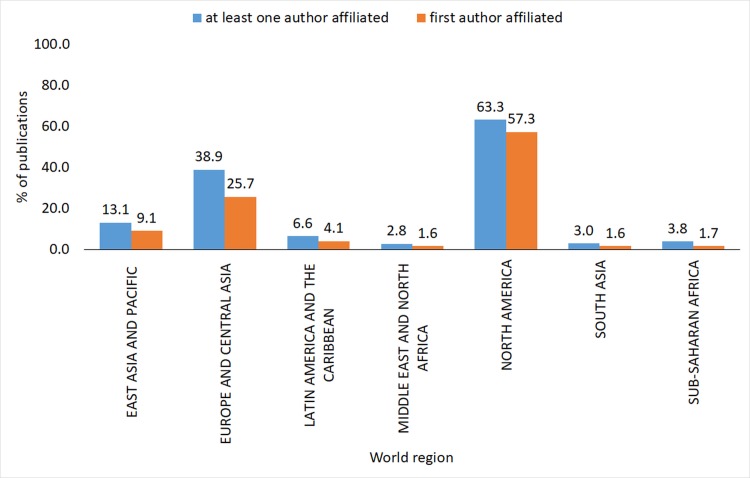
159 countries (via authorship affiliation) contributed to this scientific production, three times as many countries than previously found. Scientific output on health inequalities has exponentially grown over the last five decades, with several marked shift points, and a visible country-income group affiliation gradient in the initiation and consistent publication frequency. Higher income countries, especially Anglo-Saxon and European countries, disproportionately dominate first and co-authorship, and are at the core of the global collaborative research networks, with the Global South on the periphery. However, several country anomalies exist that suggest that the causes of these research inequalities, and potential underlying dependencies, run deeper than simply differences in country income and language.
Whilst the global evidence base has expanded, Global North-South research gaps exist, persist and, in some cases, are widening. Greater understanding of the structural determinants of these research inequalities and national research capacities is needed, to further strengthen the evidence base, and support the long term agenda for global health equity.
越来越多的证据表明,国家之间以及国家内部存在健康不平等现象,人们已将重点放在加强全球健康不平等研究的成果产出及应用上,以提高行动能力。然而,仍需要对这一证据基础进行全面概述,以确定关于全球和历史上健康不平等方面的科学研究成果有哪些,其在国家收入群体和世界区域方面是如何分布的,随时间发生了怎样的变化,以及存在哪些国际合作动态。
利用Scopus数据库对1966年至2015年全球关于健康不平等的科学研究成果进行了全面的文献计量分析。考虑了健康不平等研究的历史和全球演变情况,并通过连接点回归分析和可视化网络图对上述问题进行了研究。
159个国家(通过作者所属机构)为这一科学研究成果做出了贡献,数量是此前发现的三倍。在过去五十年中,关于健康不平等的科学产出呈指数级增长,有几个明显的转折点,且在初始发表和持续发表频率方面存在明显的国家收入群体归属梯度。高收入国家,尤其是盎格鲁-撒克逊国家和欧洲国家,在第一作者和共同作者方面占比过高,处于全球合作研究网络的核心位置,而南半球国家处于边缘位置。然而,存在一些国家异常情况,这表明这些研究不平等现象的成因以及潜在的内在依存关系比单纯的国家收入和语言差异更为复杂。
虽然全球证据基础有所扩大,但南北研究差距依然存在,且在某些情况下还在扩大。需要更深入地了解这些研究不平等现象的结构决定因素和国家研究能力,以进一步加强证据基础,并支持全球健康公平的长期议程。