Bergs Amelie, Schultheis Christian, Fischer Elisabeth, Tsunoda Satoshi P, Erbguth Karen, Husson Steven J, Govorunova Elena, Spudich John L, Nagel Georg, Gottschalk Alexander, Liewald Jana F
Buchmann Institute for Molecular Life Sciences, Goethe-University, Frankfurt, Germany.
Department of Biochemistry, Chemistry and Pharmacy, Institute of Biophysical Chemistry, Goethe-University, Frankfurt, Germany.
PLoS One. 2018 Feb 1;13(2):e0191802. doi: 10.1371/journal.pone.0191802. eCollection 2018.
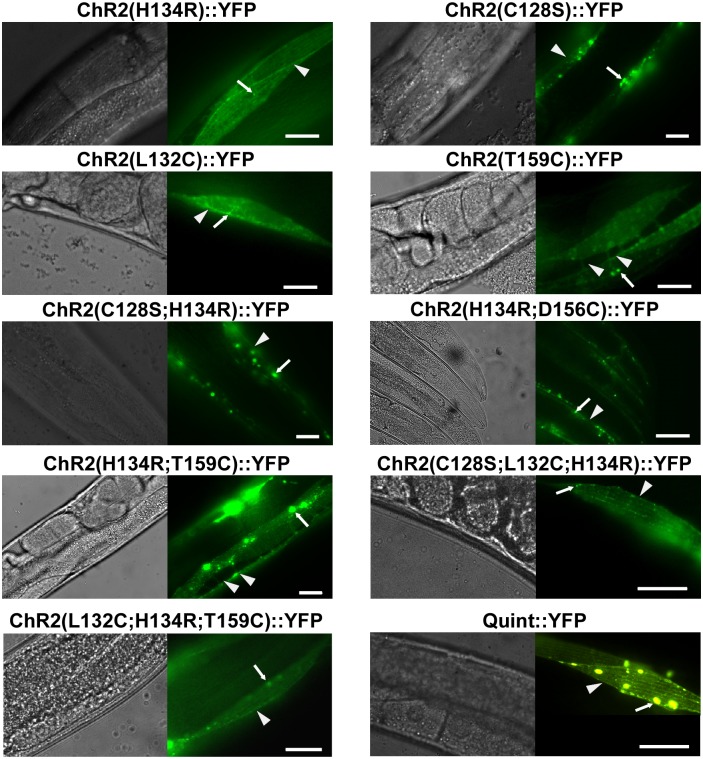
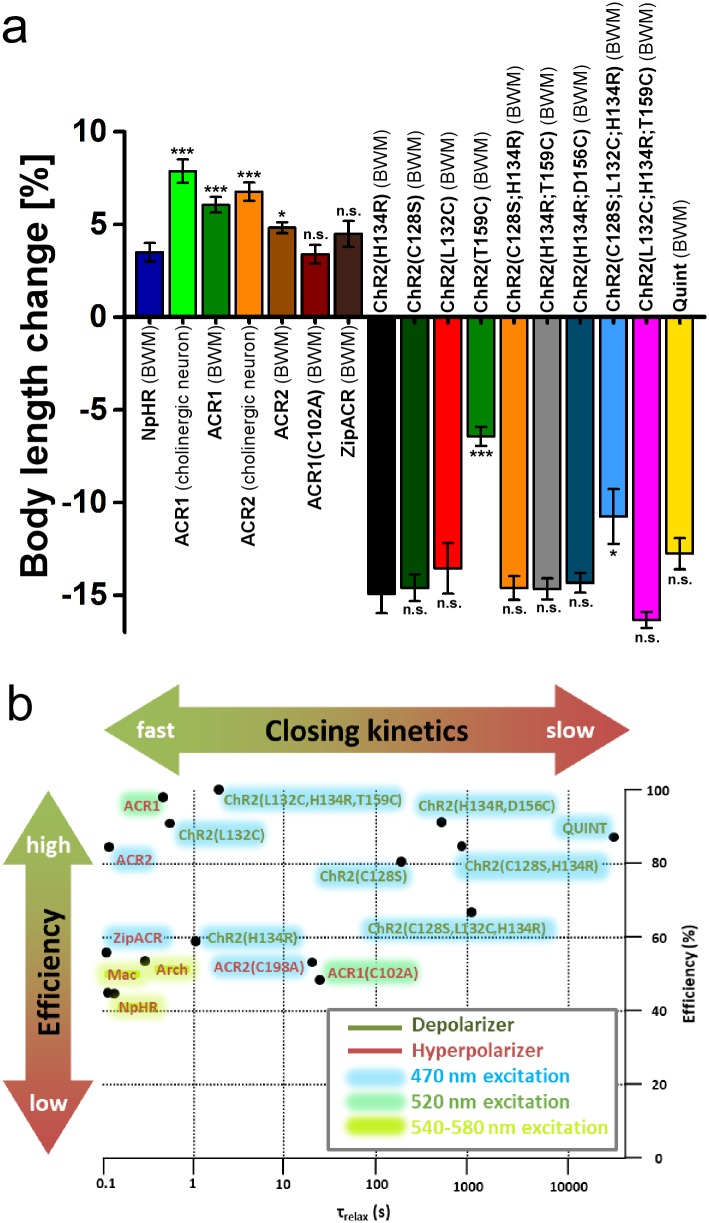
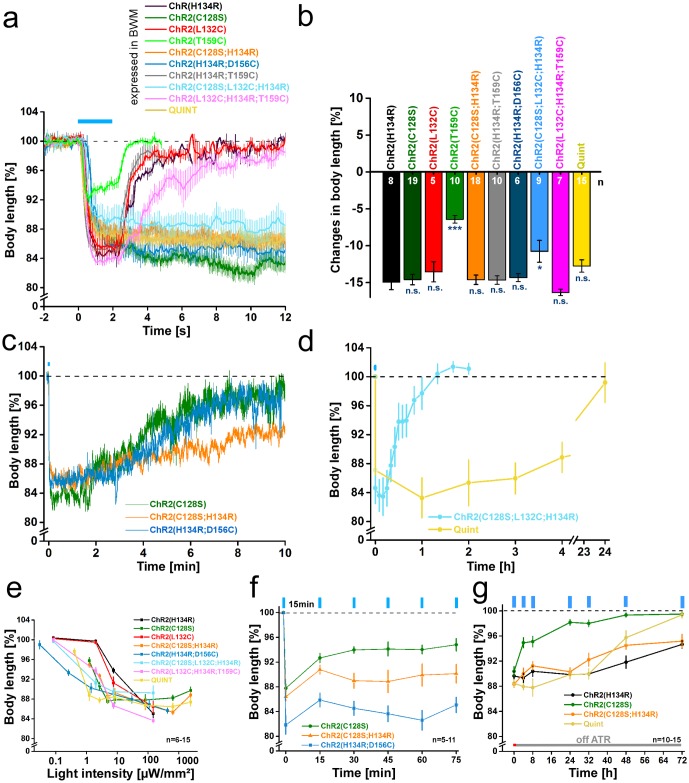
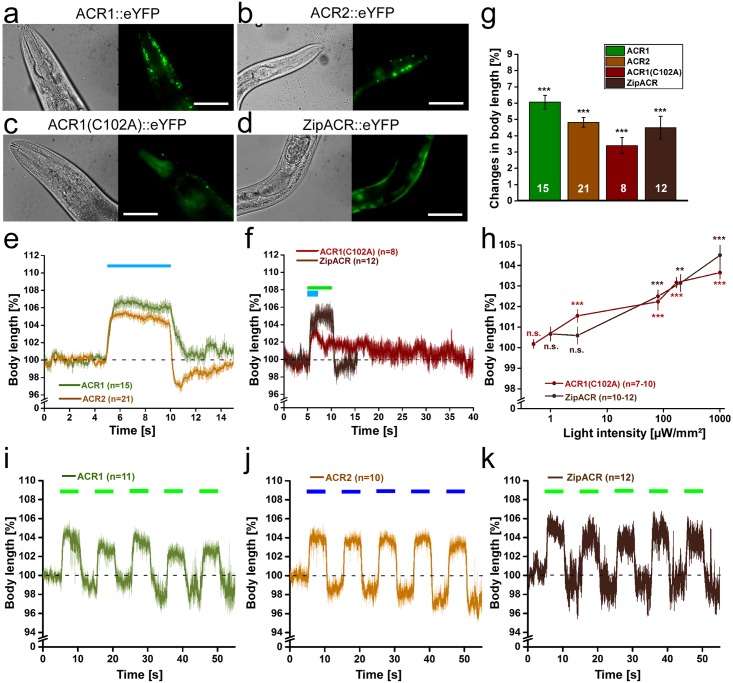
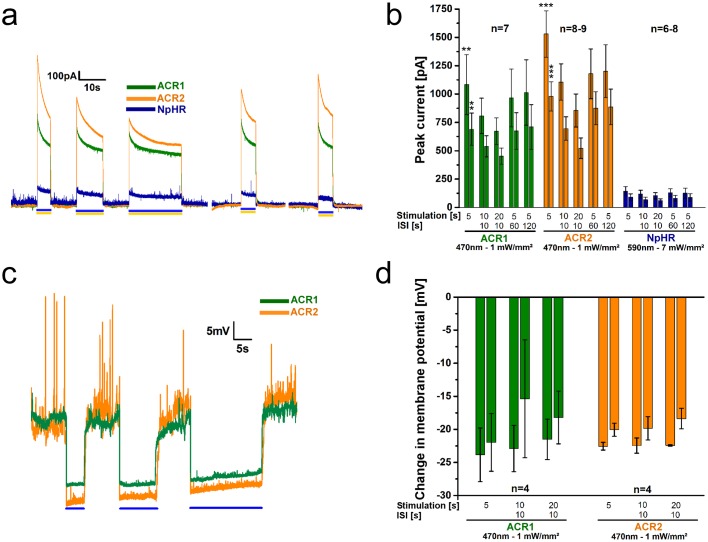
In optogenetics, rhodopsins were established as light-driven tools to manipulate neuronal activity. However, during long-term photostimulation using channelrhodopsin (ChR), desensitization can reduce effects. Furthermore, requirement for continuous presence of the chromophore all-trans retinal (ATR) in model systems lacking sufficient endogenous concentrations limits its applicability. We tested known, and engineered and characterized new variants of de- and hyperpolarizing rhodopsins in Caenorhabditis elegans. ChR2 variants combined previously described point mutations that may synergize to enable prolonged stimulation. Following brief light pulses ChR2(C128S;H134R) induced muscle activation for minutes or even for hours ('Quint': ChR2(C128S;L132C;H134R;D156A;T159C)), thus featuring longer open state lifetime than previously described variants. Furthermore, stability after ATR removal was increased compared to the step-function opsin ChR2(C128S). The double mutants C128S;H134R and H134R;D156C enabled increased effects during repetitive stimulation. We also tested new hyperpolarizers (ACR1, ACR2, ACR1(C102A), ZipACR). Particularly ACR1 and ACR2 showed strong effects in behavioral assays and very large currents with fast kinetics. In sum, we introduce highly light-sensitive optogenetic tools, bypassing previous shortcomings, and thus constituting new tools that feature high effectiveness and fast kinetics, allowing better repetitive stimulation or investigating prolonged neuronal activity states in C. elegans and, possibly, other systems.
在光遗传学中,视紫红质被确立为用于操纵神经元活动的光驱动工具。然而,在使用通道视紫红质(ChR)进行长期光刺激期间,脱敏作用会降低效果。此外,在缺乏足够内源性浓度的模型系统中,发色团全反式视黄醛(ATR)的持续存在要求限制了其适用性。我们在秀丽隐杆线虫中测试了已知的、经过工程改造和表征的去极化和超极化视紫红质新变体。ChR2变体结合了先前描述的可能协同作用以实现延长刺激的点突变。在短暂的光脉冲后,ChR2(C128S;H134R)诱导肌肉激活持续数分钟甚至数小时(“Quint”:ChR2(C128S;L132C;H134R;D156A;T159C)),因此其开放状态寿命比先前描述的变体更长。此外,与阶跃函数视蛋白ChR2(C128S)相比,去除ATR后的稳定性有所提高。双突变体C128S;H134R和H134R;D156C在重复刺激期间增强了效果。我们还测试了新的超极化剂(ACR1、ACR2、ACR1(C102A)、ZipACR)。特别是ACR1和ACR2在行为测定中显示出强烈的效果,并且具有快速动力学的非常大的电流。总之,我们引入了高度光敏的光遗传学工具,克服了先前的缺点,从而构成了具有高效性和快速动力学的新工具,能够在秀丽隐杆线虫以及可能的其他系统中实现更好的重复刺激或研究延长神经元活动状态。