Department of Anatomy and Cell Biology, Wayne State University School of Medicine, Detroit, Michigan, United States.
Department of Ophthalmology, Kresge Eye Institute, Wayne State University School of Medicine, Detroit, Michigan, United States.
Invest Ophthalmol Vis Sci. 2018 Mar 1;59(3):1288-1294. doi: 10.1167/iovs.17-23278.
To develop an animal behavioral assay for the quantitative assessment of the functional efficacy of optogenetic therapies.
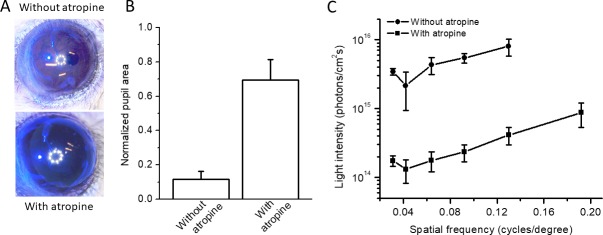
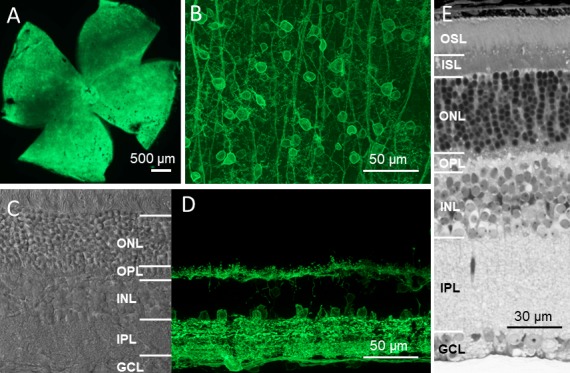
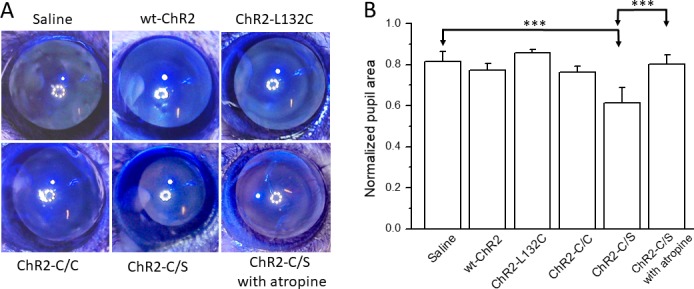
A triple-knockout (TKO) mouse line, Gnat1-/-Cnga3-/-Opn4-/-, and a double-knockout mouse line, Gnat1-/-Cnga3-/-, were employed. The expression of channelrhodopsin-2 (ChR2) and its three more light-sensitive mutants, ChR2-L132C, ChR2-L132C/T159C, and ChR2-132C/T159S, in inner retinal neurons was achieved using rAAV2 vectors via intravitreal delivery. Pupillary constriction was assessed by measuring the pupil diameter. The optomotor response (OMR) was examined using a homemade optomotor system equipped with light-emitting diodes as light stimulation.
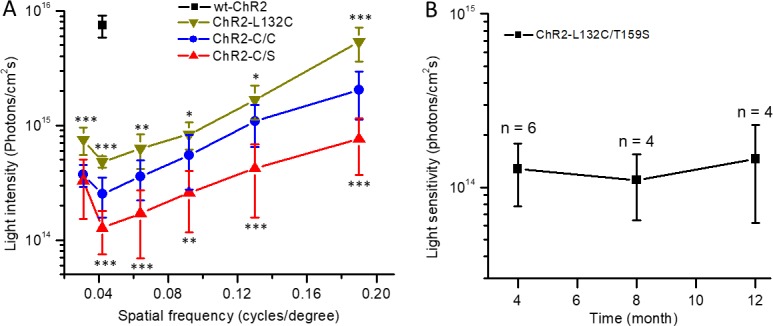
A robust OMR was restored in the ChR2-mutant-expressing TKO mice; however, significant pupillary constriction was observed only for the ChR2-L132C/T159S mutant. The ability to evoke an OMR was dependent on both the light intensity and grating frequency. The most light-sensitive frequency for the three ChR2 mutants was approximately 0.042 cycles per degree. Among the three ChR2 mutants, ChR2-L132C/T159S was the most light sensitive, followed by ChR2-L132C/T159C and ChR2-L132C. Melanopsin-mediated pupillary constriction resulted in a substantial reduction in the light sensitivity of the ChR2-mediated OMR.
The OMR assay using TKO mice enabled the quantitative assessment of the efficacy of different optogenetic tools and the properties of optogenetically restored vision. Thus, the assay can serve as a valuable tool for developing effective optogenetic therapies.
开发一种动物行为测定法,用于定量评估光遗传学疗法的功能疗效。
使用三重敲除(TKO)小鼠品系 Gnat1-/-Cnga3-/-Opn4-/-和双敲除小鼠品系 Gnat1-/-Cnga3-/--,通过眼内注射 rAAV2 载体实现视蛋白通道蛋白-2(ChR2)及其三种更敏感的突变体 ChR2-L132C、ChR2-L132C/T159C 和 ChR2-132C/T159S 在视网膜内神经元中的表达。通过测量瞳孔直径评估瞳孔收缩。使用自制的配备发光二极管作为光刺激的光运动反应(OMR)系统检查光运动反应。
在 ChR2 突变体表达的 TKO 小鼠中,恢复了强大的 OMR;然而,仅观察到 ChR2-L132C/T159S 突变体引起明显的瞳孔收缩。诱发 OMR 的能力取决于光强度和光栅频率。三种 ChR2 突变体的最敏感光频率约为 0.042 度/周期。在三种 ChR2 突变体中,ChR2-L132C/T159S 最敏感,其次是 ChR2-L132C/T159C 和 ChR2-L132C。黑视素介导的瞳孔收缩导致 ChR2 介导的 OMR 的光敏感性显著降低。
使用 TKO 小鼠的 OMR 测定法能够定量评估不同光遗传学工具的疗效和光遗传学恢复视力的特性。因此,该测定法可作为开发有效光遗传学疗法的有价值工具。