Department of Physiological Sciences, Faculty of Veterinary Medicine, Warsaw University of Life Sciences - SGGW, Nowoursynowska 159, 02-776, Warsaw, Poland.
Department of Animal Improvement, Institute of Genetics and Animal Breeding of the Polish Academy of Sciences, Postępu 36A, Jastrzębiec, 05-552, Magdalenka, Poland.
BMC Genomics. 2018 Jan 31;19(1):109. doi: 10.1186/s12864-018-4492-5.
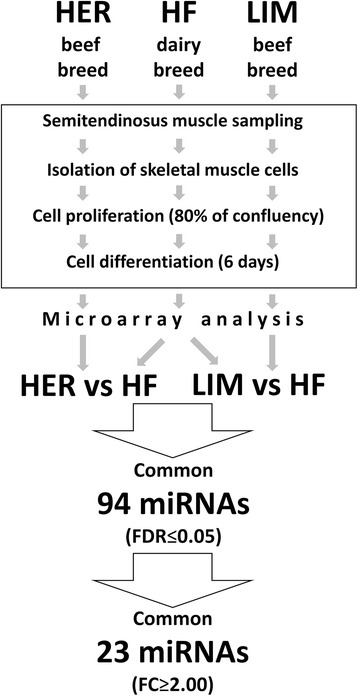
Skeletal muscle in livestock develops into meat, an important source of protein and other nutrients for human consumption. The muscle is largely composed of a fixed number of multinucleated myofibers determined during late gestation and remains constant postnatally. A population of postnatal muscle stem cells, called satellite cells, gives rise to myoblast cells that can fuse with the existing myofibers, thus increasing their size. This requires a delicate balance of transcription and growth factors and specific microRNA (miRNA) expressed by satellite cells and their supporting cells from the muscle stem cell niche. The role of transcription and growth factors in bovine myogenesis is well-characterized; however, very little is known about the miRNA activity during this process. We have hypothesized that the expression of miRNA can vary between primary cultures of skeletal muscle cells isolated from the semitendinosus muscles of different cattle breeds and subjected to myogenic differentiation.
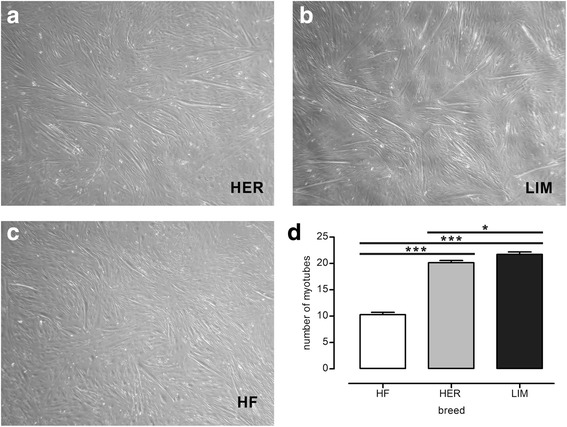
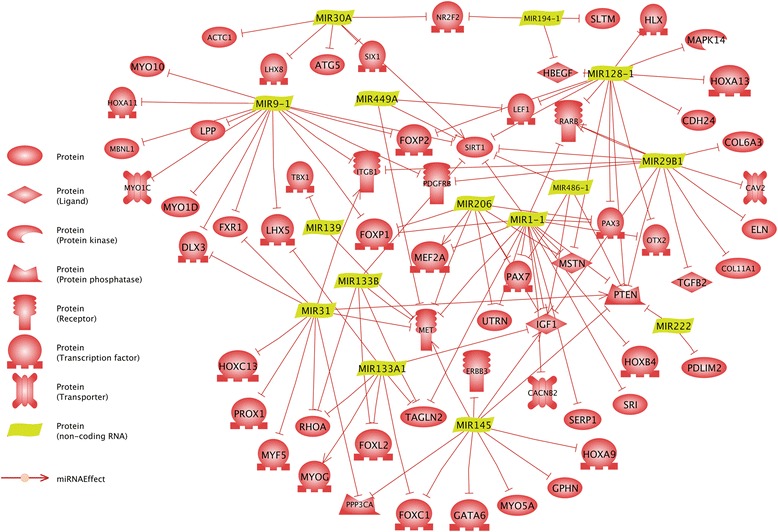
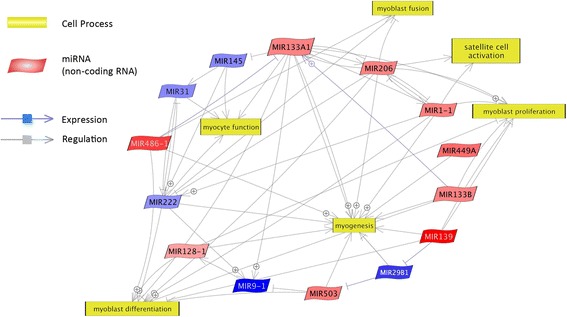
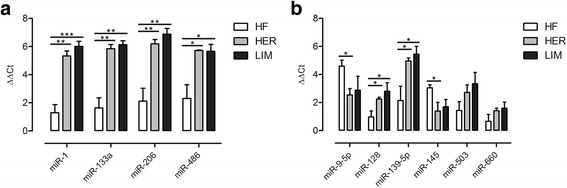
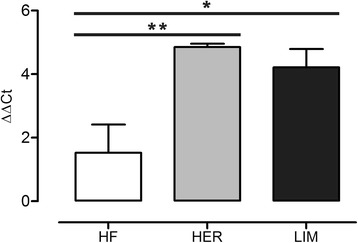
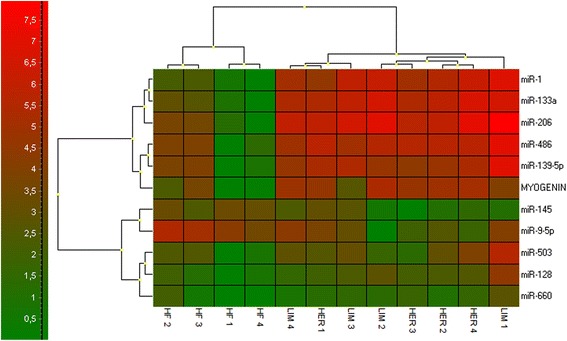
After a 6-day myogenic differentiation of cells isolated from the muscles of the examined cattle breeds, we found statistically significant differences in the number of myotubes between Hereford (HER)/Limousine (LIM) beef breeds and the Holstein-Friesian (HF) dairy breed (p ≤ 0.001). The microarray analysis revealed differences in the expression of 23 miRNA among the aforementioned primary cultures. On the basis of a functional analysis, we assigned 9 miRNA as molecules responsible for differentiation progression (miR-1, -128a, -133a, -133b, -139, -206, -222, -486, and -503). The target gene prediction and functional analysis revealed 59 miRNA-related genes belonging to the muscle organ development process.
The number of myotubes and the miRNA expression in the primary cultures of skeletal muscle cells derived from the semitendinosus muscles of the HER/LIM beef cattle breeds and the HF dairy breed vary when cells are subjected to myogenic differentiation. The net effect of the identified miRNA and their target gene action should be considered the result of the breed-dependent activity of satellite cells and muscle stem cell niche cells and their mutual interactions, which putatively can be engaged in the formation of a larger number of myotubes in beef cattle-related cells (HER/LIM) during in vitro myogenesis.
家畜的骨骼肌发育成肉,是人类食用的蛋白质和其他营养物质的重要来源。肌肉主要由在妊娠后期确定的固定数量的多核肌纤维组成,并在出生后保持不变。一群称为卫星细胞的产后肌肉干细胞产生成肌细胞,这些成肌细胞可以与现有的肌纤维融合,从而增加其大小。这需要转录和生长因子以及卫星细胞及其来自肌肉干细胞龛的支持细胞表达的特定 microRNA(miRNA)之间的微妙平衡。转录因子和生长因子在牛肌肉发生中的作用已经得到很好的描述;然而,在这个过程中,miRNA 的活性知之甚少。我们假设,分离自不同牛品种半腱肌的骨骼肌细胞的原代培养物在经历成肌分化时,miRNA 的表达可能会有所不同。
对来自所检查牛品种肌肉的细胞进行 6 天的成肌分化后,我们发现赫里福德(HER)/利木赞(LIM)肉牛品种和荷斯坦-弗里生(HF)奶牛品种之间的肌管数量存在统计学显著差异(p≤0.001)。微阵列分析显示上述原代培养物中 23 种 miRNA 的表达存在差异。基于功能分析,我们将 9 种 miRNA 分配为负责分化进展的分子(miR-1、-128a、-133a、-133b、-139、-206、-222、-486 和 -503)。靶基因预测和功能分析揭示了 59 种 miRNA 相关基因,属于肌肉器官发育过程。
源自赫里福德(HER)/利木赞(LIM)肉牛品种和荷斯坦-弗里生(HF)奶牛品种半腱肌的骨骼肌细胞原代培养物在经历成肌分化时,肌管数量和 miRNA 表达存在差异。鉴定的 miRNA 及其靶基因作用的净效应应被视为卫星细胞和肌肉干细胞龛细胞的种属依赖性活性及其相互作用的结果,这可能涉及在体外肌肉发生过程中形成更多的肌管(HER/LIM)相关细胞。