Department of Neurology, Cangzhou People's Hospital, No.7 North Qingchi Road, Cangzhou, Hebei Province, 061000, China.
Lipids Health Dis. 2018 Feb 2;17(1):20. doi: 10.1186/s12944-018-0669-9.
The risks of atherosclerotic cardiovascular and cerebrovascular diseases in women rapidly increase with age in post-menopausal women. We aimed to investigate the lipid profiles in peri-menopausal women with cerebral infarction and to explore the effects of atorvastatin intervention.
We collected women aged 40-60 with cerebral infarction between January 2013 and December 2016. Atorvastatin was applied for 6 months in all included patients. Blood lipid profiles, serum pro-inflammation cytokines, intracranial plaque and NIH stroke scale (NIHSS) scores were evaluated before and after atorvastatin treatment.
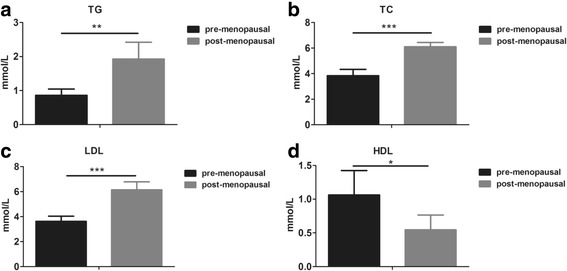
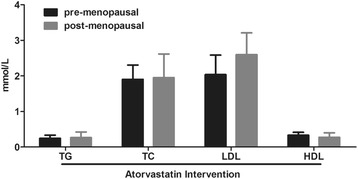
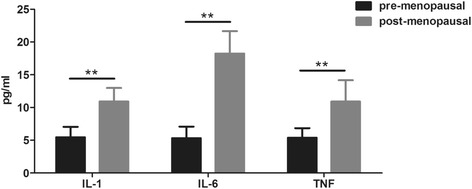
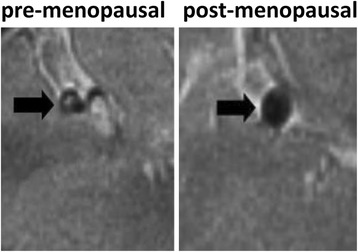
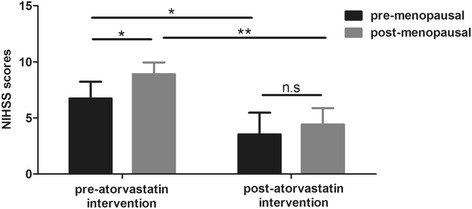
Totally 210 patients were included. Before atorvastatin treatment, post-menopausal patients had significantly higher levels of triglyceride, cholesterol, low-density lipoprotein and a reduced level of high-density lipoprotein than those in pre-menopausal patients. Blood levels of pro-inflammatory cytokines including interleukin (IL)-1, IL-6 and tumor necrosis factor-α were higher in post-menopausal patients, who had larger intracranial plaques than pre-menopausal patients. Consistently, post-menopausal patients had higher NIHSS scores than pre-menopausal ones. Atorvastatin reduced NIHSS scores and improved dyslipidemia in patients and eliminated the differences of these parameters between pre- and post-menopausal patients.
Post-menopausal patients were severer than pre-menopausal patients in terms of dyslipidemia, systemic inflammation and NIHSS scores. Atorvastatin may be beneficial for women with cerebral infarction.
绝经后女性的动脉粥样硬化性心血管和脑血管疾病风险随着年龄的增长迅速增加。本研究旨在探讨围绝经期女性脑梗死的血脂谱,并探讨阿托伐他汀的干预作用。
收集 2013 年 1 月至 2016 年 12 月期间患有脑梗死的 40-60 岁女性。所有纳入患者均应用阿托伐他汀治疗 6 个月。评估阿托伐他汀治疗前后的血脂谱、血清促炎细胞因子、颅内斑块和 NIH 卒中量表(NIHSS)评分。
共纳入 210 例患者。阿托伐他汀治疗前,与绝经前患者相比,绝经后患者的甘油三酯、胆固醇、低密度脂蛋白水平更高,高密度脂蛋白水平更低。绝经后患者的促炎细胞因子(白细胞介素(IL)-1、IL-6 和肿瘤坏死因子-α)水平较高,颅内斑块较绝经前患者大。同样,绝经后患者的 NIHSS 评分高于绝经前患者。阿托伐他汀降低了患者的 NIHSS 评分,改善了血脂异常,并消除了绝经前和绝经后患者这些参数的差异。
在血脂异常、全身炎症和 NIHSS 评分方面,绝经后患者比绝经前患者更为严重。阿托伐他汀可能对患有脑梗死的女性有益。