Department of Geriatrics, The 117th Hospital of PLA, Hangzhou, Zhejiang 310013, P.R. China.
Department of Clinical Laboratory, Hangzhou Clinical College of The People's Liberation Army of Anhui Medical University, Hangzhou, Zhejiang 310013, P.R. China.
Mol Med Rep. 2018 Apr;17(4):5007-5012. doi: 10.3892/mmr.2018.8477. Epub 2018 Jan 24.
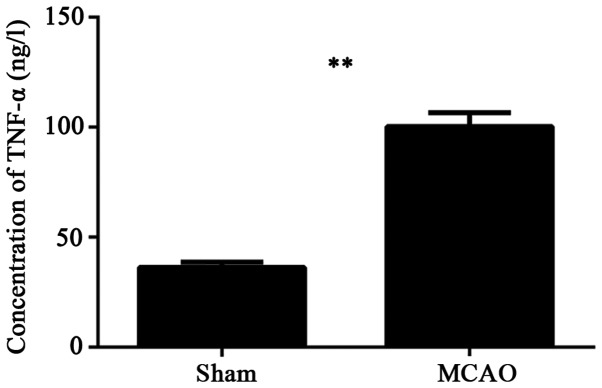
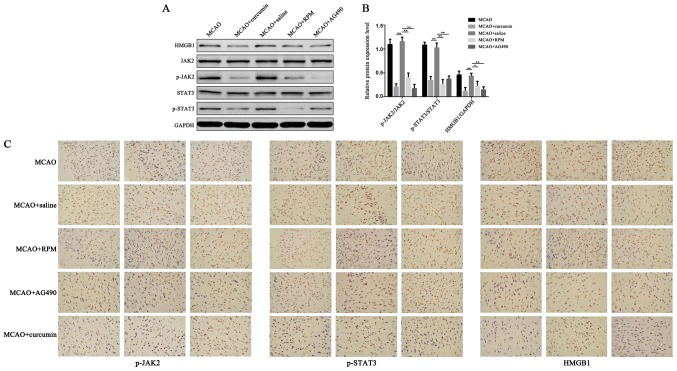
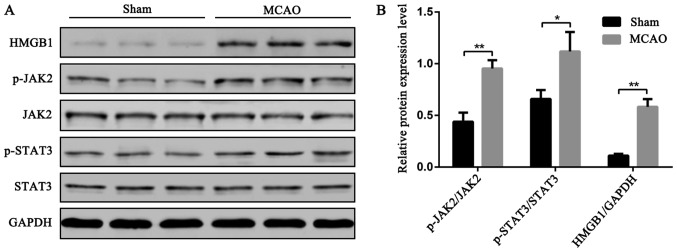
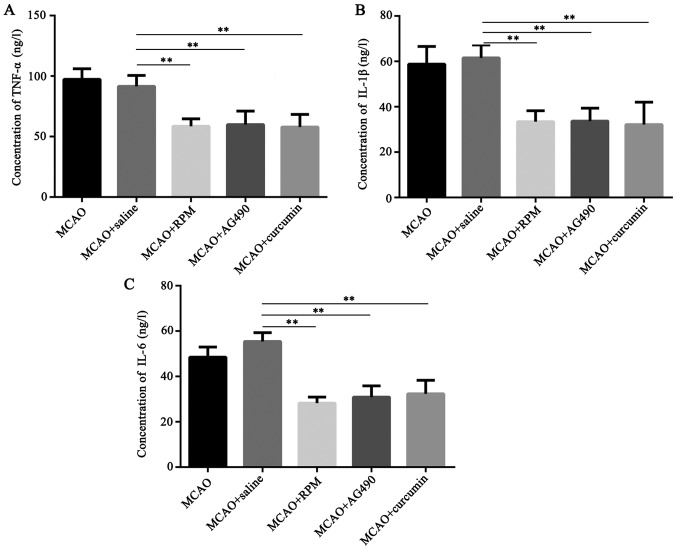
The present study aimed to investigate the mechanism by which the Janus kinase (JAK)2/signal transducer and activator of transcription (STAT)3 signaling pathway mediates cerebral ischemia and the efficacy of pharmaceutical intervention. The rat model of middle cerebral artery occlusion (MCAO) was established and confirmed via assessment of changes in the expression of phosphorylated (p)‑JAK2, p‑STAT3, high‑mobility group box 1 (HMGB1), and inflammatory factors using ELISA and western blot analysis. The effects of JAK2/STAT3 inhibitor and curcumin on the expression of p‑JAK2, p‑STAT3, HMGB1, and inflammatory factors after cerebral ischemia were observed with ELISA, western blotting and immunohistochemical staining. The concentrations of tumor necrosis factor (TNF)‑α and HMGB1 in brain tissue homogenate of MCAO group were significantly higher than in the sham group (P<0.01). The concentration of p‑JAK2/JAK2 and p‑STAT3/STAT3 in the brain tissue homogenate of MCAO group was significantly higher than in the sham group (P<0.05). The concentrations of TNF‑α, interleukin (IL)‑1β, IL‑6, and HMGB1 in the group treated with STAT3 inhibitor (MCAO + rapamycin), JAK2 inhibitor (MCAO + AG490), and MCAO + curcumin were significantly lower than in the MCAO group (P<0.01), as well as the relative content of p‑JAK2/JAK2 and p‑STAT3/STAT3 (P<0.05). Inhibition of the JAK2/STAT3 signaling pathway, such as curcumin can reduce the expression of HMGB1 in brain tissue after cerebral ischemia, which can significantly reduce the inflammatory response after cerebral ischemia.
本研究旨在探讨 Janus 激酶(JAK)2/信号转导子和转录激活子(STAT)3 信号通路介导脑缺血的机制及药物干预的疗效。通过酶联免疫吸附试验和 Western blot 分析评估磷酸化(p)-JAK2、p-STAT3、高迁移率族蛋白 B1(HMGB1)和炎症因子表达的变化,建立并验证大鼠大脑中动脉闭塞(MCAO)模型。采用酶联免疫吸附试验、Western blot 和免疫组织化学染色观察 JAK2/STAT3 抑制剂和姜黄素对脑缺血后 p-JAK2、p-STAT3、HMGB1 和炎症因子表达的影响。MCAO 组脑组织匀浆中肿瘤坏死因子(TNF)-α和 HMGB1 浓度明显高于假手术组(P<0.01)。MCAO 组脑组织匀浆中 p-JAK2/JAK2 和 p-STAT3/STAT3 浓度明显高于假手术组(P<0.05)。STAT3 抑制剂(MCAO+雷帕霉素)、JAK2 抑制剂(MCAO+AG490)和 MCAO+姜黄素处理组 TNF-α、白细胞介素(IL)-1β、IL-6 和 HMGB1 浓度明显低于 MCAO 组(P<0.01),p-JAK2/JAK2 和 p-STAT3/STAT3 相对含量也明显降低(P<0.05)。抑制 JAK2/STAT3 信号通路,如姜黄素,可减少脑缺血后脑组织中 HMGB1 的表达,显著减轻脑缺血后的炎症反应。