Department of Microbial Ecology, Groningen Institute for Evolutionary Life Sciences, University of Groningen, Nijenborgh 7, 9747 AG, Groningen, The Netherlands.
Appl Microbiol Biotechnol. 2018 Mar;102(6):2913-2927. doi: 10.1007/s00253-017-8714-6. Epub 2018 Feb 3.
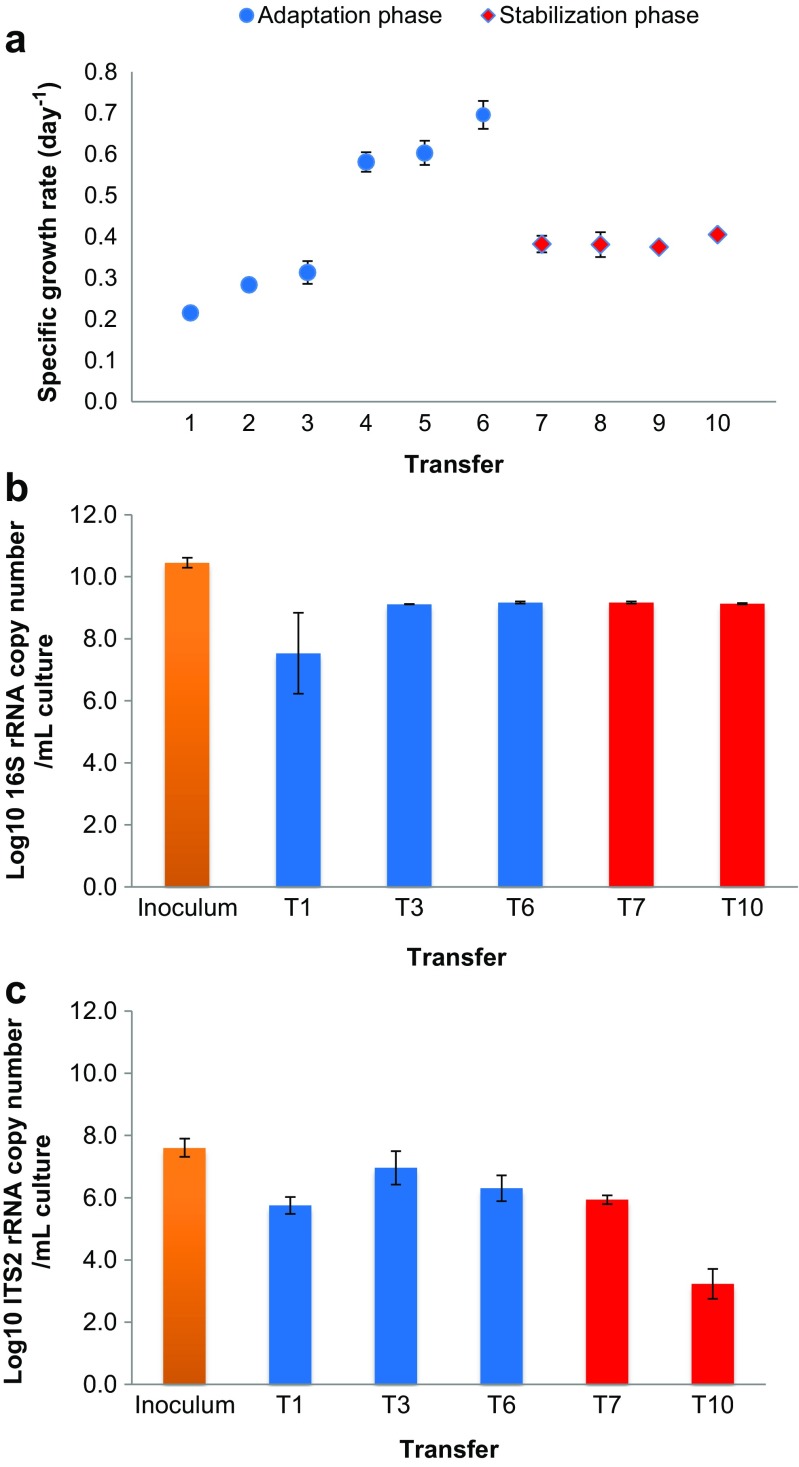
The microbial degradation of plant-derived compounds under salinity stress remains largely underexplored. The pretreatment of lignocellulose material, which is often needed to improve the production of lignocellulose monomers, leads to high salt levels, generating a saline environment that raises technical considerations that influence subsequent downstream processes. Here, we constructed halotolerant lignocellulose degrading microbial consortia by enriching a salt marsh soil microbiome on a recalcitrant carbon and energy source, i.e., wheat straw. The consortia were obtained after six cycles of growth on fresh substrate (adaptation phase), which was followed by four cycles on pre-digested (highly-recalcitrant) substrate (stabilization phase). The data indicated that typical salt-tolerant bacteria made up a large part of the selected consortia. These were "trained" to progressively perform better on fresh substrate, but a shift was observed when highly recalcitrant substrate was used. The most dominant bacteria in the consortia were Joostella marina, Flavobacterium beibuense, Algoriphagus ratkowskyi, Pseudomonas putida, and Halomonas meridiana. Interestingly, fungi were sparsely present and negatively affected by the change in the substrate composition. Sarocladium strictum was the single fungal strain recovered at the end of the adaptation phase, whereas it was deselected by the presence of recalcitrant substrate. Consortia selected in the latter substrate presented higher cellulose and lignin degradation than consortia selected on fresh substrate, indicating a specialization in transforming the recalcitrant regions of the substrate. Moreover, our results indicate that bacteria have a prime role in the degradation of recalcitrant lignocellulose under saline conditions, as compared to fungi. The final consortia constitute an interesting source of lignocellulolytic haloenzymes that can be used to increase the efficiency of the degradation process, while decreasing the associated costs.
在盐胁迫下,植物衍生化合物的微生物降解在很大程度上仍未得到充分探索。木质纤维素材料的预处理通常需要提高木质纤维素单体的产量,这会导致盐分水平升高,产生高盐环境,从而产生影响后续下游工艺的技术问题。在这里,我们通过在一种难以降解的碳和能源源(即小麦秸秆)上富集盐沼土壤微生物组,构建了耐盐木质纤维素降解微生物群落。在新鲜基质上进行了六轮生长(适应阶段)后获得了群落,然后在预先消化(高度难降解)的基质上进行了四轮生长(稳定阶段)。数据表明,典型的耐盐细菌构成了所选群落的大部分。这些细菌“经过训练”可以在新鲜基质上逐步表现得更好,但当使用高度难降解的基质时,会观察到转变。群落中最占优势的细菌是 Joostella marina、Flavobacterium beibuense、Algoriphagus ratkowskyi、Pseudomonas putida 和 Halomonas meridiana。有趣的是,真菌很少存在,并且受到基质组成变化的负面影响。Sarocladium strictum 是适应阶段结束时回收的唯一真菌菌株,而当存在难降解的基质时,它被选择去除。在后者基质中选择的群落比在新鲜基质中选择的群落表现出更高的纤维素和木质素降解能力,这表明它们在转化基质的难降解区域方面具有专业化。此外,我们的结果表明,与真菌相比,细菌在盐胁迫下难降解木质纤维素的降解中起主要作用。最终的群落构成了有趣的木质纤维素耐盐酶的来源,可以用来提高降解过程的效率,同时降低相关成本。