Wan Tao, Shao Jing, Hu Bin, Liu Gang, Luo Peng, Zhou Yanming
Department of Hepatobiliary & Pancreatovascular Surgery.
Department of Clinical Laboratory Medicine, First Affiliated Hospital of Xiamen University, Xiamen, China.
Onco Targets Ther. 2018 Jan 17;11:383-393. doi: 10.2147/OTT.S153682. eCollection 2018.
HSF1 is reported to be overexpressed in various solid tumors and play a pivotal role in cancer progression. A meta-analysis was conducted to assess the potential prognostic role of HSF1 in patients with solid tumors.
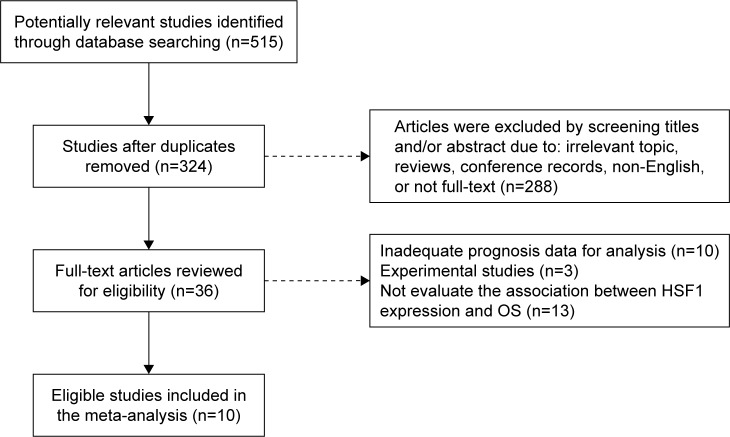
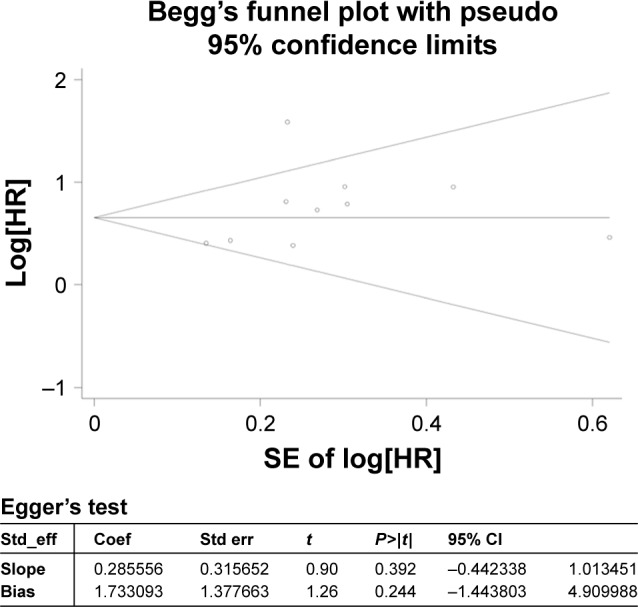
An extensive electronic search of three databases was performed for relevant articles. The pooled hazard ratios (HRs) or odds ratios with their corresponding 95% CI were calculated with a random-effects model. Heterogeneity and publication bias analyses were also conducted.
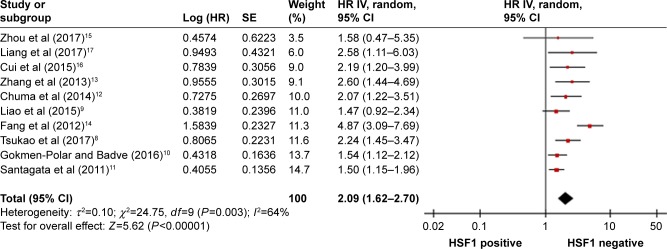
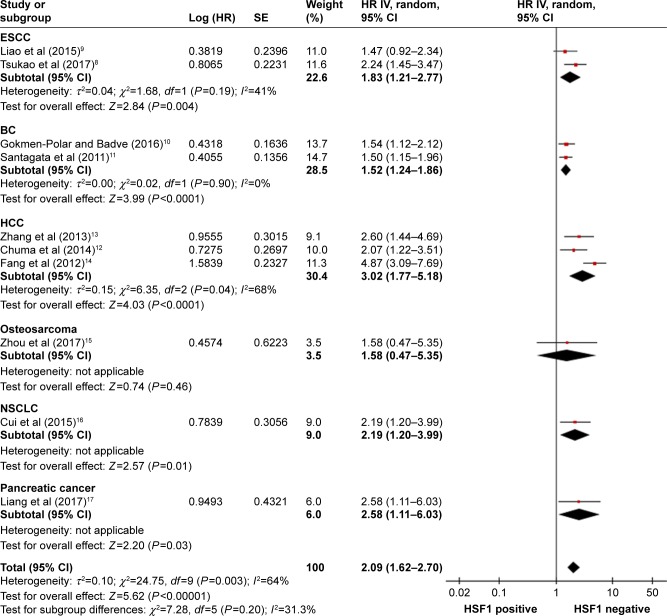
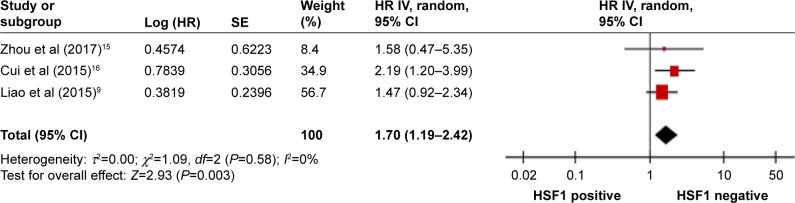
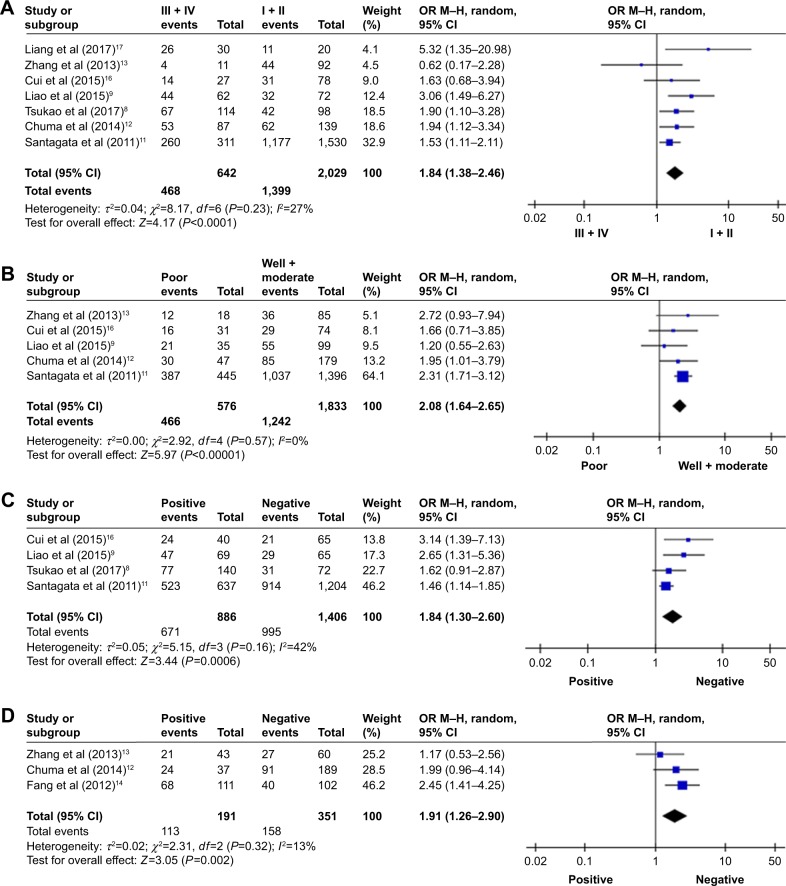
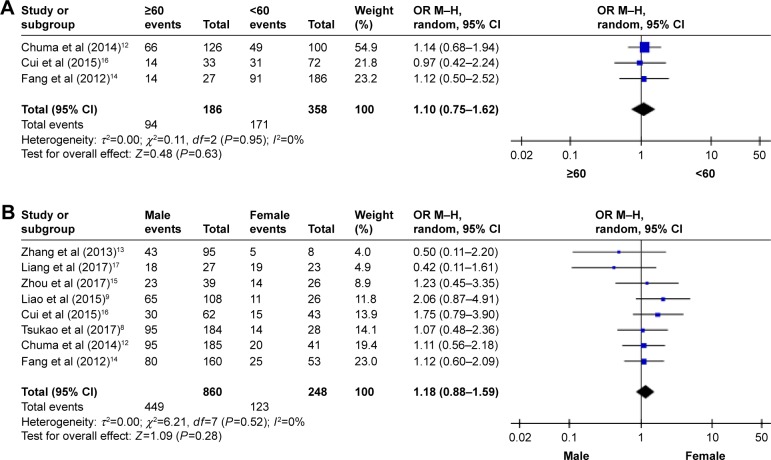
A total of 3,159 patients from 10 eligible studies were included into the analysis. The results showed that positive HSF1 expression was significantly correlated with poor overall survival in all tumors (HR=2.09; 95% CI: 1.62-2.70; <0.001). Subgroup analysis revealed that there was a significant association between HSF1 overexpression and poor prognosis in esophageal squamous cell carcinoma (ESCC) (HR=1.83; 95% CI: 1.21-2.77; =0.004), breast cancer (BC) (HR=1.52; 95% CI: 1.24-2.86; <0.001), hepatocellular carcinoma (HR=3.02; 95% CI: 1.77-5.18; <0.001), non-small-cell lung cancer (HR=2.19; 95% CI: 1.20-3.99; =0.01), and pancreatic cancer (HR=2.58; 95% CI: 1.11-6.03; =0.03) but not in osteosarcoma (HR=1.58; 95% CI: 0.47-5.35; =0.46). In addition, HSF1 overexpression was significantly associated with some phenotypes of tumor aggressiveness including TNM stage, histological grade, lymph node metastasis, and vascular invasion.
HSF1 overexpression may prove to be an unfavorable prognostic biomarker for solid tumor patients.
据报道,热休克因子1(HSF1)在多种实体瘤中过度表达,并在癌症进展中起关键作用。进行了一项荟萃分析,以评估HSF1在实体瘤患者中的潜在预后作用。
对三个数据库进行广泛的电子检索以查找相关文章。采用随机效应模型计算合并风险比(HRs)或比值比及其相应的95%置信区间。还进行了异质性和发表偏倚分析。
来自10项符合条件研究的3159例患者纳入分析。结果显示,在所有肿瘤中,HSF1阳性表达与总体生存率差显著相关(HR = 2.09;95%置信区间:1.62 - 2.70;P < 0.001)。亚组分析显示,HSF1过表达与食管鳞状细胞癌(ESCC)(HR = 1.83;95%置信区间:1.21 - 2.77;P = 0.004)、乳腺癌(BC)(HR = 1.52;95%置信区间:1.24 - 2.86;P < 0.001)、肝细胞癌(HR = 3.02;95%置信区间:1.77 - 5.18;P < 0.001)、非小细胞肺癌(HR = 2.19;95%置信区间:1.20 - 3.99;P = 0.01)和胰腺癌(HR = 2.58;95%置信区间:1.11 - 6.03;P = 0.03)的预后不良显著相关,但与骨肉瘤无关(HR = 1.58;95%置信区间:0.47 - 5.35;P = 0.46)。此外,HSF1过表达与肿瘤侵袭性的一些表型显著相关,包括TNM分期、组织学分级、淋巴结转移和血管侵犯。
HSF1过表达可能是实体瘤患者预后不良的生物标志物。