Division of Psychology and Language Sciences, University College London, London, UK.
Faculty of Education, University of Cambridge, Cambridge, UK.
Dev Cogn Neurosci. 2019 Feb;35:47-56. doi: 10.1016/j.dcn.2018.01.010. Epub 2018 Jan 31.
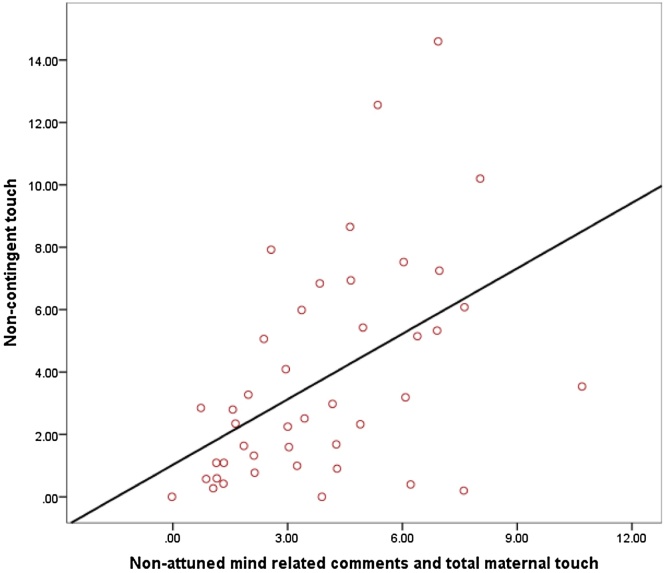
Increasing evidence shows that maternal touch may promote emotion regulation in infants, however less is known about how parental higher-order social cognition abilities are translated into tactile, affect-regulatory behaviours towards their infants. During 10 min book-reading, mother-infant sessions when infants were 12 months old (N = 45), we investigated maternal mind-mindedness (MM), the social cognitive ability to understand an infant's mental state, by coding the contingency of maternal verbal statements towards the infants' needs and desires. We also rated spontaneous tactile interactions in terms of their emotional contingency. We found that frequent non-attuned mind-related comments were associated with touch behaviours that were not contingent with the infant's emotions; ultimately discouraging affective tactile responses from the infant. However, comments that were more appropriate to infant's mental states did not necessarily predict more emotionally-contingent tactile behaviours. These findings suggest that when parental high-order social cognitive abilities are compromised, they are also likely to translate into inappropriate, tactile attempts to regulate infant's emotions.
越来越多的证据表明,母亲的触摸可以促进婴儿的情绪调节,但对于父母的高阶社会认知能力如何转化为对婴儿的触觉、情感调节行为,人们知之甚少。在 12 个月大的婴儿进行 10 分钟的读书活动时(N=45),我们通过对母亲针对婴儿的需求和愿望的言语陈述的一致性进行编码,研究了母亲的心理意识(MM),即理解婴儿心理状态的社会认知能力。我们还根据情感一致性对自发的触觉互动进行了评分。我们发现,频繁的不匹配的与心理相关的评论与不符合婴儿情绪的触摸行为有关;最终阻碍了婴儿的情感触觉反应。然而,更符合婴儿心理状态的评论并不一定预示着更具有情感一致性的触觉行为。这些发现表明,当父母的高阶社会认知能力受到损害时,他们也可能会做出不恰当的触觉尝试来调节婴儿的情绪。