Siemionow Krzysztof B, Glowka Pawel, Blok Robert J, Gillespy Mark C, Gundanna Mukund I, Smith William D, Hyder Zeshan, McCormack Bruce M
Department of Orthopedic, University of Illinois at Chicago, Chicago, IL, USA.
Department of Spine Disorders and Children Orthopaedics, University of Medical Sciences, Poznan, Poland.
J Craniovertebr Junction Spine. 2017 Oct-Dec;8(4):342-349. doi: 10.4103/jcvjs.JCVJS_61_17.
Posterior cervical cages have recently become available as an alternative to lateral mass fixation in patients undergoing cervical spine surgery.
The purpose of this study was to quantify the perioperative complications associated with cervical decompression and fusion in patients treated with a posterior cervical fusion (PCF) and bilateral cages.
A retrospective, multicenter review of prospectively collected data was performed at 11 US centers.
The charts of 89 consecutive patients with cervical radiculopathy treated surgically at one level with PCF and cages were reviewed. Three cohorts of patients were included standalone primary PCF with cages, circumferential surgery, and patients with postanterior cervical discectomy and fusion pseudarthrosis. Follow-up evaluation included clinical status and pain scale (visual analog scale).
The Wilcoxon test was used to test the differences for the data. The level of 0.05 was considered significant.
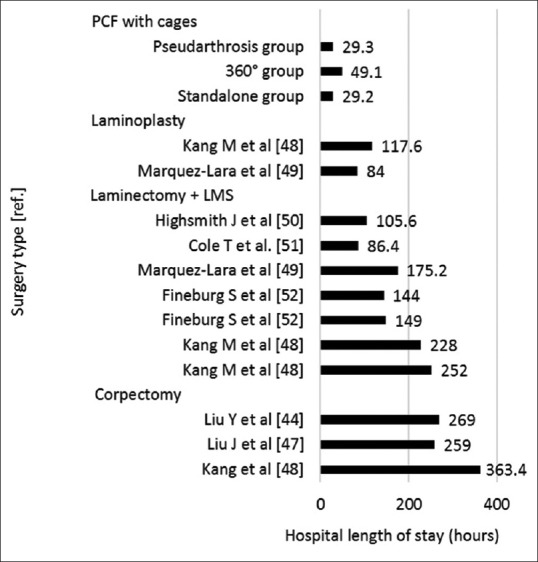
The mean follow-up interval was 7 months (range: 62 weeks - 2 years). The overall postsurgery complication rate was 4.3%. There were two patients with neurological complications (C5 palsy, spinal cord irritation). Two patients had postoperative complications after discharge including one with atrial fibrillation and one with a parietal stroke. After accounting for relatedness to the PCF, the overall complication rate was 3.4%. The average (median) hospital stay for all three groups was 29 h.
The results of our study show that PCF with cages can be considered a safe alternative for patients undergoing cervical spine surgery. The procedure has a favorable overall complication profile, short length of stay, and negligible blood loss.
颈椎后路椎间融合器最近已成为颈椎手术患者侧块固定的替代方案。
本研究的目的是量化接受颈椎后路融合术(PCF)和双侧椎间融合器治疗的患者在颈椎减压融合术中的围手术期并发症。
在美国11个中心对前瞻性收集的数据进行回顾性多中心研究。
回顾了89例连续接受单节段PCF和椎间融合器手术治疗的神经根型颈椎病患者的病历。三组患者包括单独的原发性带椎间融合器的PCF、环形手术以及颈椎前路椎间盘切除融合术后假关节形成的患者。随访评估包括临床状况和疼痛量表(视觉模拟量表)。
采用Wilcoxon检验对数据进行差异检验。以0.05为显著性水平。
平均随访时间为7个月(范围:62周 - 2年)。术后总体并发症发生率为4.3%。有2例患者出现神经并发症(C5麻痹、脊髓刺激)。2例患者出院后出现术后并发症,包括1例房颤和1例脑顶叶卒中。在考虑与PCF的相关性后,总体并发症发生率为3.