Shigiyama Fumika, Kumashiro Naoki, Furukawa Yasuhiko, Funayama Takashi, Takeno Kageumi, Wakui Noritaka, Ikehara Takashi, Nagai Hidenari, Taka Hikari, Fujimura Tsutomu, Uchino Hiroshi, Tamura Yoshifumi, Watada Hirotaka, Nemoto Tetsuo, Shiraga Nobuyuki, Sumino Yasukiyo, Hirose Takahisa
Division of Diabetes Metabolism, and Endocrinology, Department of Medicine, Toho University Graduate School of Medicine Tokyo Japan.
Department of Metabolism and Endocrinology Juntendo University Graduate School of Medicine Tokyo Japan.
Hepatol Commun. 2017 Jul 29;1(7):634-647. doi: 10.1002/hep4.1077. eCollection 2017 Sep.
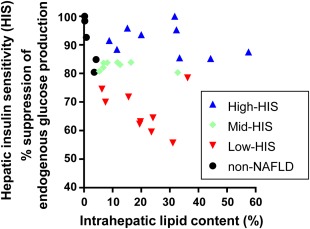
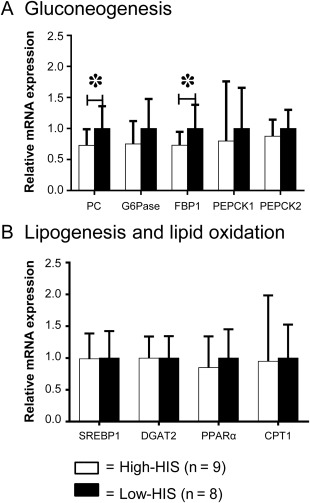
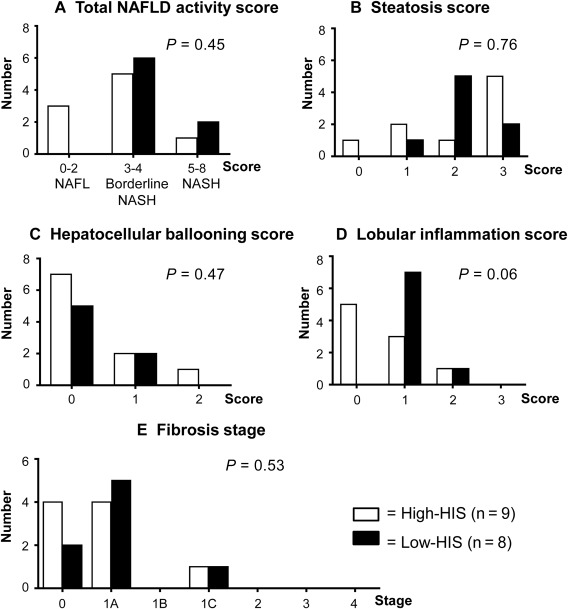
Nonalcoholic fatty liver disease (NAFLD) plays a crucial role in type 2 diabetes and hepatocellular carcinoma. The major underlying pathogenesis is hepatic insulin resistance. The aim of the present study was to characterize patients with NAFLD with paradoxically normal hepatic insulin sensitivity relative to patients with NAFLD with hepatic insulin resistance. We recruited 26 patients with NAFLD and divided them into three groups ranked by the level of hepatic insulin sensitivity (HIS; high-HIS, mid-HIS, low-HIS), as assessed by the hyperinsulinemic-euglycemic clamp studies using stable isotope. Hepatic insulin sensitivity of the high-HIS group was identical to that of the non-NAFLD lean control (clamped percent suppression of endogenous glucose production, 91.1% ± 5.2% versus 91.0% ± 8.5%, respectively) and was significantly higher than that of the low-HIS group (66.6% ± 7.5%; < 0.01). Adiposity (subcutaneous, visceral, intrahepatic, and muscular lipid content), hepatic histopathology, and expression levels of various genes by using liver biopsies, muscle, and adipose tissue insulin sensitivity, plasma metabolites by metabolomics analysis, putative biomarkers, and lifestyles were assessed and compared between the high-HIS and low-HIS groups. Among these, adipose tissue insulin sensitivity assessed by clamped percent suppression of free fatty acid, serum high molecular weight adiponectin, and plasma tricarboxylic acid cycle metabolites, such as citric acid and -aconitic acid, were significantly higher in the high-HIS group compared to the low-HIS group. In contrast, there were no differences in adiposity, including intrahepatic lipid content assessed by proton magnetic resonance spectroscopy (28.3% ± 16.1% versus 20.4% ± 9.9%, respectively), hepatic histopathology, other putative biomarkers, and lifestyles. : High levels of adipose tissue insulin sensitivity, serum high molecular weight adiponectin, and plasma tricarboxylic acid cycle metabolites are unique characteristics that define patients with hepatic insulin-sensitive NAFLD regardless of intrahepatic lipid content. ( 2017;1:634-647).
非酒精性脂肪性肝病(NAFLD)在2型糖尿病和肝细胞癌中起着关键作用。其主要潜在发病机制是肝脏胰岛素抵抗。本研究的目的是将肝脏胰岛素敏感性反常正常的NAFLD患者与存在肝脏胰岛素抵抗的NAFLD患者进行特征对比。我们招募了26例NAFLD患者,并根据使用稳定同位素的高胰岛素-正葡萄糖钳夹试验评估的肝脏胰岛素敏感性(HIS;高HIS、中HIS、低HIS)水平将他们分为三组。高HIS组的肝脏胰岛素敏感性与非NAFLD瘦对照组相同(内源性葡萄糖生成的钳夹抑制百分比分别为91.1%±5.2%和91.0%±8.5%),且显著高于低HIS组(66.6%±7.5%;P<0.01)。通过肝活检评估肥胖程度(皮下、内脏、肝内和肌肉脂质含量)、肝脏组织病理学以及各种基因的表达水平,比较高HIS组和低HIS组之间的肌肉和脂肪组织胰岛素敏感性、代谢组学分析的血浆代谢物、假定生物标志物和生活方式。其中,通过游离脂肪酸钳夹抑制百分比评估的脂肪组织胰岛素敏感性以及血清高分子量脂联素和血浆三羧酸循环代谢物(如柠檬酸和乌头酸)在高HIS组中显著高于低HIS组。相比之下,在肥胖程度方面没有差异,包括通过质子磁共振波谱评估的肝内脂质含量(分别为28.3%±16.1%和20.4%±9.9%)、肝脏组织病理学、其他假定生物标志物和生活方式。结论:高水平的脂肪组织胰岛素敏感性、血清高分子量脂联素和血浆三羧酸循环代谢物是定义肝脏胰岛素敏感型NAFLD患者的独特特征,无论肝内脂质含量如何。(《细胞代谢》2017年;26卷:634 - 647页)