Bonfante Ivan Luiz Padilha, Chacon-Mikahil Mara Patricia Traina, Brunelli Diego Trevisan, Gáspari Arthur Fernandes, Duft Renata Garbellini, Oliveira Alexandre Gabarra, Araujo Tiago Gomes, Saad Mario Jose Abdalla, Cavaglieri Cláudia Regina
Laboratório de Fisiologia do Exercício, Faculdade de Educação Física, Universidade Estadual de Campinas (Unicamp), Campinas, SP, Brasil.
Instituto de Biociências, Universidade Estadual Paulista "Júlio de Mesquita Filho" (Unesp), Rio Claro, SP, Brasil.
Arch Endocrinol Metab. 2017 Dec;61(6):524-533. doi: 10.1590/2359-3997000000305.
Thus, the aim of this study was to compare if higher or smaller fibronectin type 3 domain-containing protein 5 (FNDC5)/irisin levels are associated with inflammatory and metabolic markers, caloric/macronutrient intake, physical fitness and type 2 diabetes mellitus (T2DM) risk in obese middle-aged men, and also to correlate all variables analyzed with FNDC5/irisin.
On the basis of a cluster study, middle-aged obese men (IMC: 31.01 ± 1.64 kg/m2) were divided into groups of higher and smaller levels of FNDC5/irisin. The levels of leptin, resistin, adiponectin, tumor necrosis factor alpha (TNFα), interleukin 6 and 10 (IL6, IL10), lipopolysaccharide (LPS), glucose, insulin, glycated hemoglobin, insulin resistance and sensibility, lipid profile, risk of T2DM development, body composition, rest energy expenditure, caloric/macronutrient intake and physical fitness were measured.
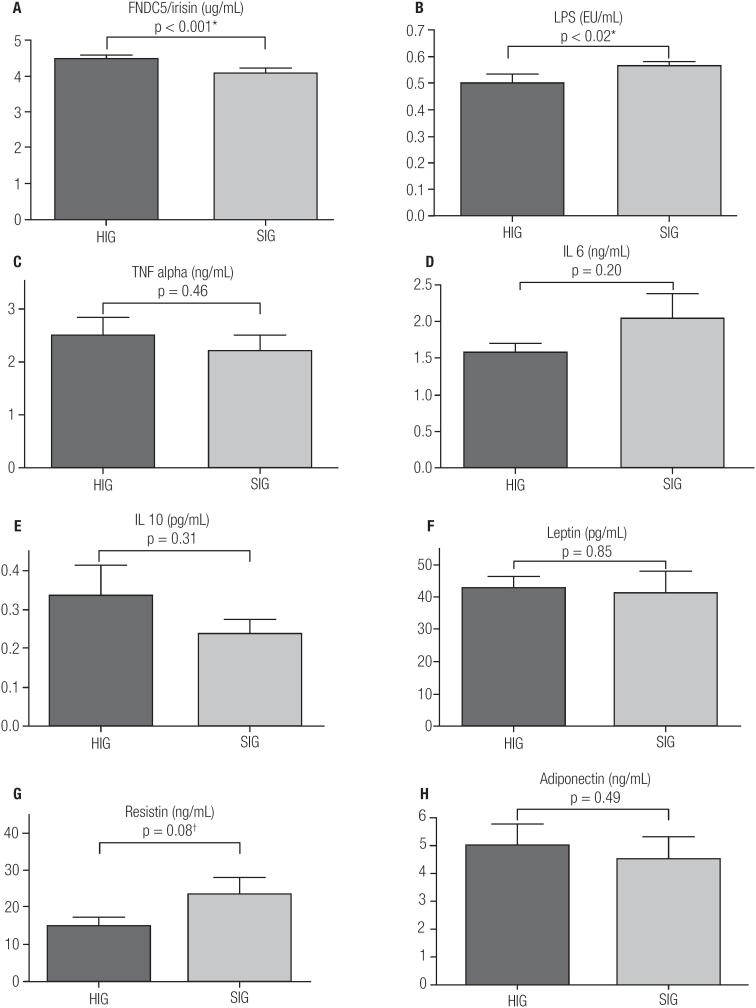
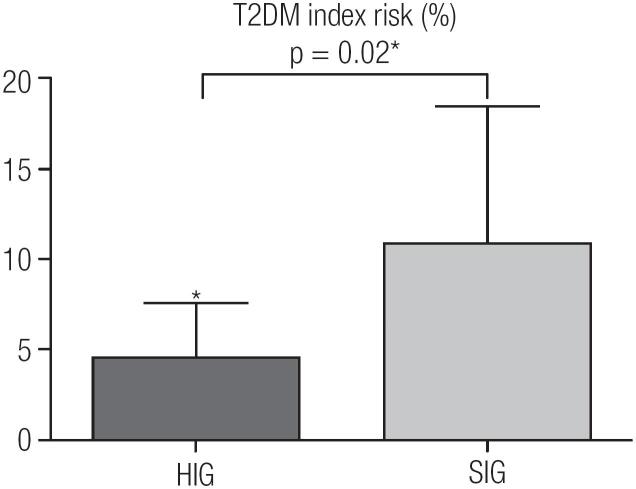
The higher FNDC5/ irisin group presented improved insulin sensibility (homeostasis model assessment - sensibility (HOMA-S) (p = 0.01) and QUICKI index (p < 0.01)), insulin (p = 0.02) and triglyceride levels (p = 0.01), lower insulin resistance (homeostasis model assessment - insulin resistance (HOMA-IR) (p = 0.01), triglycerides/glucose (TYG index) (p = 0.02), neck circumference (p = 0.02), risk of T2DM development (p = 0.02), tendency to decrease serum resistin (p = 0.08) and significant lower LPS levels (p = 0.02). Inverse correlations between FNDC5/irisin and body weight (r -0.46, p = 0.04), neck circumference (r -0.51, p = 0.02), free fat mass (r -0.49, p = 0.02), triglycerides (r -0.43, p = 0.05) and risk of developing T2DM (r -0.61, p = 0.04) were observed.
These results suggest that higher FNDC5/irisin levels in obese middle-aged men are related to a better metabolic profile and lower risk of T2DM development and serum LPS, a potential inducer of insulin resistance.
因此,本研究的目的是比较肥胖中年男性中较高或较低水平的含Ⅲ型纤连蛋白结构域蛋白5(FNDC5)/鸢尾素是否与炎症和代谢标志物、热量/常量营养素摄入、体能及2型糖尿病(T2DM)风险相关,并且将所有分析变量与FNDC5/鸢尾素进行相关性分析。
基于一项整群研究,将中年肥胖男性(体质指数:31.01±1.64kg/m²)分为FNDC5/鸢尾素水平较高和较低的组。测量瘦素、抵抗素、脂联素、肿瘤坏死因子α(TNFα)、白细胞介素6和10(IL6、IL10)、脂多糖(LPS)、血糖、胰岛素、糖化血红蛋白、胰岛素抵抗和敏感性、血脂谱、T2DM发生风险、身体成分、静息能量消耗、热量/常量营养素摄入及体能。
FNDC5/鸢尾素水平较高组的胰岛素敏感性(稳态模型评估-敏感性(HOMA-S)(p=0.01)和定量胰岛素敏感性检查指数(QUICKI)(p<0.01))、胰岛素(p=0.02)和甘油三酯水平(p=0.01)有所改善,胰岛素抵抗(稳态模型评估-胰岛素抵抗(HOMA-IR)(p=0.01)、甘油三酯/血糖(TYG指数)(p=0.02)、颈围(p=0.02)、T2DM发生风险(p=0.02)降低,血清抵抗素水平有下降趋势(p=0.08),LPS水平显著降低(p=0.02)。观察到FNDC5/鸢尾素与体重(r=-0.46,p=0.04)、颈围(r=-0.51,p=0.02)、游离脂肪量(r=-0.49,p=0.02)、甘油三酯(r=-0.43,p=0.05)及T2DM发生风险(r=-0.61,p=0.04)呈负相关。
这些结果表明,肥胖中年男性中较高的FNDC5/鸢尾素水平与更好的代谢状况、较低的T2DM发生风险及血清LPS水平相关,LPS是胰岛素抵抗的潜在诱导因素。