Alonso Fabiola, Vogel Dorian, Johansson Johannes, Wårdell Karin, Hemm Simone
Department of Biomedical Engineering, Linköping University, 58185 Linköping, Sweden.
Institute for Medical and Analytical Technologies, School of Life Sciences, University of Applied Sciences and Arts Northwestern Switzerland FHNW, 4132 Muttenz, Switzerland.
Brain Sci. 2018 Feb 6;8(2):28. doi: 10.3390/brainsci8020028.
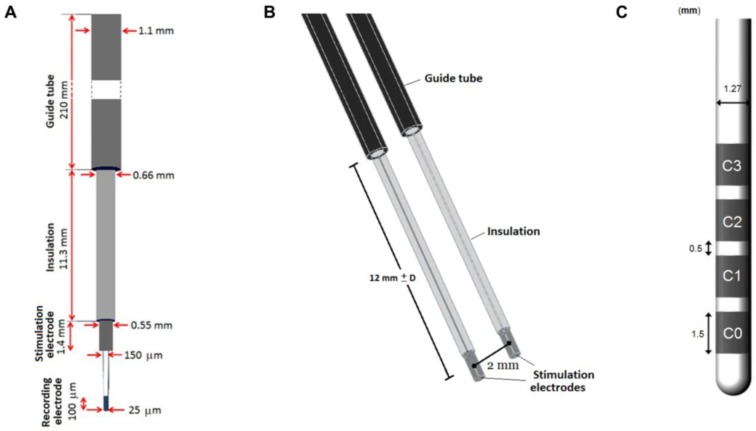
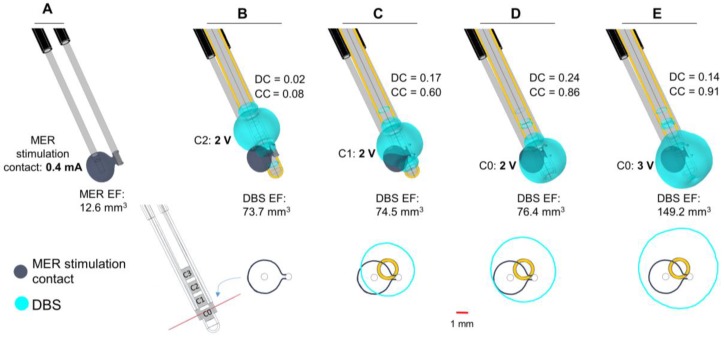
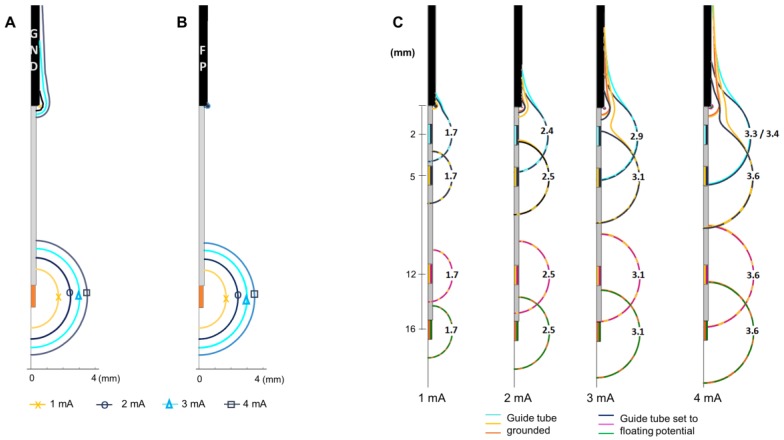
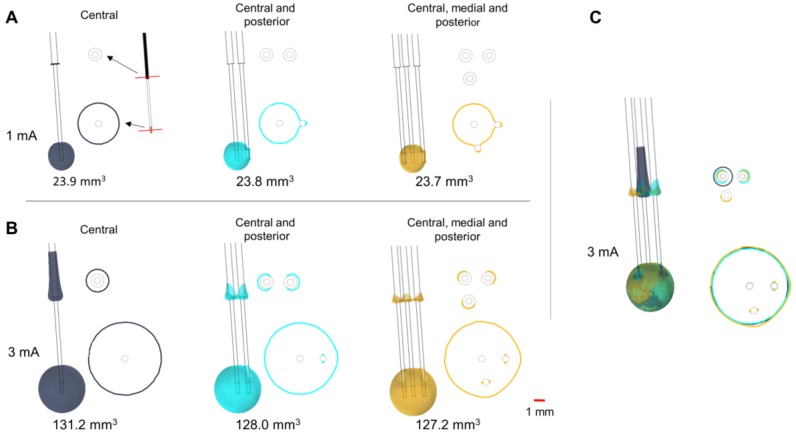
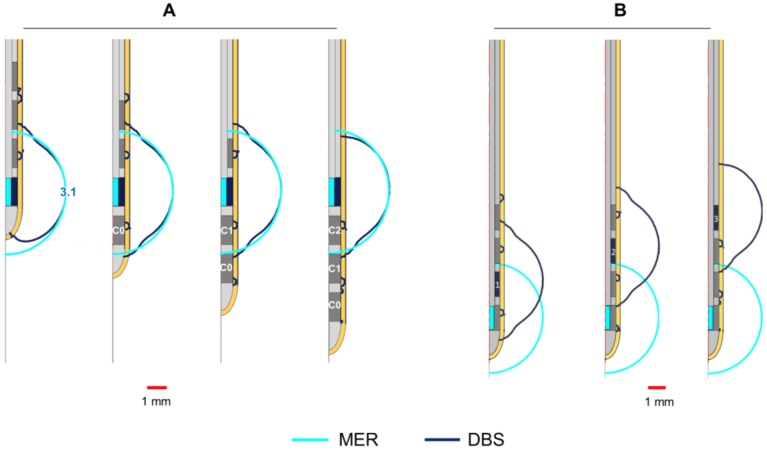
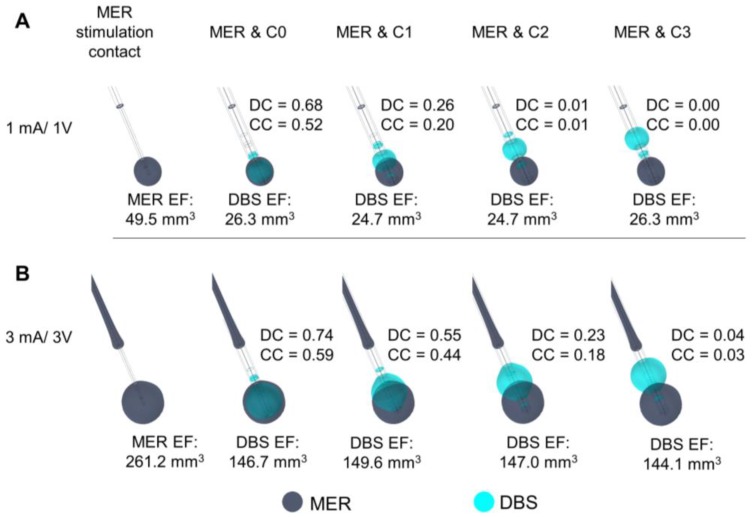
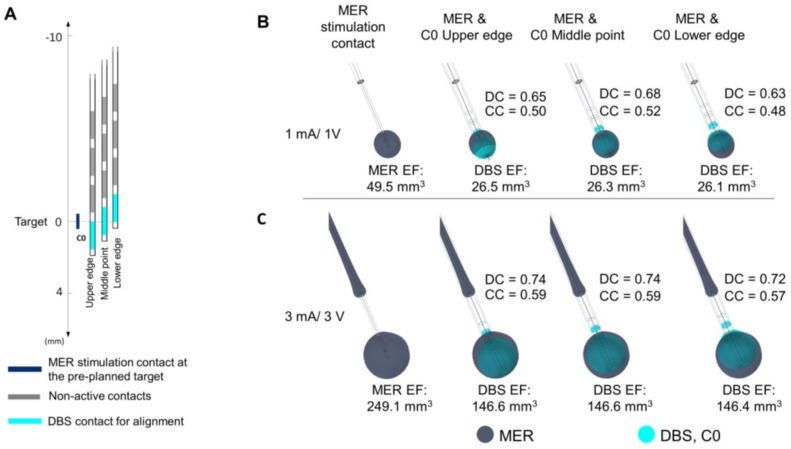
The success of deep brain stimulation (DBS) relies primarily on the localization of the implanted electrode. Its final position can be chosen based on the results of intraoperative microelectrode recording (MER) and stimulation tests. The optimal position often differs from the final one selected for chronic stimulation with the DBS electrode. The aim of the study was to investigate, using finite element method (FEM) modeling and simulations, whether lead design, electrical setup, and operating modes induce differences in electric field (EF) distribution and in consequence, the clinical outcome. Finite element models of a MER system and a chronic DBS lead were developed. Simulations of the EF were performed for homogenous and patient-specific brain models to evaluate the influence of grounding (guide tube vs. stimulator case), parallel MER leads, and non-active DBS contacts. Results showed that the EF is deformed depending on the distance between the guide tube and stimulating contact. Several parallel MER leads and the presence of the non-active DBS contacts influence the EF distribution. The DBS EF volume can cover the intraoperatively produced EF, but can also extend to other anatomical areas. In conclusion, EF deformations between stimulation tests and DBS should be taken into consideration as they can alter the clinical outcome.
脑深部电刺激(DBS)的成功主要依赖于植入电极的定位。其最终位置可根据术中微电极记录(MER)和刺激测试的结果来选择。最佳位置往往与为DBS电极慢性刺激所选择的最终位置不同。本研究的目的是使用有限元方法(FEM)建模和模拟来研究导联设计、电气设置和操作模式是否会导致电场(EF)分布的差异,进而影响临床结果。开发了MER系统和慢性DBS导联的有限元模型。针对均匀和特定患者的脑模型进行了EF模拟,以评估接地(导管与刺激器外壳)、平行MER导联和非活性DBS触点的影响。结果表明,EF会根据导管与刺激触点之间的距离而变形。多个平行MER导联和非活性DBS触点的存在会影响EF分布。DBS的EF体积可以覆盖术中产生的EF,但也可能延伸到其他解剖区域。总之,刺激测试和DBS之间的EF变形应予以考虑,因为它们可能会改变临床结果。