Khan Sikandar, Biju Ashok, Wang Sophia, Gao Sujuan, Irfan Omar, Harrawood Amanda, Martinez Stephanie, Brewer Emily, Perkins Anthony, Unverzagt Frederick W, Lasiter Sue, Zarzaur Ben, Rahman Omar, Boustani Malaz, Khan Babar
Division of Pulmonary, Critical Care, Sleep and Occupational Medicine, Department of Medicine, Indiana University School of Medicine, Indianapolis, IN, USA.
IU Center of Aging Research, Regenstrief Institute, Indianapolis, IN, USA.
Trials. 2018 Feb 7;19(1):94. doi: 10.1186/s13063-018-2449-2.
Patients admitted to intensive care units (ICU) with acute respiratory failure (ARF) face chronic complications that can impede return to normal daily function. A mobile, collaborative critical care model may enhance the recovery of ARF survivors.
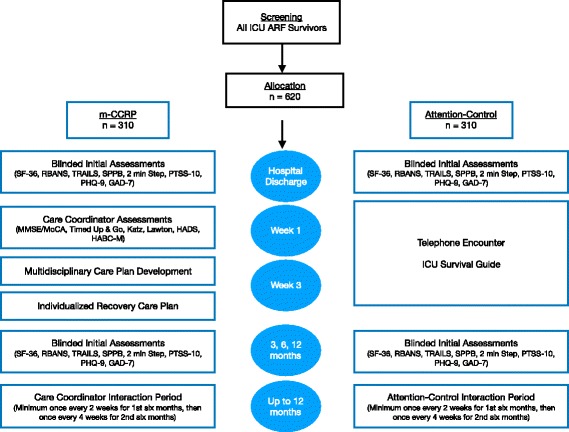
The Mobile Critical Care Recovery Program (m-CCRP) study is a two arm, randomized clinical trial. We will randomize 620 patients admitted to the ICU with acute respiratory failure requiring mechanical ventilation in a 1:1 ratio to one of two arms (310 patients per arm) - m-CCRP intervention versus attention control. Those in the intervention group will meet with a care coordinator after hospital discharge in predetermined intervals to aid in the recovery process. Baseline assessments and personalized goal setting will be used to develop an individualized care plan for each patient after discussion with an interdisciplinary team. The attention control arm will receive printed material and telephone reminders emphasizing mobility and management of chronic conditions. Duration of the intervention and follow-up is 12 months post-randomization. Our primary aim is to assess the efficacy of m-CCRP in improving the quality of life of ARF survivors at 12 months. Secondary aims of the study are to evaluate the efficacy of m-CCRP in improving function (cognitive, physical, and psychological) of ARF survivors and to determine the efficacy of m-CCRP in reducing acute healthcare utilization.
The proposed randomized controlled trial will evaluate the efficacy of a collaborative critical care recovery program in accomplishing the Institute of Healthcare Improvement's triple aims of better health, better care, at lower cost. We have developed a collaborative critical care model to promote ARF survivors' recovery from the physical, psychological, and cognitive impacts of critical illness. In contrast to a single disease focus and clinic-based access, m-CCRP represents a comprehensive, accessible, mobile, ahead of the curve intervention, focused on the multiple aspects of the unique recovery needs of ARF survivors.
NCT03053245 , clinicaltrials.gov, registered February 1, 2017.
因急性呼吸衰竭(ARF)入住重症监护病房(ICU)的患者面临着可能阻碍其恢复正常日常功能的慢性并发症。一种移动协作式重症护理模式可能会促进ARF幸存者的康复。
移动重症护理康复项目(m-CCRP)研究是一项双臂随机临床试验。我们将把620名因急性呼吸衰竭需要机械通气而入住ICU的患者按1:1的比例随机分为两组(每组310名患者)——m-CCRP干预组与对照关注组。干预组的患者在出院后将按预定时间间隔与护理协调员会面,以协助康复进程。在与跨学科团队讨论后,将通过基线评估和个性化目标设定为每位患者制定个性化护理计划。对照关注组将收到强调活动能力和慢性病管理的印刷材料及电话提醒。干预和随访时长为随机分组后的12个月。我们的主要目的是评估m-CCRP在12个月时改善ARF幸存者生活质量的疗效。该研究的次要目的是评估m-CCRP在改善ARF幸存者功能(认知、身体和心理)方面的疗效,并确定m-CCRP在减少急性医疗保健利用方面的疗效。
拟议的随机对照试验将评估一项协作式重症护理康复项目在实现医疗保健改进研究所提出的改善健康、提升护理质量、降低成本这三大目标方面的疗效。我们已开发出一种协作式重症护理模式,以促进ARF幸存者从危重病的身体、心理和认知影响中康复。与单一疾病关注和基于诊所的就医途径不同,m-CCRP代表着一种全面、可及、移动且领先的干预措施,专注于ARF幸存者独特康复需求的多个方面。
NCT03053245,clinicaltrials.gov,于2017年2月1日注册。