Maslov Ivan, Bogorodskiy Andrey, Mishin Alexey, Okhrimenko Ivan, Gushchin Ivan, Kalenov Sergei, Dencher Norbert A, Fahlke Christoph, Büldt Georg, Gordeliy Valentin, Gensch Thomas, Borshchevskiy Valentin
Research Center for Molecular Mechanisms of Aging and Age-Related Diseases, Moscow Institute of Physics and Technology, 141700, Dolgoprudniy, Russia.
Mendeleyev University of Chemical Technology of Russia, 125047, Moscow, Russia.
Sci Rep. 2018 Feb 7;8(1):2549. doi: 10.1038/s41598-018-20839-7.
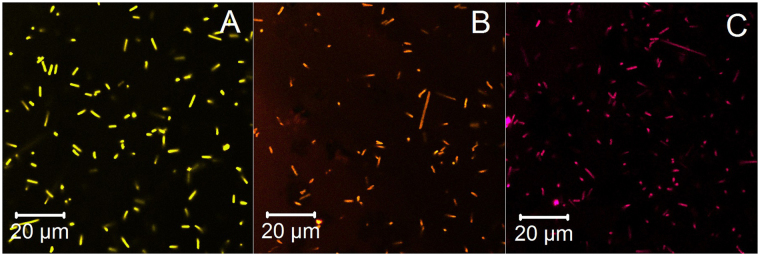
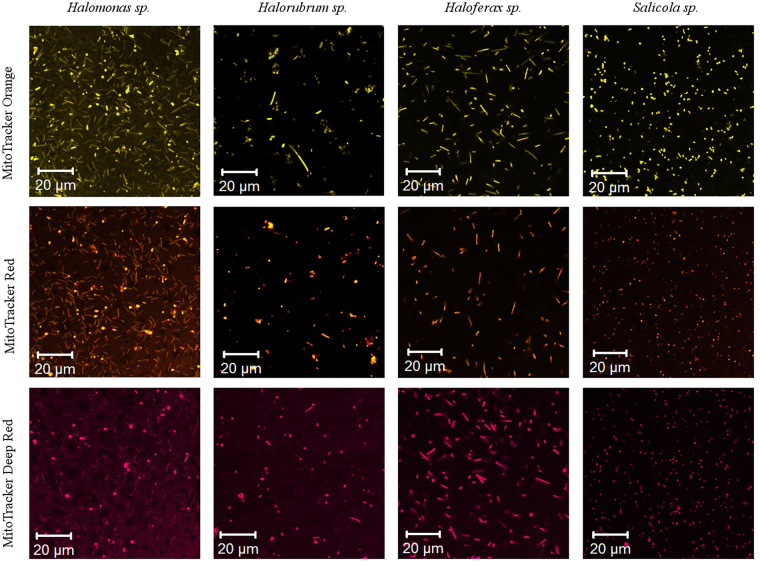
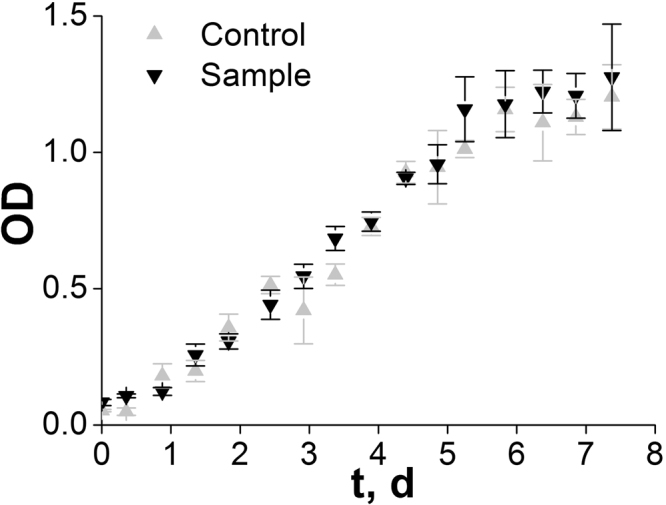
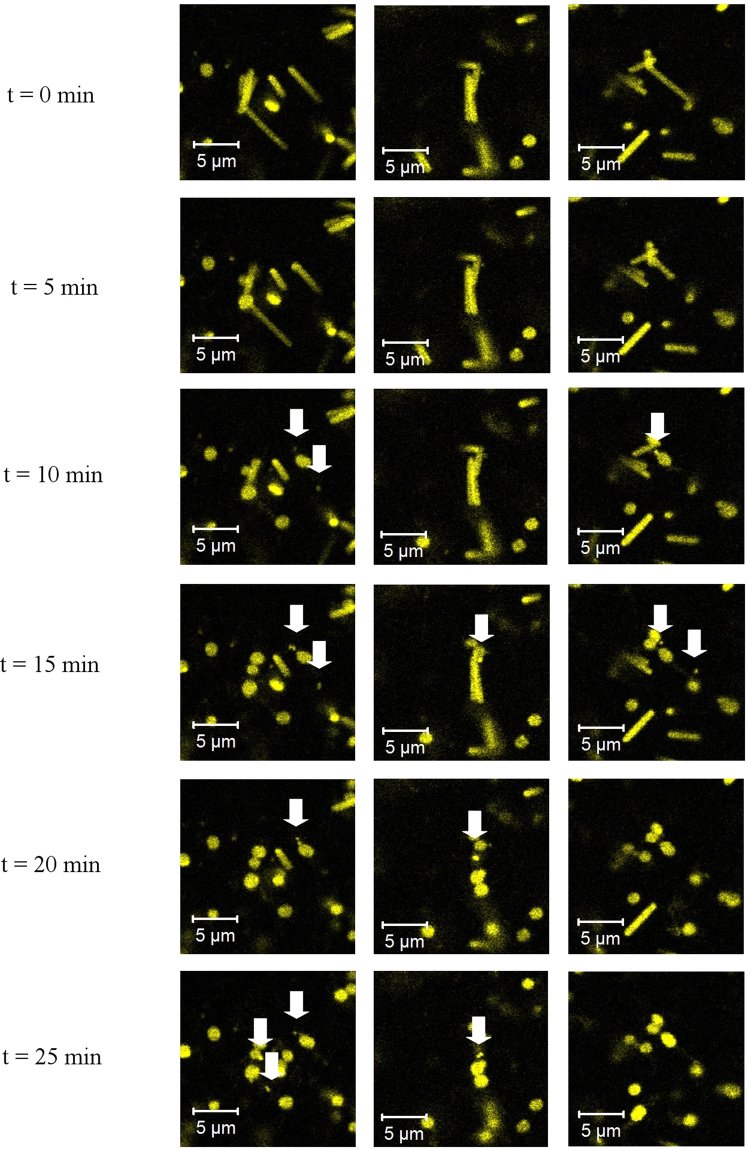
Research on halophilic microorganisms is important due to their relation to fundamental questions of survival of living organisms in a hostile environment. Here we introduce a novel method to stain halophiles with MitoTracker fluorescent dyes in their growth medium. The method is based on membrane-potential sensitive dyes, which were originally used to label mitochondria in eukaryotic cells. We demonstrate that these fluorescent dyes provide high staining efficiency and are beneficial for multi-staining purposes due to the spectral range covered (from orange to deep red). In contrast with other fluorescent dyes used so far, MitoTracker does not affect growth rate, and remains in cells after several washing steps and several generations in cell culture. The suggested dyes were tested on three archaeal (Hbt. salinarum, Haloferax sp., Halorubrum sp.) and two bacterial (Salicola sp., Halomonas sp.) strains of halophilic microorganisms. The new staining approach provides new insights into biology of Hbt. salinarum. We demonstrated the interconversion of rod-shaped cells of Hbt. salinarium to spheroplasts and submicron-sized spheres, as well as the cytoplasmic integrity of giant rod Hbt. salinarum species. By expanding the variety of tools available for halophile detection, MitoTracker dyes overcome long-standing limitations in fluorescence microscopy studies of halophiles.
由于嗜盐微生物与生物体在恶劣环境中的生存这一基本问题相关,因此对其进行研究具有重要意义。在此,我们介绍一种在嗜盐微生物生长培养基中用MitoTracker荧光染料对其进行染色的新方法。该方法基于对膜电位敏感的染料,这些染料最初用于标记真核细胞中的线粒体。我们证明,这些荧光染料具有很高的染色效率,并且由于其覆盖的光谱范围(从橙色到深红色),有利于多染色目的。与迄今为止使用的其他荧光染料相比,MitoTracker不影响生长速率,并且在经过几次洗涤步骤和细胞培养几代后仍保留在细胞中。所建议的染料在三种嗜盐古菌(嗜盐嗜盐杆菌、嗜盐嗜盐菌属、嗜盐嗜盐菌属)和两种嗜盐细菌(盐栖菌属、嗜盐单胞菌属)菌株上进行了测试。这种新的染色方法为嗜盐嗜盐杆菌的生物学研究提供了新的见解。我们证明了嗜盐嗜盐杆菌的杆状细胞向原生质体和亚微米大小球体的相互转化,以及巨型杆状嗜盐嗜盐杆菌物种的细胞质完整性。通过扩展可用于嗜盐微生物检测的工具种类,MitoTracker染料克服了嗜盐微生物荧光显微镜研究中长期存在的局限性。