Alamri Abdulaziz, Hamid Mohamed E, Abid Muhammad, Alwahhabi Abdulrahman M, Alqahtani Khalid M, Alqarni Mohammed S, Abomughaid Mosleh
Department of Surgery and Medical Education, College of Medicine, King Khalid University, Abha, Saudi Arabia.
Department of Microbiology, College of Medicine, King Khalid University, Abha, Saudi Arabia.
Urol Ann. 2018 Jan-Mar;10(1):41-46. doi: 10.4103/UA.UA_68_17.
To analyze the prevalence and resistance rates of bacterial agents causing urinary tract infections (UTIs) in Aseer, Saudi Arabia (2013-2016).
This was a 4-year (2013-2016) retrospective study undertaken in Aseer Central Hospital, Saudi Arabia. A total of 49,779 urine and other UT specimens obtained from patients suspected of having a UTI were analyzed. Urine specimens were inoculated onto cystine lactose electrolyte deficient agar following standard procedures. Cultures showing significant bacteriuria were subjected to identification and sensitivity testing using VITEK 2 system. Data of patients and uropathogens were assembled, checked, and analyzed using SPSS software.
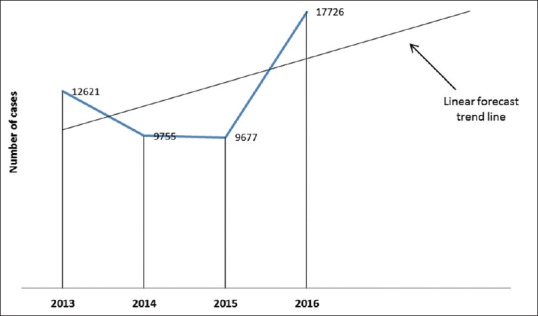
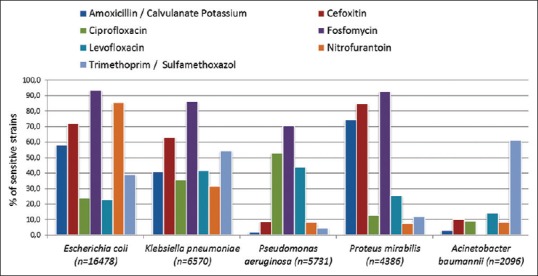
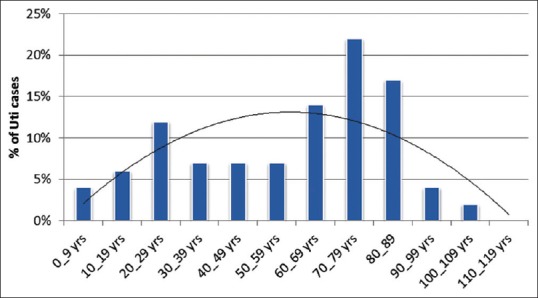
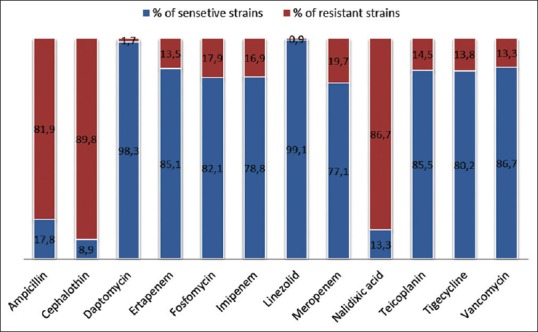
Culture positive samples were 49,779 (59.9% males, 40.1% females; = 0.000). Year trend showed significant variations ( = 0.000) and the forecast trend line hypothesized a clear rise. Age groups 70-79 years were the most vulnerable group (22.3%). Gram-negative bacilli were 91.8% and the major species were - 39.7%, Klebsiella pneumoniae - 15.8%; Pseudomonas aeruginosa - 13.8%, Proteus mirabilis - 10.6%, and Acinetobacter baumannii - 5%. Antimicrobials with high sensitivity rate were linezolid (99.1%), daptomycin (89.3%), vancomycin (86.7%), teicoplanin (85.5%), ertapenem (85.1%), fosfomycin (82.1%), and tigecycline (80.2%). High resistant rates to uropathogens were encountered with cephalothin (89.8%), nalidixic acid (86.7%), and ampicillin (81.9%).
The majority of uropathogens were resistant to antibiotics commonly used in clinical practice. Linezolid, daptomycin, and vancomycin showed the lowest resistance to all uropathogens; this can be revised for empirical treatment of UTIs. Continuous surveillance of uropathogens and their susceptibility is important.
分析沙特阿拉伯阿西尔地区(2013 - 2016年)引起尿路感染(UTIs)的细菌病原体的流行率和耐药率。
这是一项在沙特阿拉伯阿西尔中心医院进行的为期4年(2013 - 2016年)的回顾性研究。共分析了49779份从疑似患有UTI的患者中获取的尿液及其他UT标本。按照标准程序将尿液标本接种到胱氨酸乳糖电解质缺乏琼脂上。对显示有显著菌尿的培养物使用VITEK 2系统进行鉴定和药敏试验。使用SPSS软件收集、检查和分析患者及尿路病原体的数据。
培养阳性样本有49779份(男性占59.9%,女性占40.1%;P = 0.000)。年份趋势显示出显著差异(P = 0.000),预测趋势线表明呈明显上升趋势。70 - 79岁年龄组是最易感染的群体(22.3%)。革兰氏阴性杆菌占91.8%,主要菌种为大肠埃希菌 - 39.7%、肺炎克雷伯菌 - 15.8%;铜绿假单胞菌 - 13.8%、奇异变形杆菌 - 10.6%以及鲍曼不动杆菌 - 5%。敏感性率高的抗菌药物有利奈唑胺(99.1%)、达托霉素(89.3%)、万古霉素(86.7%)、替考拉宁(85.5%)、厄他培南(85.1%)、磷霉素(82.1%)和替加环素(80.2%)。尿路病原体对头孢噻吩(89.8%)、萘啶酸(86.7%)和氨苄西林(81.9%)的耐药率较高。
大多数尿路病原体对临床常用抗生素耐药。利奈唑胺、达托霉素和万古霉素对所有尿路病原体的耐药性最低;这可用于UTIs经验性治疗的调整。持续监测尿路病原体及其药敏情况很重要。