Administration of Pharmaceutical Care, Alahsa Health Cluster, Ministry of Health, Rashdiah Street, P. O. Box 12944, Alahsa, 31982, Saudi Arabia.
Research Center, Almoosa Specialist Hospital, Alahsa, Saudi Arabia.
Ann Clin Microbiol Antimicrob. 2021 Jun 12;20(1):43. doi: 10.1186/s12941-021-00450-x.
Studying time-related changes in susceptible pathogens causing healthcare-associated infections (HAIs) is vital in improving local antimicrobial and infection control practices.
Describe susceptibility patterns to several antimicrobials in gram-positive and gram-negative pathogens isolated from patients causing HAIs at three private tertiary care hospitals in Saudi Arabia over a 5-year period.
Data on trends of antimicrobial susceptibility among bacteria causing HAIs events in children and adults at three tertiary private hospitals located in Riyadh and Qassim, Saudi Arabia, were collected retrospectively between 2015 and 2019 using the surveillance data datasets.
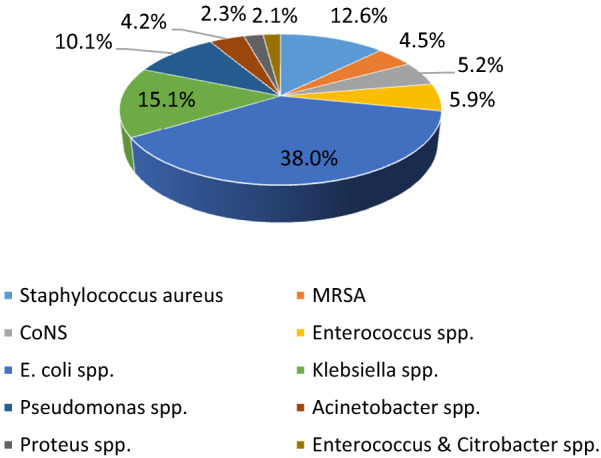
Over a 5-year period, 38,624 pathogens caused 17,539 HAI events in 17,566 patients. About 9450 (53.8%) of patients who suffered HAIs were females and the average age was 41.7 ± 14.3 years (78.1% were adults and 21.9% were children). Gram-negative pathogens were 2.3-times more likely to cause HAIs compared to gram-positive bacteria (71.9% vs. 28.1%). The ranking of causative pathogens in decreasing order was: Escherichia coli (38%), Klebsiella species (15.1%), and Staphylococcus aureus (12.6%). Gram-positive isolates were mostly susceptible to linezolid (91.8%) whereas they were resistant to ampicillin (52.6%), cefoxitin (54.2%), and doxycycline (55.9%). Gram-negative isolates were mostly sensitive to tigecycline (95%) whereas they were resistant to cefotaxime (49.5%) and cefixime (59.6%). During the 5 years, there were relatively stable susceptibility patterns to all tested antimicrobials, except for cefotaxime which shown a susceptibility reduction by 41.4%, among Escherichia coli and Klebsiella species. An increase in the susceptibility of Acinetobacter and Enterobacter and Citrobacter species to all studied antimicrobials was observed except for colistin that had a slight sensitivity reduction in 2019 by 4.3% against Acinetobacter species. However, we noted reduced sensitivity of MRSA, CoNS and Enterococcus species to gentamicin; and increased resistance of MRSA to linezolid and vancomycin.
The observed increase in susceptibility of gram-positive and gram-negative bacteria to studied antimicrobials is important; however, reduced sensitivity of MRSA, CoNS and Enterococcus species to gentamicin; and increased resistance of MRSA to linezolid and vancomycin is a serious threat and calls for effective antimicrobial stewardship programs.
研究易感病原体在导致医疗保健相关感染(HAI)方面的时间相关变化对于改善当地的抗菌和感染控制实践至关重要。
描述在沙特阿拉伯的三家私立三级护理医院的 5 年内,从导致 HAI 的患者中分离出的革兰氏阳性和革兰氏阴性病原体对几种抗菌药物的敏感性模式。
使用监测数据数据集,回顾性收集了 2015 年至 2019 年期间,位于沙特阿拉伯利雅得和卡西姆的三家私立三级医院的儿童和成人发生的 HAI 事件中导致 HAI 的细菌的抗生素敏感性趋势数据。
在 5 年期间,38624 种病原体导致 17539 例 HAI 事件,涉及 17566 名患者。约 9450 名(53.8%)发生 HAI 的患者为女性,平均年龄为 41.7±14.3 岁(78.1%为成年人,21.9%为儿童)。与革兰氏阳性细菌相比,革兰氏阴性病原体导致 HAI 的可能性高 2.3 倍(71.9% vs. 28.1%)。按致病病原体降序排列为:大肠埃希菌(38%)、肺炎克雷伯菌(15.1%)和金黄色葡萄球菌(12.6%)。革兰氏阳性分离物对利奈唑胺的敏感性最高(91.8%),而对氨苄西林(52.6%)、头孢西丁(54.2%)和强力霉素(55.9%)的耐药性较高。革兰氏阴性分离物对替加环素的敏感性最高(95%),而对头孢噻肟(49.5%)和头孢克肟(59.6%)的耐药性较高。在 5 年期间,除头孢噻肟的敏感性降低 41.4%外,所有测试的抗生素都显示出相对稳定的敏感性模式,头孢噻肟对大肠埃希菌和肺炎克雷伯菌的敏感性降低。除多粘菌素对不动杆菌和肠杆菌科和柠檬酸杆菌属的敏感性略有降低外,观察到这些属对所有研究的抗生素的敏感性增加,而 2019 年对不动杆菌属的多粘菌素敏感性降低了 4.3%。然而,我们注意到耐甲氧西林金黄色葡萄球菌(MRSA)、凝固酶阴性葡萄球菌(CoNS)和肠球菌对庆大霉素的敏感性降低;以及耐甲氧西林金黄色葡萄球菌对利奈唑胺和万古霉素的耐药性增加。
观察到革兰氏阳性和革兰氏阴性细菌对研究中抗生素的敏感性增加很重要;然而,耐甲氧西林金黄色葡萄球菌、凝固酶阴性葡萄球菌和肠球菌对庆大霉素的敏感性降低;以及耐甲氧西林金黄色葡萄球菌对利奈唑胺和万古霉素的耐药性增加是一个严重的威胁,需要有效的抗菌药物管理计划。