Agarwal Dipti, Gupta Prem Parkash, Sood Sushma
Department of Physiology Postgraduate Institute of Medical Sciences, Pt. B. D. Sharma University of Health Sciences, Rohtak, Haryana, India.
Department of TB and Respiratory Medicine, Postgraduate Institute of Medical Sciences, Pt. B. D. Sharma University of Health Sciences, Rohtak, Haryana, India.
Int J Yoga. 2017 Sep-Dec;10(3):145-151. doi: 10.4103/0973-6131.213472.
Breathing exercises have been described to be useful in asthma management by few researchers in the past.
To assess the efficacy of breathing exercises (Pranayamas) added to regular optimal medications in asthma patients in improving health impairment using St. George's Respiratory Questionnaire (SGRQ).
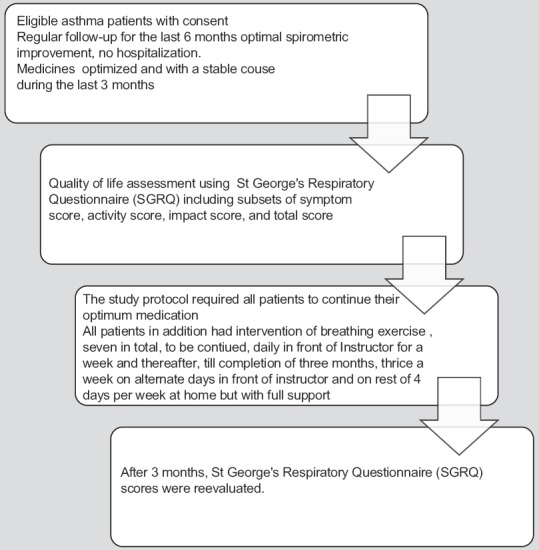
Sixty stable asthma patients (34 females) receiving optimal treatment at our institute for 3 months or more as per the Global Initiative for Asthma guidelines were included in the study. They performed seven breathing exercises under supervision at yoga center of our institute for 3 months in addition to their regular medications. SGRQ (1 month symptoms version) was used to assess the quality of life before and after breathing exercises intervention for following subsets: Symptom score, activity score, impact score, and total score to assess the efficacy of breathing exercises.
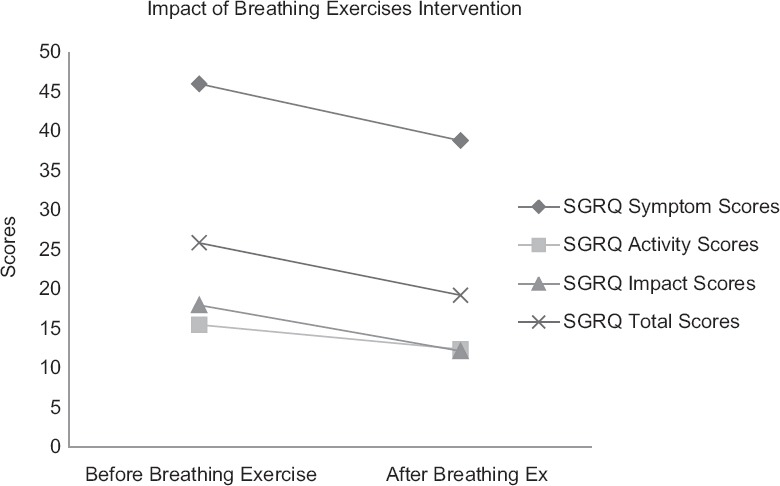
Of 60 asthma patients, 34 were females and 26 were males, and their mean age was 25.45 ± 5.41 years. Their baseline spirometric values were as follow: Forced expiratory volume in 1 s (FEV) - 2.492 ± 0.358 L and peak expiratory flow rate (PEFR) - 283.82 ± 51.12 L/min. The SGRQ scores after breathing exercises intervention decreased from 45.98 ± 5.61 to 38.78 ± 4.92 for symptom subset, from 15.45 ± 3.33 to 12.34 ± 2.39 for activity subset, from 17.95 ± 4.22 to 12.12 ± 3.82 for impact subset, and from 25.83 ± 8.31 to 19.20 ± 7.09 for total scores. All these reductions were statistically highly significant ( < 0.001). Decrease in symptoms, activity, and total SGRQ scores each was significantly correlated with FEV, FEV/forced vital capacity (FVC) ratio, and PEFR; decrease in impact score was significantly related only with FEV/FVC ratio.
Breathing exercises significantly decreased all component scores of SGRQ, signifying a global improvement in health impairment due to asthma; this improvement was in addition to that was achieved with optimal asthma therapy alone.
过去很少有研究人员描述呼吸练习在哮喘管理中是有用的。
使用圣乔治呼吸问卷(SGRQ)评估在哮喘患者中,在常规最佳药物治疗基础上加用呼吸练习(调息法)对改善健康损害的疗效。
纳入60例稳定期哮喘患者(34例女性),他们按照全球哮喘防治创议指南在我院接受最佳治疗3个月或更长时间。除常规药物治疗外,他们在我院瑜伽中心的监督下进行7种呼吸练习,为期3个月。SGRQ(1个月症状版)用于评估呼吸练习干预前后以下亚组的生活质量:症状评分、活动评分、影响评分和总分,以评估呼吸练习的疗效。
60例哮喘患者中,34例为女性,26例为男性,平均年龄为25.45±5.41岁。他们的基线肺功能值如下:第1秒用力呼气容积(FEV)-2.492±0.358L,呼气峰值流速(PEFR)-283.82±51.12L/min。呼吸练习干预后,症状亚组的SGRQ评分从45.98±5.61降至38.78±4.92,活动亚组从15.45±3.33降至12.34±2.39,影响亚组从17.95±4.22降至12.12±3.82,总分从25.83±8.31降至19.20±7.09。所有这些降低在统计学上均具有高度显著性(<0.001)。症状、活动和SGRQ总分的降低均与FEV、FEV/用力肺活量(FVC)比值和PEFR显著相关;影响评分的降低仅与FEV/FVC比值显著相关。
呼吸练习显著降低了SGRQ的所有组成评分,表明哮喘所致健康损害得到全面改善;这种改善是在仅采用最佳哮喘治疗所取得的效果之外的。