Verdière Kevin J, Roy Raphaëlle N, Dehais Frédéric
ISAE-SUPAERO, Institut Supérieur de l'Aéronautique et de l'Espace, Université Fédérale de Midi-Pyrénées, Toulouse, France.
Front Hum Neurosci. 2018 Jan 25;12:6. doi: 10.3389/fnhum.2018.00006. eCollection 2018.
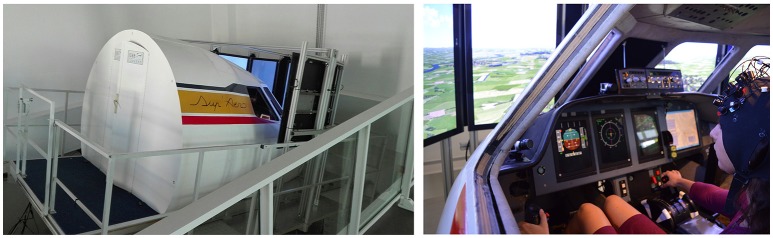
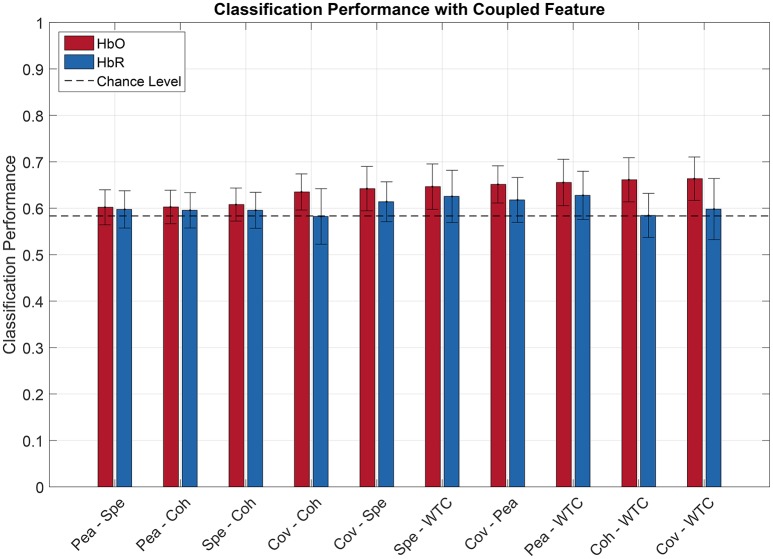
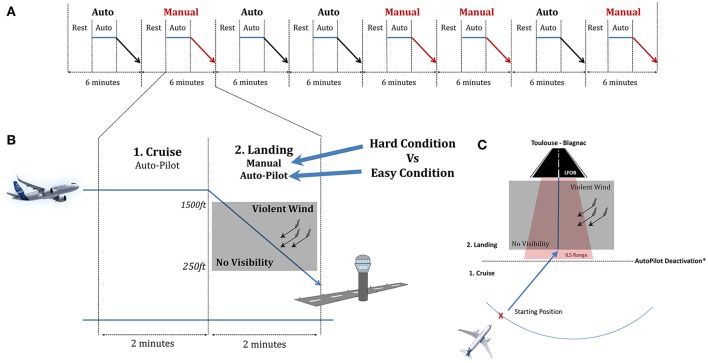
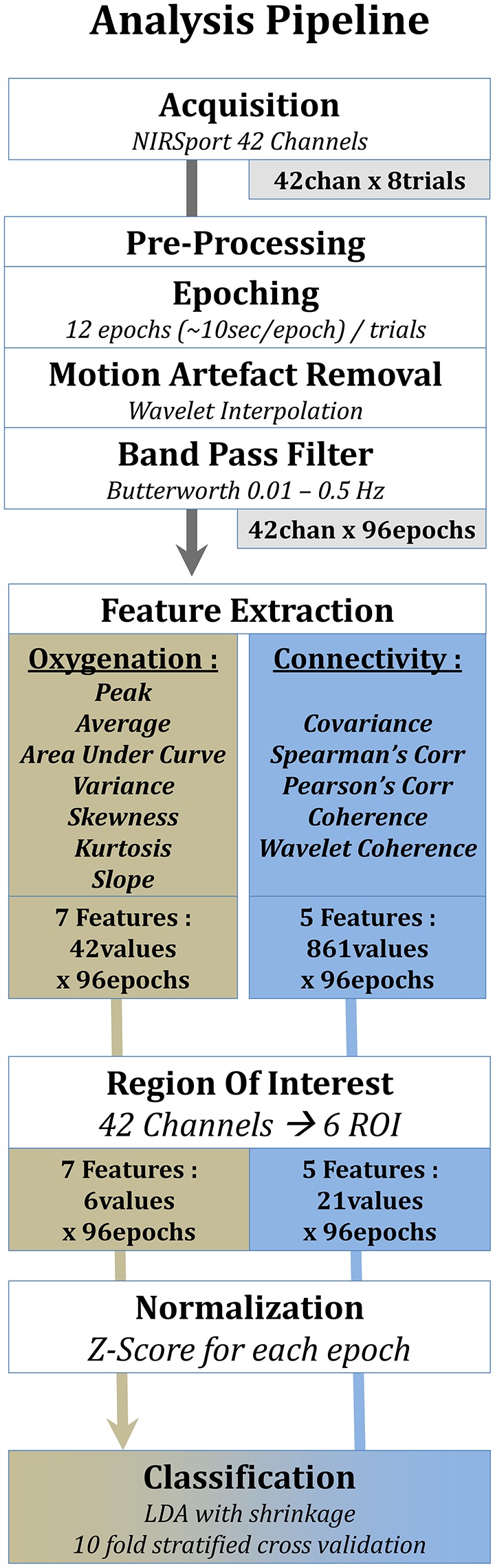
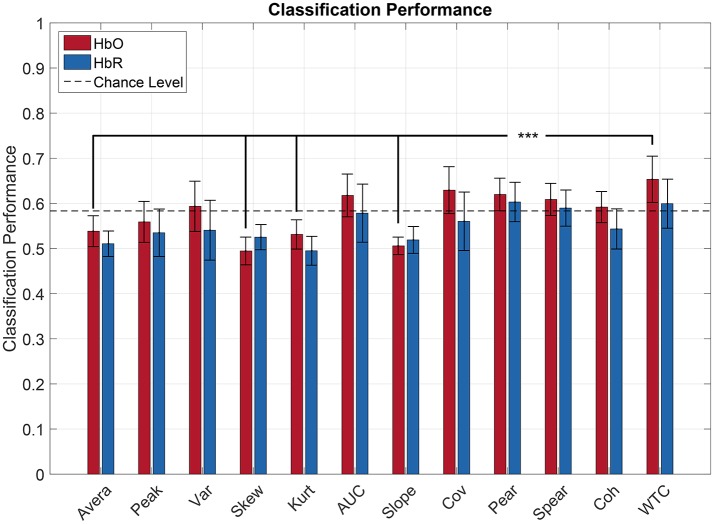
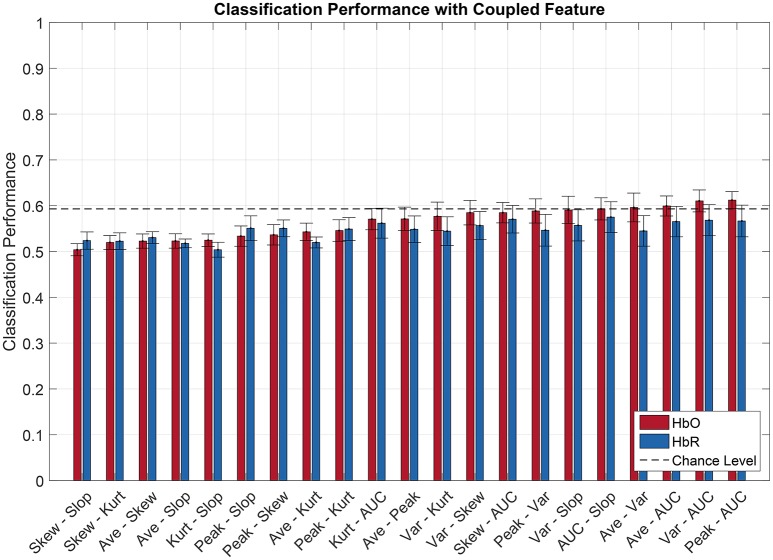
Monitoring pilot's mental states is a relevant approach to mitigate human error and enhance human machine interaction. A promising brain imaging technique to perform such a continuous measure of human mental state under ecological settings is Functional Near-InfraRed Spectroscopy (fNIRS). However, to our knowledge no study has yet assessed the potential of fNIRS connectivity metrics as long as passive Brain Computer Interfaces (BCI) are concerned. Therefore, we designed an experimental scenario in a realistic simulator in which 12 pilots had to perform landings under two contrasted levels of engagement (manual vs. automated). The collected data were used to benchmark the performance of classical oxygenation features (i.e., Average, Peak, Variance, Skewness, Kurtosis, Area Under the Curve, and Slope) and connectivity features (i.e., Covariance, Pearson's, and Spearman's Correlation, Spectral Coherence, and Wavelet Coherence) to discriminate these two landing conditions. Classification performance was obtained by using a shrinkage Linear Discriminant Analysis (sLDA) and a stratified cross validation using each feature alone or by combining them. Our findings disclosed that the connectivity features performed significantly better than the classical concentration metrics with a higher accuracy for the wavelet coherence (average: 65.3/59.9 %, min: 45.3/45.0, max: 80.5/74.7 computed for HbO/HbR signals respectively). A maximum classification performance was obtained by combining the area under the curve with the wavelet coherence (average: 66.9/61.6 %, min: 57.3/44.8, max: 80.0/81.3 computed for HbO/HbR signals respectively). In a general manner all connectivity measures allowed an efficient classification when computed over HbO signals. Those promising results provide methodological cues for further implementation of fNIRS-based passive BCIs.
监测飞行员的心理状态是减少人为失误和加强人机交互的一种相关方法。功能近红外光谱技术(fNIRS)是一种很有前景的脑成像技术,可在自然环境下对人类心理状态进行这种连续测量。然而,据我们所知,就被动式脑机接口(BCI)而言,尚无研究评估fNIRS连接性指标的潜力。因此,我们在一个逼真的模拟器中设计了一个实验场景,让12名飞行员在两种不同的参与程度(手动与自动)下进行着陆操作。收集到的数据用于对经典氧合特征(即平均值、峰值、方差、偏度、峰度、曲线下面积和斜率)和连接性特征(即协方差、皮尔逊相关系数和斯皮尔曼相关系数、谱相干和小波相干)的性能进行基准测试,以区分这两种着陆条件。通过使用收缩线性判别分析(sLDA)和分层交叉验证来获得分类性能,单独使用或组合使用每个特征。我们的研究结果表明,连接性特征的表现明显优于经典浓度指标,小波相干的准确率更高(分别针对HbO/HbR信号计算,平均为65.3/59.9%,最小值为45.3/45.0,最大值为80.5/74.7)。通过将曲线下面积与小波相干相结合,获得了最大分类性能(分别针对HbO/HbR信号计算,平均为66.9/61.6%,最小值为57.3/44.8,最大值为80.0/81.3)。一般来说,当对HbO信号进行计算时,所有连接性测量都能实现高效分类。这些有前景的结果为基于fNIRS的被动式BCI的进一步实施提供了方法学线索。